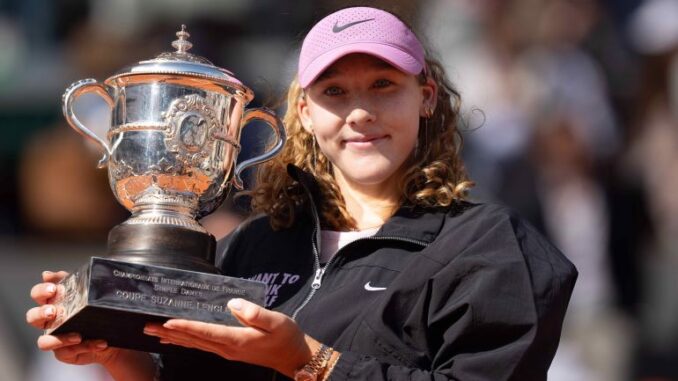
Mirra Andreeva: A Champion’s Triumph at Roland Garros On June 6, 2026, under the warm Parisian sun on the iconic red clay of Court Philippe-Chatrier, 19-year-old Mirra Andreeva wrote her name into tennis history. The young Russian defeated Polish qualifier Maja Chwalińska 6-3, 6-2 in a confident, straight-sets victory to capture her first Grand Slam title. It was more than just a win—it was a statement. Andreeva became the youngest women’s singles champion at the French Open since Monica Seles back in 1992. The final was over in under 90 minutes. Andreeva displayed remarkable poise, powerful baseline play, and impressive mental strength throughout. Chwalińska had been the tournament’s fairy-tale story, coming through qualifying all the way to her first major final. But on this day, she simply couldn’t match Andreeva’s consistency and authority on the surface that has launched so many legendary careers. When the last point was won, Andreeva dropped to her knees on the clay, overcome with emotion as the stadium erupted. She then climbed into the stands to share hugs with her team, her coach Conchita Martínez, family members, and everyone who had supported her along the way. In her victory speech, she said something that instantly became memorable: “I also want to thank myself for believing in myself.”From Siberian Winters to Parisian Glory Mirra Andreeva was born on April 29, 2007, in Krasnoyarsk, Siberia—a place far removed from the usual tennis power centers. Growing up amid harsh winters, she had to show extraordinary dedication just to pursue the sport. Now standing at 5’9″ with a complete, well-rounded game, the right-hander brings powerful groundstrokes, sharp tactical thinking, and a serve that has become more and more reliable.Her rise happened quickly. At just 15, she turned heads by reaching the third round of the 2022 Madrid Open as a wildcard. Her first WTA title came in 2024 at the Iasi Open. Things really accelerated in 2025: she won big WTA 1000 titles at Indian Wells—where she beat Aryna Sabalenka in the final to become the youngest champion there since Serena Williams—and also in Dubai. By the start of 2026, she already had six WTA singles titles, a career-high ranking inside the top 6, and an Olympic doubles silver medal from Paris 2024 alongside her compatriot Diana Shnaider.Her comfort on clay was evident throughout the 2026 season. Even after finishing runner-up in Madrid, she arrived at Roland Garros as the eighth seed, brimming with belief. She handled a tough draw with impressive authority, winning most of her matches in straight sets. One standout performance was her semifinal victory over Marta Kostyuk, 6-1, 6-3, which ended the Ukrainian player’s strong run on clay. Throughout the two weeks in Paris, Andreeva kept talking about staying composed. In press conferences and on-court interviews, she emphasized how important it was to maintain focus under the pressure of a first Grand Slam final. “I kept my focus, kept my composure,” she said, showing the kind of mental maturity that often separates good players from true champions.
The Speech That Touched Many Andreeva’s victory speech wasn’t just polite thank-yous. It felt like a genuine look into her heart. She expressed gratitude to her coaches—especially the legendary Conchita Martínez, a former Wimbledon champion who has been an outstanding mentor—along with her family, friends, fellow players, the fans, and the tournament staff.
Then came the moment that stood out. Towards the end, she said: “Last but not least, I also want to thank myself for believing in myself, always giving 100 percent, even when it’s tough, trying every day to be better as a player and as a person, believing, fighting so many demons inside of me. Only I know how tough it was for me and how nervous I was throughout these two weeks.”This wasn’t about being arrogant or self-centered. It was honest self-recognition. At only 19, Andreeva has dealt with the heavy spotlight that comes with being a prodigy, the loneliness of intense training schedules, the expectations placed on Russian talents, and all those private struggles—doubt, anxiety, and the drive for perfection—that top athletes face alone. By thanking herself openly, she reminded everyone that real, lasting success needs strong inner belief alongside all the external support. The line built on something she had mentioned lightly before, but here it carried real depth. It showed her growth. In a time when so many athletes speak about mental health struggles, Andreeva’s words highlighted resilience, daily hard work, and the bravery to keep going even when nerves and setbacks try to hold you back.What This Victory Really MeansAndreeva’s triumph puts her among an elite group of teenage French Open winners. It also confirms the arrival of a fresh wave of talent on the WTA Tour. With six titles already and now a major trophy, she stands alongside players like Coco Gauff who have successfully moved from promising juniors to Grand Slam champions.Her style fits clay beautifully—strong topspin on the forehand, excellent sliding defense, and smart point construction. People who follow her closely have noticed big improvements in how she handles important moments and in her overall physical conditioning. Working with Coach Martínez has clearly helped her add tactical sharpness drawn from years of high-level experience.Off the court, Mirra’s warm personality wins over fans. She comes across as bubbly but down-to-earth, speaks fluent English, and radiates positive, lively energy. She combines fierce competitiveness with genuine humility. Her success has also shone a fresh light on Russian tennis after the Sharapova era, and Maria Sharapova herself was quick to send warm congratulations.Of course, the title brings a nice financial boost—her career earnings were already substantial before Paris and have now grown significantly. Yet what matters more are the doors it opens: bigger endorsements, wider recognition, and the challenge of living up to new expectations.A Story That InspiresAndreeva’s path—from cold Siberian beginnings to standing on the winner’s podium in Paris—captures what perseverance really looks like. Tennis isn’t only about natural talent. It demands an unshakable belief in yourself. Her heartfelt line in the speech feels like a personal manifesto for young athletes everywhere: outside noise will always exist, but your inner voice is what truly carries you forward.Parents, coaches, and aspiring juniors can learn a lot from how she balances big dreams with personal well-being. By admitting she had to fight internal “demons” and felt nervous during the tournament, she made the champion feel more human. That honesty builds stronger connections with fans and offers a healthier example in a sport that can be incredibly demanding.Next up, all eyes will be on her grass-court season and Wimbledon, where she reached the quarterfinals in 2025. She has already described the feeling of winning a major as “addicting” and made it clear she wants more. No one knows yet how many Grand Slams she will collect, but with her skills, mental growth, and strong support system, she seems built for long-term success.
The Beginning of Something Special Mirra Andreeva’s 2026 French Open victory is far more than a final score or a shiny trophy. It represents years of sacrifice, quiet belief, and personal development coming together at the perfect time. The 6-3, 6-2 result showed her dominance, but the real story is one of inner strength and self-mastery.As she lifted the Suzanne-Lenglen Cup—wearing a special jacket that playfully nodded to her now-famous catchphrase—the moment felt complete. Champions are shaped by belief, tested by challenges, and sustained by gratitude, including gratitude toward themselves.That line—“I also want to thank myself for believing in myself”—will likely be remembered as one of the defining quotes of her career. It will inspire many others to trust their own journey, even on the hardest days.At just 19 years old, Mirra Andreeva has already done what most players only dream about. Her first Grand Slam title probably won’t be her last. Paris 2026 isn’t the end of the story—it’s the exciting start of what looks like a bright, long chapter in women’s tennis. The young woman with roots in Siberia and the heart of a champion has truly arrived, and she believes in herself enough to keep going far.
Leave a Reply