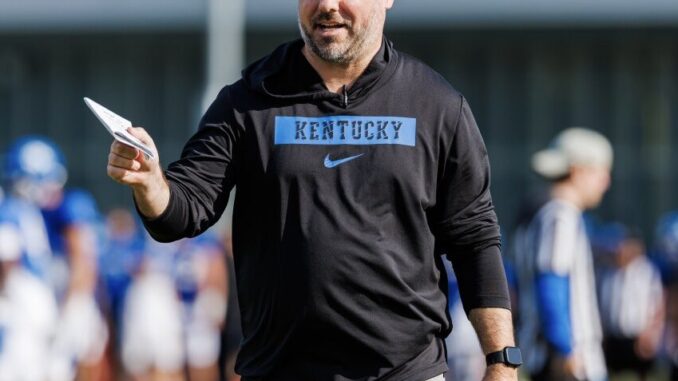
Kentucky General Manager Pat Biondo Announces Departure After Just Seven Months, Leaving Wildcats to Search for New Leadership
The University of Kentucky football program is facing another significant offseason change after general manager Pat Biondo announced Tuesday that he is stepping away from the Wildcats after spending only seven months in the role.
Biondo’s departure comes as a surprise given the relatively short amount of time he spent helping shape Kentucky’s football operations. His exit creates another important vacancy for head coach Mark Stoops and his staff as the program continues navigating one of the most challenging periods in modern college football, where recruiting, the transfer portal and Name, Image and Likeness (NIL) opportunities have transformed the responsibilities of college football front offices.
Although Biondo’s tenure lasted less than a year, his position carried significant importance within Kentucky’s football program. As general manager, he was responsible for overseeing roster management, evaluating transfer portal opportunities, coordinating recruiting strategy and helping the Wildcats adapt to the rapidly changing landscape of college athletics.
In today’s college football environment, the general manager has become one of the most influential figures behind the scenes.
Programs no longer rely solely on coaches to build championship rosters. General managers now play a critical role in talent acquisition, scholarship management, NIL coordination and long-term roster planning. Their responsibilities often resemble those of executives in professional sports, making the position one of the fastest-growing roles across major college football.
That makes Biondo’s decision to leave after only seven months particularly noteworthy.
While neither Kentucky nor Biondo initially offered extensive details about the reasons behind his departure, the timing raises questions about what comes next for both the program and the veteran football executive.
Biondo arrived at Kentucky with a respected reputation in football personnel circles. Before joining the Wildcats, he built a career working in talent evaluation and football operations, earning praise for his ability to identify players and manage complex roster-building strategies.
His hiring reflected Kentucky’s commitment to modernizing its football operations.
As college football continues evolving, successful programs increasingly rely on experienced personnel executives to complement coaching staffs. Recruiting has become a year-round process, the transfer portal requires constant evaluation and NIL opportunities demand careful planning.
Kentucky believed Biondo could help strengthen those areas.
Instead, the partnership proved to be much shorter than anyone anticipated.
The departure also places additional pressure on Mark Stoops.
Entering another important season, Stoops has been working to keep Kentucky competitive in the highly demanding Southeastern Conference. The Wildcats have enjoyed periods of success under his leadership, becoming a consistent bowl team and raising expectations throughout the program.
However, maintaining that momentum has become increasingly difficult.
The SEC continues to grow stronger every year, with programs investing heavily in recruiting, facilities and front-office personnel. Schools are constantly searching for competitive advantages, and stability within the football operation has become increasingly valuable.
Losing a general manager after only seven months creates another challenge for a coaching staff already balancing recruiting, preseason preparation and roster development.
The timing is especially significant because college football’s calendar rarely slows down.
Recruiting never truly ends.
Transfer portal evaluations continue throughout the year.
Roster planning requires constant attention.
NIL opportunities must be managed carefully.
Each of those responsibilities typically involves close collaboration between the coaching staff and the general manager.
Replacing someone in that role is not as simple as filling an administrative position.
Kentucky will now need to identify a candidate capable of stepping into a demanding job while quickly building relationships throughout the football program.
The Wildcats are hardly alone in facing turnover among football executives.
Across college football, front-office positions have become increasingly fluid as schools compete for experienced personnel directors, recruiting specialists and general managers.
Many administrators who succeed in these positions become attractive candidates for larger opportunities elsewhere, while others choose to return to professional football or pursue executive roles outside college athletics.
The profession itself continues evolving.
Just a few years ago, very few college football programs employed general managers with responsibilities comparable to those seen today.
Now, many of the nation’s top programs consider the position essential.
General managers are expected to analyze recruiting classes, monitor transfer portal movement, coordinate scholarship distribution, evaluate high school prospects, advise coaches on roster construction and help manage NIL strategies.
It is an enormous workload requiring football knowledge, organizational skills and an understanding of an increasingly complicated NCAA landscape.
Biondo’s departure underscores how important these behind-the-scenes positions have become.
While assistant coaches and coordinators often receive public attention, much of a program’s long-term success depends on the work done away from the practice field.
Roster management has become almost as important as game planning.
Kentucky now faces the challenge of maintaining continuity despite the leadership change.
Fortunately for the Wildcats, Mark Stoops has demonstrated throughout his tenure that he can adapt to changing circumstances.
Over the years, Stoops has guided Kentucky through coaching changes, player departures, injuries and evolving conference competition.
His ability to keep the program competitive has earned him widespread respect throughout college football.
That experience could prove valuable once again.
The Wildcats still have an experienced coaching staff, talented players and a recruiting operation capable of continuing its work while the search for a new general manager begins.
Even so, finding the right replacement will be critical.
The ideal candidate must understand Kentucky’s culture while also bringing fresh ideas to a rapidly changing sport.
Recruiting strategies continue evolving.
The transfer portal has fundamentally changed roster construction.
NIL opportunities remain one of the biggest factors influencing player decisions.
The next general manager will need to navigate all of those areas successfully.
For Biondo, the departure represents another chapter in an accomplished football career.
Although his time at Kentucky was brief, his experience and reputation within football circles suggest that he will likely remain a respected figure in personnel and executive roles.
His next move will undoubtedly attract attention from programs looking to strengthen their own football operations.
Meanwhile, Kentucky must focus on the future.
The Wildcats cannot afford to lose momentum during an important period for the program.
Every recruiting cycle matters.
Every transfer portal window presents opportunities.
Every roster decision can influence the outcome of an entire season.
That reality makes stability in the front office increasingly valuable.
Players are also watching closely.
Modern college athletes understand how important administrative leadership has become. General managers often play key roles during recruiting visits, transfer discussions and NIL conversations.
Maintaining confidence throughout those processes will be important as Kentucky works through the transition.
The Wildcats have built a reputation under Stoops for resilience.
Time and again, the program has responded to adversity by remaining focused on long-term goals rather than short-term distractions.
This latest challenge will test that mindset once again.
Although Biondo’s seven-month tenure ended much sooner than expected, Kentucky’s broader mission remains unchanged.
The Wildcats want to compete with the SEC’s best programs, develop NFL-caliber talent and continue building a roster capable of challenging for meaningful victories every season.
Achieving those goals will require strong leadership both on and off the field.
The search for Biondo’s successor now becomes one of the program’s most important offseason priorities.
Finding the right executive could shape Kentucky’s recruiting success, transfer portal strategy and roster construction for years to come.
For now, however, the focus remains on moving forward.
Pat Biondo’s departure closes a brief but significant chapter in Kentucky football history. While his time in Lexington lasted only seven months, the vacancy he leaves behind highlights just how essential the general manager position has become in today’s college football landscape.
As the Wildcats prepare for another demanding SEC campaign, they will do so while searching for a new architect to help guide the future of the program behind the scenes—a role that may ultimately prove just as important as any coach standing on the sideline.
Leave a Reply