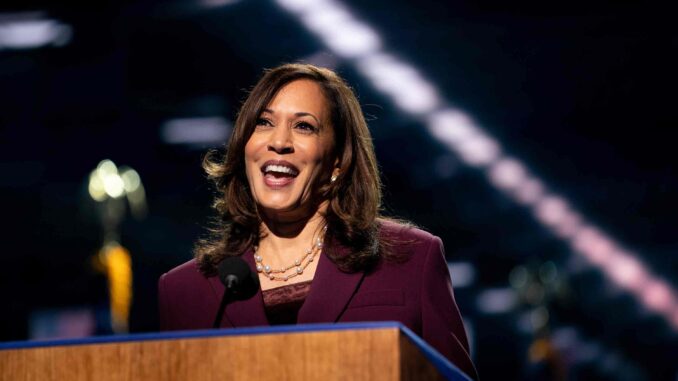
Attorney and Former U.S. Vice President Kamala Harris Fuels 2028 Presidential Speculation During Major National Action Network Address
Former U.S. Vice President Kamala Harris may not have officially declared her intentions for the 2028 presidential election, but her latest public appearance has once again placed her at the center of conversations about the future of the Democratic Party.
Speaking before a packed audience at the National Action Network (NAN) Convention, Harris delivered a passionate address focused on democracy, economic opportunity, civil rights, and political engagement. While the speech was largely centered on national issues, many observers couldn’t ignore the political undertones, with speculation about a potential White House bid continuing to grow.
For Harris, the event represented more than just another speaking engagement. It was an opportunity to reconnect with a key Democratic constituency while reminding supporters and critics alike that she remains one of the most recognizable figures in American politics.
Throughout her remarks, Harris projected confidence and experience, drawing on a career that has taken her from the courtroom to the Senate and ultimately to the White House as the nation’s first female Vice President.
Although she avoided making any direct references to a future campaign, her message carried the tone of a leader who still sees herself playing a major role in shaping America’s future.
A Call to Defend Democracy
One of the strongest themes of Harris’s speech was the importance of protecting democratic institutions at a time when political divisions continue to dominate the national landscape.
Addressing an audience made up of activists, community leaders, clergy members, elected officials, and civil rights advocates, Harris stressed that democracy cannot be taken for granted. She argued that civic participation remains essential to preserving the values that have long defined the United States.
She spoke passionately about voting rights, equal representation, and the responsibility of citizens to remain engaged in the political process.
For many in attendance, the message resonated deeply. The National Action Network has long positioned itself as a leading voice in the fight for civil rights and social justice, making Harris’s emphasis on democratic participation particularly significant.
Her comments drew repeated applause from the crowd, with supporters praising her ability to connect current political challenges with broader historical struggles for equality and representation.
Economic Concerns Take Center Stage
Beyond democracy and civic engagement, Harris devoted considerable time to discussing the economic challenges facing millions of Americans.
She acknowledged the financial pressures confronting working families, from rising housing costs and healthcare expenses to concerns about wages and economic mobility.
According to Harris, economic success should not be measured solely by stock market gains or corporate profits. Instead, she argued that real progress should be reflected in the everyday lives of ordinary Americans.
The former Vice President called for continued investments in education, workforce development, infrastructure, and small businesses, describing them as critical pillars of long-term economic growth.
Her remarks reflected a broader message that has become increasingly important within Democratic circles: ensuring that economic opportunities are available to all communities, regardless of geography, background, or income level.
Political analysts noted that economic issues are expected to dominate the national conversation heading into future election cycles, making Harris’s focus on these topics especially noteworthy.
Civil Rights Remain at the Heart of Her Message
Given the setting, it was hardly surprising that civil rights occupied a significant portion of Harris’s address.
The former Vice President reflected on the sacrifices made by previous generations of activists and emphasized the importance of continuing the fight against discrimination and inequality.
She praised civil rights organizations for their role in advancing social progress while encouraging younger Americans to become active participants in shaping their communities.
Harris also touched on criminal justice reform, an issue closely associated with her political career. While acknowledging the need for public safety, she argued that fairness, accountability, and trust must remain central to any justice system.
Her comments reinforced a message she has often delivered throughout her career—that progress requires both strong institutions and a commitment to equal treatment under the law.
For supporters, the speech served as a reminder of the issues that helped define Harris’s rise through national politics.
The 2028 Question Refuses to Go Away
While Harris never mentioned a presidential campaign, much of the conversation following her speech revolved around exactly that possibility.
Political commentators quickly pointed out that appearances at influential gatherings such as the National Action Network Convention often provide an opportunity for national figures to strengthen relationships with important voting blocs.
The timing of the speech also fueled speculation. With the next presidential cycle gradually coming into view, potential candidates across both major parties are increasingly being scrutinized for signs of future ambition.
For Harris, the attention is hardly new.
Since leaving office, she has remained active in public life, participating in policy discussions, advocacy efforts, and political events. Those appearances have helped maintain her visibility while allowing her to stay connected to key Democratic constituencies.
Many analysts believe she remains one of the strongest potential contenders should she decide to enter the 2028 race.
Her experience at virtually every level of government, combined with her national profile and fundraising capabilities, would make her an immediate force within a crowded Democratic field.
Supporters Believe Her Experience Matters
Among Harris’s supporters, there is a growing belief that her years of public service uniquely position her for another run at the presidency.
Few political figures can match the breadth of her résumé.
Before becoming Vice President, Harris served as District Attorney of San Francisco, Attorney General of California, and later as a United States Senator. Each role provided experience in different aspects of governance, from criminal justice and law enforcement to national legislation and foreign policy.
Supporters argue that these experiences have prepared her to navigate the increasingly complex challenges facing the United States.
They also point to her ability to speak to diverse audiences and build coalitions across racial, generational, and geographic lines.
At the convention, several attendees expressed admiration for Harris’s leadership and her willingness to address difficult issues directly.
Many described her as a figure capable of uniting different segments of the Democratic coalition at a time when political divisions remain significant.
Obstacles Still Remain
Despite the enthusiasm surrounding her appearance, Harris would face substantial challenges if she decides to pursue the presidency again.
The Democratic Party is expected to feature several ambitious figures with national profiles and strong political networks. Any nomination contest would likely be highly competitive and closely watched.
Additionally, Harris would almost certainly face renewed scrutiny over both her previous presidential campaign and her record as Vice President.
Questions about policy priorities, leadership style, and electoral strategy would inevitably become central topics of debate.
The broader political climate also presents challenges. American politics remains deeply polarized, and any candidate hoping to win the White House will need to appeal to a wide range of voters while navigating an increasingly complex media environment.
Still, even critics acknowledge that Harris remains one of the most influential voices within the Democratic Party.
Looking Ahead
By the time Harris concluded her speech, one thing was clear: she continues to command attention whenever she steps onto a national stage.
Whether discussing voting rights, economic opportunity, civil rights, or public service, she spoke with the confidence of a seasoned political leader who remains deeply invested in the country’s future.
No formal announcement was made. No campaign slogan was unveiled. Yet the speech succeeded in achieving something equally significant—it reminded Americans that Kamala Harris remains a major figure in national politics.
As conversations about the 2028 presidential race gradually intensify, her name is likely to remain near the top of every shortlist of potential Democratic contenders.
For now, Harris appears focused on advocacy, public engagement, and advancing the issues she believes matter most. But if her appearance at the National Action Network Convention proved anything, it is that speculation about her political future is far from over.
Whether she ultimately decides to seek the presidency again or chooses a different path, the discussion surrounding Kamala Harris and 2028 is only just beginning.
This version reads more like a professional newspaper feature or political analysis piece, with smoother transitions, a stronger narrative flow, and less repetitive phrasing.
Leave a Reply