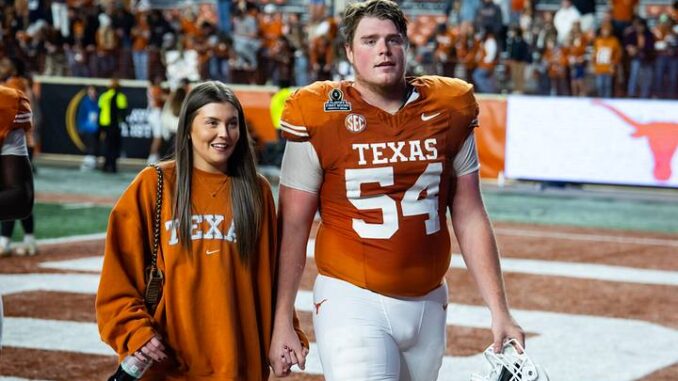
Former Texas offensive lineman Cole Hutson has taken a significant step in his effort to continue his college football career after securing a temporary restraining order (TRO) against the NCAA. The ruling temporarily allows Hutson to resume football-related activities while his legal challenge over an additional year of eligibility continues through the court system. The decision has quickly become one of the most closely watched eligibility cases in college football, highlighting the growing legal battles surrounding NCAA rules and athlete rights.
Hutson, who spent four seasons with the Texas Longhorns, believed his collegiate career had come to an end following the 2025 season. After going undrafted in the 2026 NFL Draft, he pursued opportunities at the professional level, including participating in rookie minicamps. However, changes to the NCAA’s eligibility framework prompted him to seek another chance to compete at the college level, arguing that the revised rules unfairly disadvantaged athletes from his recruiting class.
The lawsuit centers on the NCAA’s recently adopted age-based eligibility model. Hutson’s legal team contends that the new policy benefits future athletes while leaving players like him without the same opportunity, despite competing during a transitional period. According to the lawsuit, the rule change creates unequal treatment by granting greater flexibility to athletes entering college after 2022 while denying similar opportunities to players whose careers began just before the policy shift.
By obtaining the temporary restraining order, Hutson has earned an important short-term victory. While the TRO does not permanently resolve the dispute, it prevents the NCAA from enforcing its eligibility restriction against him until a court can fully examine the merits of the case. In practical terms, it allows him to participate in football activities while awaiting a hearing on whether a longer-term injunction should be granted.
For Texas, the ruling could have meaningful football implications. Hutson brings extensive experience to the Longhorns’ offensive line after appearing in 48 games and making 23 starts during his career. His versatility has been one of his greatest strengths, as he has played both guard and center while earning the trust of multiple coaching staffs. Having a veteran with that level of experience available could provide valuable stability for a team expected to compete at the highest level in the SEC.
Hutson’s college career has been defined by adaptability. As a freshman in 2022, he immediately stepped into a starting role at right guard, demonstrating maturity beyond his years. Over the following seasons, he accepted different assignments along the offensive line, shifting between reserve and starting responsibilities whenever the team required. In 2025, he opened the season as Texas’ starting center before an injury interrupted his campaign. After recovering, he returned to the lineup and finished the year as the starting left guard, once again proving his ability to excel at multiple positions.
Texas head coach Steve Sarkisian has acknowledged that the program is closely monitoring Hutson’s legal proceedings. While avoiding predictions about the outcome, Sarkisian emphasized Hutson’s experience and noted that the growing number of lawsuits challenging NCAA eligibility rules reflects the changing landscape of college athletics. The coach also recognized that Hutson’s situation differs from many other players because he went undrafted and still hopes to continue developing before pursuing another opportunity at the professional level.
The timing of Hutson’s case is particularly noteworthy because it comes during a period of sweeping change in college sports. In recent years, courts have increasingly become involved in disputes involving athlete compensation, transfer rules, and eligibility restrictions. Student-athletes are now more willing than ever to challenge NCAA regulations they believe unfairly limit their opportunities, whether academically, athletically, or financially.
Hutson’s lawsuit argues that denying him another season affects more than simply his ability to play football. His legal filing claims that the rule limits his opportunity to continue earning scholarship support while pursuing graduate studies, further develop his skills for a professional football career, and benefit from Name, Image and Likeness (NIL) opportunities that have become a major part of today’s college athletics landscape.
Should Hutson ultimately receive a permanent injunction or win his case outright, he would likely become an immediate contender for a starting role on the Texas offensive line. The Longhorns have room on their expanded roster, and his experience could make him one of the most reliable veterans available. Coaches often value experienced offensive linemen because continuity in the trenches can play a major role in protecting quarterbacks and establishing a consistent running game.
The NCAA, meanwhile, has defended its revised eligibility structure, stating that the age-based model is designed to create a clearer and more consistent system while preserving opportunities for future student-athletes. Although the organization has not specifically addressed every argument raised in Hutson’s lawsuit, it maintains that the updated framework represents a common-sense approach to managing eligibility moving forward.
Regardless of the final outcome, Hutson’s case is likely to influence future discussions surrounding NCAA eligibility. If courts continue granting temporary relief to athletes challenging the rules, additional players could pursue similar legal action, potentially leading to broader changes across college football and other NCAA sports. The growing number of eligibility lawsuits suggests that the legal landscape surrounding collegiate athletics is far from settled.
For Hutson personally, the temporary restraining order represents renewed hope. Just weeks ago, it appeared his football career had shifted entirely toward pursuing NFL opportunities after going undrafted. Now, he once again has the possibility of returning to the college field, continuing his education, and strengthening his résumé before making another attempt at professional football.
The coming weeks will determine whether this temporary victory becomes a permanent one. A court hearing on a longer-term injunction will ultimately decide whether Hutson can officially reclaim a fifth season of college eligibility. Until then, the experienced offensive lineman remains at the center of one of college football’s most significant legal battles, a case that could shape how eligibility disputes are handled for years to come.
Leave a Reply