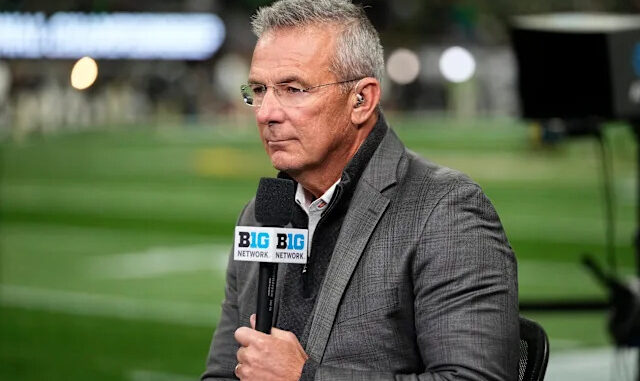
The ongoing war of words between the Texas Longhorns and Texas Tech Red Raiders has added another prominent voice to the conversation, with legendary college football coach Urban Meyer offering his perspective on the increasingly public scheduling feud between the two programs.
Appearing on The Triple Option, Meyer addressed the growing tension that has emerged following strong comments from Texas Tech head coach Joey McGuire and influential Red Raiders supporter Cody Campbell, both of whom have publicly criticized Texas and questioned the Longhorns’ unwillingness to schedule a future matchup.
While the debate has generated significant attention across the college football landscape, Meyer took a straightforward position on the issue, suggesting that Texas has little incentive to accommodate the requests coming from Lubbock.
His remarks immediately added another layer to a story that has become one of the most talked-about rivalries-that-isn’t-currently-a-rivalry in college football.
A Growing Public Dispute
The discussion surrounding a potential Texas-Texas Tech matchup has intensified in recent months.
Since Texas departed the Big 12 and moved into the SEC, opportunities for regular-season meetings between the two schools have become far less likely. The move effectively ended an annual conference rivalry that had existed for decades and produced numerous memorable moments.
For many Texas Tech supporters, the separation left unfinished business.
That frustration has occasionally surfaced through comments from figures connected to the Red Raiders program, including McGuire, who has never been shy about expressing confidence in Texas Tech’s direction.
Campbell, one of the university’s most influential supporters, has also publicly challenged Texas to schedule a game, arguing that fans would welcome the opportunity and that the matchup would generate enormous interest throughout the state.
The comments have fueled debate among college football fans, with some arguing that Texas should embrace the rivalry while others believe the Longhorns have moved beyond needing such games on their schedule.
Urban Meyer’s Perspective
Meyer approached the topic from a practical standpoint rather than an emotional one.
From his perspective, scheduling decisions are often driven by strategic considerations rather than public pressure.
Programs at the highest level of college football evaluate future schedules based on factors that include conference commitments, playoff implications, recruiting considerations, financial opportunities, and overall program objectives.
Meyer suggested that Texas currently occupies a position where it does not need to respond to outside challenges.
The Longhorns are members of one of the most competitive conferences in college football and already face a demanding schedule on an annual basis. As a result, Meyer questioned what additional benefit Texas would gain by adding another high-profile matchup simply because another program is demanding it.
His comments reflected the reality of modern college football, where scheduling is often viewed through the lens of risk versus reward.
Texas’ Position Has Changed
One reason Meyer appears to understand Texas’ perspective is because he has spent decades operating at the highest levels of college football.
Programs with championship aspirations often make scheduling decisions differently than schools attempting to climb the national ladder.
Texas today is not the same program it was several years ago.
Under head coach Steve Sarkisian, the Longhorns have rebuilt their national profile, recruited at an elite level, and positioned themselves as legitimate contenders within the SEC and on the national stage.
That status changes how scheduling opportunities are evaluated.
For Texas, every non-conference game carries potential consequences. A difficult matchup may create excitement among fans, but it also introduces risk that could impact playoff positioning.
From that perspective, Meyer appears to believe the Longhorns have little motivation to alter their plans simply because another program wants the game.
Why Texas Tech Wants the Matchup
While Meyer focused largely on Texas’ perspective, the motivations behind Texas Tech’s desire for the game are easy to understand.
A matchup against Texas would instantly become one of the most anticipated games on the Red Raiders’ schedule.
The rivalry has deep roots, passionate fan bases, and decades of history behind it. Even though the schools are no longer conference opponents, emotions surrounding the relationship remain strong.
For Texas Tech, playing Texas would provide a major opportunity to showcase the program on a national stage.
Victories over highly ranked opponents can significantly impact recruiting, national perception, and overall program momentum.
McGuire has worked aggressively to elevate Texas Tech’s profile, and a matchup against the Longhorns would fit perfectly into that vision.
From the Red Raiders’ point of view, the benefits are obvious.
The Business Side of College Football
Meyer’s comments also highlighted a broader reality within modern college athletics.
College football has increasingly become a business-driven environment where decisions are often made with long-term strategic goals in mind.
Conference realignment, media rights agreements, playoff expansion, and recruiting battles all influence how programs operate.
In that environment, traditional rivalries sometimes take a back seat to broader organizational objectives.
Texas’ move to the SEC fundamentally altered its scheduling priorities.
The Longhorns now compete in a conference that features some of the biggest brands and toughest schedules in the sport. Games against traditional SEC powers already provide the level of competition and national exposure that programs seek.
As a result, Texas may view additional rivalry games differently than fans who prioritize tradition above all else.
Meyer’s comments seemed to acknowledge that reality.
Fans Still Want Answers
Despite the strategic arguments, many fans continue to hope the two programs eventually meet again.
Rivalries are among the most valuable elements of college football. They create passion, tradition, and memorable moments that transcend generations.
For older fans, Texas and Texas Tech share a history that remains meaningful regardless of conference affiliations.
Every time public comments are exchanged between the schools, interest in a potential matchup grows.
That is exactly what has happened throughout this latest dispute.
What began as criticism and challenges from Texas Tech figures has evolved into a statewide conversation involving coaches, analysts, media personalities, and fans.
Looking Ahead
Whether Texas and Texas Tech ultimately schedule a future game remains uncertain.
The demand clearly exists among portions of both fan bases, and the matchup would undoubtedly attract significant attention whenever it occurs.
However, Urban Meyer’s comments reflect the reality that scheduling decisions are rarely driven by emotion alone.
From his viewpoint, Texas currently holds the stronger position and has no obligation to respond simply because another program is calling for a matchup.
That does not mean the rivalry is dead.
If anything, the public exchanges between the two sides demonstrate that the emotions surrounding the series remain very much alive.
For now, the debate continues.
Texas Tech continues to push for the game. Texas remains focused on its future in the SEC. And college football fans across the state continue wondering whether one of Texas’ most compelling rivalries will eventually find its way back onto the field.
Until that happens, comments like Meyer’s will continue to fuel one of the sport’s most intriguing off-field discussions.
Leave a Reply