Donald Trump has stepped into the growing controversy surrounding FIFA president Gianni Infantino, warning that removing the football governing body’s leader would be a “terrible mistake” at a time when pressure on Infantino is intensifying.
Trump’s intervention adds another major political dimension to a dispute that has increasingly moved beyond the usual arguments about football administration. Infantino is facing criticism from powerful football organizations over his leadership and a controversial proposal involving private investment in FIFA’s commercial rights. With calls for greater accountability and governance reforms growing louder, Trump’s public defense gives Infantino an influential ally at a critical moment.
The U.S. president made his position clear in a post on Truth Social on Tuesday. Trump argued that FIFA would be making a serious error if it considered replacing Infantino and praised the FIFA president’s record, particularly his role in overseeing the 2026 World Cup.
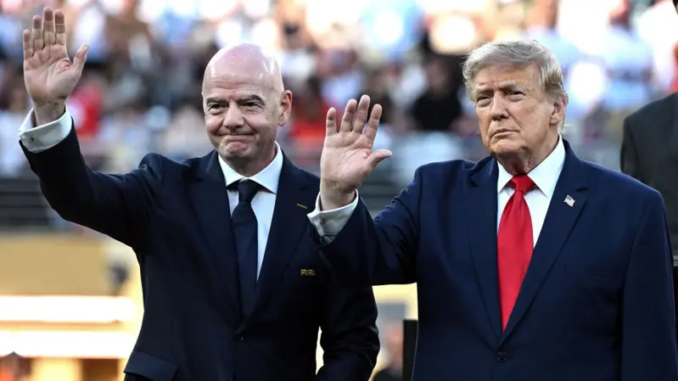
The intervention comes only weeks after Trump and Infantino shared the spotlight during the conclusion of the 2026 World Cup. Their relationship has become increasingly visible over recent years, making Trump’s latest comments unsurprising to those who have followed the two men’s close association.
Still, the timing is significant.
Infantino is not simply dealing with criticism from individual football officials or commentators. Opposition has reportedly grown among major confederations, including UEFA, Concacaf and the Asian Football Confederation. Those organizations have been pushing for changes to FIFA’s governance following Infantino’s controversial plan to explore selling a stake in World Cup commercial rights to private investors.
That means Trump’s decision to publicly defend Infantino has the potential to make an already complicated situation even more politically charged.
Why Infantino Is Under Pressure
Infantino’s current difficulties are linked largely to a proposal that would have involved selling a significant stake in FIFA’s commercial rights.
The plan reportedly aimed to raise billions of dollars through a transaction involving private investors. The proposal generated immediate concern among parts of the football establishment because of questions about governance, transparency and the long-term consequences of allowing private interests to gain an ownership stake in important World Cup-related commercial assets.
The proposal was eventually shelved, but the controversy did not disappear with it.
Instead, opposition to Infantino’s leadership intensified.
According to reports, UEFA, Concacaf and the Asian Football Confederation have been working together on a new framework for how world football could be governed. Their discussions indicate that dissatisfaction with FIFA’s current leadership is broader than a single disagreement over commercial rights.
For Infantino, that presents a serious challenge.
FIFA is an enormous organization with 211 member associations, and the president’s authority ultimately depends on maintaining enough support across the global football community. While Infantino still has supporters, the emergence of coordinated opposition among major confederations creates an uncomfortable political situation.
Trump’s support therefore arrives at a moment when Infantino needs allies.
Trump’s Strong Defense
Trump did not attempt to hide his opinion.
Instead, he warned FIFA against even considering the possibility of replacing Infantino. His argument was based largely on the belief that Infantino has helped make the World Cup more successful and commercially valuable.
Trump has been closely involved in the 2026 World Cup because the United States hosted the majority of matches in the tournament, alongside Canada and Mexico. He chaired the U.S. government’s World Cup task force and repeatedly promoted the tournament as a major international event.
That relationship has also brought Trump and Infantino into frequent contact.
The FIFA president has praised Trump’s involvement in the tournament, while Trump has repeatedly spoken positively about Infantino. Their relationship became especially visible during the World Cup, when the two appeared together at major events.
Trump’s latest comments therefore represent more than a casual endorsement.
They show that he sees Infantino as an important partner in the future of international football.
Trump also suggested that the World Cup’s success and profitability could be affected if Infantino were removed. That is a powerful argument because FIFA’s financial strength is closely connected to the commercial success of its flagship tournament.
The 2026 World Cup was expanded to 48 teams and featured 104 matches across the United States, Canada and Mexico. Its enormous scale made the tournament one of the biggest sporting events ever staged.
For Trump, Infantino deserves credit for helping make that expansion possible.
A Relationship That Has Attracted Attention
Trump’s relationship with Infantino has not gone unnoticed.
The two men have developed unusually close ties for leaders of a global sports organization and a national government. Infantino has frequently appeared alongside Trump at major football-related events, while Trump has praised FIFA’s leadership.
Their relationship has also produced controversy.
Earlier this month, reports indicated that Infantino sought Trump’s support after facing backlash over the proposed sale of a stake in FIFA’s commercial rights. Reuters reported that Infantino had turned to Trump amid growing opposition to the plan.
That background makes Trump’s latest intervention particularly notable.
Critics could argue that FIFA’s leadership should be determined by football officials and member associations rather than political figures. Supporters of Infantino, however, may see Trump’s intervention as evidence that influential international leaders recognize the value of continuity at FIFA.
Either way, the episode highlights how closely football and politics have become connected.
The World Cup Connection
The 2026 World Cup has played an important role in the relationship between Trump and Infantino.
The tournament was a major priority for the United States government. Trump frequently spoke about the economic benefits of hosting the competition and presented it as an opportunity to showcase the United States to the world.
Infantino, meanwhile, had a major responsibility for delivering the tournament.
The competition’s expanded format created enormous logistical challenges. More teams meant more matches, more venues and greater demands on host cities. The United States hosted most of the matches, while Canada and Mexico also played central roles.
The tournament ultimately provided FIFA with a massive global platform.
Trump’s argument is essentially that replacing Infantino after such a significant event would create unnecessary instability.
That position may appeal to people who believe FIFA should focus on maintaining momentum rather than becoming consumed by an internal leadership battle.
But Opposition Is Not Going Away
Trump’s support does not automatically solve Infantino’s problems.
The criticism from football’s governing structures remains.
UEFA and other confederations have expressed concerns about FIFA’s direction, particularly over the proposed commercialization of World Cup rights and broader questions about governance. Reports indicate that Infantino’s opponents are exploring structural reforms that could significantly change the relationship between FIFA and its regional confederations.
This means the dispute could become much bigger than whether Infantino remains president.
It could turn into a debate about what FIFA should look like in the future.
Should FIFA continue expanding its commercial operations aggressively? Should major decisions involving billions of dollars face greater independent scrutiny? How much power should the FIFA president have? What role should the continental confederations play in major decisions?
Those are questions that cannot be answered simply by replacing one president.
At the same time, Infantino’s opponents believe leadership change could be necessary to restore trust.
Infantino’s Political Strength
One of Infantino’s biggest advantages is that he has built relationships across different parts of the football world.
He has supporters in numerous regions and has emphasized FIFA’s global reach throughout his presidency. His leadership has also been associated with an expansion of the World Cup and increased commercial revenues.
Those achievements give him arguments to make to FIFA’s member associations.
His supporters can point to a growing tournament, increased global participation and a financially powerful FIFA.
His critics, however, argue that financial growth should not come at the expense of governance and transparency.
That disagreement is unlikely to disappear.
Trump’s intervention may strengthen Infantino politically, but it may also encourage his critics to push harder for reforms.
Why Trump’s Support Matters
The president of the United States does not control FIFA.
FIFA is an independent international sports organization, and its president is ultimately accountable to FIFA’s member associations.
However, Trump’s influence should not be dismissed.
The United States is one of the most commercially important markets in global football. The 2026 World Cup placed the country at the center of international football, and the tournament generated enormous attention across American sports and entertainment markets.
Trump’s close relationship with Infantino therefore carries symbolic and political weight.
It also signals that the United States government has an interest in maintaining a stable relationship with FIFA.
For Infantino, that is valuable at a time when some football leaders are demanding changes.
A Bigger Battle Over the Future of FIFA
The controversy surrounding Infantino could eventually become one of the most important governance battles in modern football.
At its heart is a question about what FIFA should prioritize.
One side emphasizes growth, commercial expansion and global development. The other emphasizes institutional safeguards, transparency and limits on presidential authority.
Infantino’s supporters believe his leadership has helped FIFA become more influential and financially successful.
His critics believe that success cannot justify controversial decision-making.
Trump clearly falls on the first side of that debate.
By warning FIFA that removing Infantino would be a “terrible mistake,” he has effectively argued for continuity rather than upheaval.
But the pressure facing Infantino suggests that the debate will continue regardless of Trump’s position.
What Happens Next?
The coming months could determine whether Infantino can overcome the current challenge.
His opponents appear determined to push for governance reforms, while Infantino has shown no indication that he intends to surrender his position without a fight. The question will be whether FIFA’s member associations ultimately remain behind him or whether the opposition from major confederations becomes strong enough to force a change.
Trump’s support gives Infantino an important public endorsement.
It does not, however, guarantee his political survival inside FIFA.
The football governing body will ultimately have to deal with its own internal divisions. If Infantino can convince member associations that his leadership is necessary for FIFA’s continued growth, Trump’s backing could become another important part of his defense.
If his critics succeed in turning the controversy into a broader movement for reform, Trump’s intervention may have limited influence.
For now, though, one thing is clear: Donald Trump has chosen his side.
At a moment when Gianni Infantino is facing increasing pressure, the U.S. president has publicly defended the FIFA chief and warned against replacing him. The message is unmistakable: Trump believes Infantino should remain in charge.
Whether that support can help Infantino survive the growing storm inside FIFA remains to be seen.
What began as a dispute over a controversial commercial proposal has now become a much larger conversation about leadership, money, governance and the future direction of world football. With major confederations demanding change and Trump standing firmly behind Infantino, the battle over FIFA’s future is unlikely to end anytime soon.
For Infantino, the challenge is no longer simply convincing critics that his latest proposal was misunderstood. He must demonstrate that FIFA can move forward while maintaining confidence among the organizations that make up international football.
Trump may have given him a powerful public ally.
Now Infantino must turn that support into lasting confidence within the football world itself.
Leave a Reply