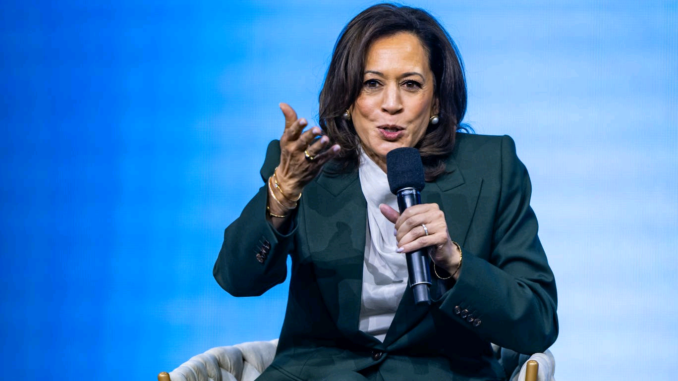
Kamala Harris’ Gen-Z-focused social media operation is turning its attention to one of the most valuable currencies in Republican politics: Donald Trump’s endorsement.
The former vice president’s rebranded social media account, known as “Headquarters,” has used a sharp, internet-friendly style to criticize President Donald Trump, his political decisions and his public missteps. This time, the account focused on a growing list of Republican candidates who received Trump’s backing but failed to win their respective primaries.
The post represents a notable change in the way Harris and her political team are engaging with Trump. Rather than relying solely on traditional political criticism, the account is presenting the information in a format designed to attract younger audiences who consume political news through social media, memes and short-form commentary.
According to reports, Harris’ former campaign account was repurposed into a Gen-Z-oriented political page earlier this year. The account has regularly targeted Trump over his policies and public statements, while attempting to maintain a tone that feels more native to younger users.
The latest attack centers on Republican candidates who had received Trump’s endorsement but subsequently lost their primary contests. Among those highlighted was Rep. Cory Mills of Florida, who was defeated in the Republican primary for Florida’s 7th Congressional District. Other names mentioned included Rep. Andy Ogles, Georgia Lieutenant Governor Burt Jones and South Carolina Lieutenant Governor Pamela Evette.
For Trump, the losses are significant because his endorsement has become one of the most recognizable political brands within the Republican Party. Candidates routinely seek his support because it can provide national attention, fundraising opportunities and access to his large and loyal political base.
But endorsements are not guarantees.
The Headquarters account appears to be using that reality to challenge the perception that Trump remains an unbeatable force within Republican politics. By highlighting candidates who failed despite receiving his backing, Harris’ team is effectively asking a broader question: How much influence does Trump really have when Republican voters enter the voting booth?
That question could become increasingly important as the 2026 political cycle develops.
Trump has spent years building an image as a political kingmaker. His endorsement has frequently been treated as a major advantage in Republican primaries, particularly for candidates who align themselves closely with the MAGA movement. For many Republicans, securing Trump’s support can immediately transform a relatively low-profile campaign into a national political story.
However, primary elections are ultimately decided by voters, not endorsements.
The defeats highlighted by Harris’ account therefore provide Democrats with an opportunity to challenge Trump’s political narrative. Even if the losses do not represent a broad collapse of Trump’s influence, they can be presented as evidence that his support has limits.
That message is particularly suited to social media.
Harris’ political operation has previously demonstrated an interest in communicating with younger voters through humor, cultural references and fast-moving online trends. During the 2024 presidential campaign, her digital team gained considerable attention for its Gen-Z-oriented approach. Axios reported at the time that a campaign mobilization team made up of young staffers used memes, viral moments and TikTok trends to contrast Harris with Trump.
The strategy was controversial, but it showed how modern political campaigns increasingly view social media as more than a tool for distributing traditional press releases.
For younger voters, politics can arrive through a meme, a viral post or a short video before it ever appears on a television news broadcast. Political campaigns have consequently been forced to compete not only on policy but also on tone, speed and cultural relevance.
Harris’ Headquarters account is clearly operating within that environment.
The latest post about Trump-endorsed candidates does not necessarily prove that the former president’s political influence is collapsing. In fact, Trump remains an extraordinarily powerful figure within the Republican Party. But the defeats give Harris’ team material that can be used to question the idea that Trump’s endorsement is automatically decisive.
There is also an element of political irony in the strategy.
Harris herself has experienced the complicated nature of political endorsements. After losing the 2024 presidential election to Trump, she remained active in Democratic politics and continued to receive attention as a potential future presidential contender. Her own recent endorsement of former Alaska congresswoman Mary Peltola in a Senate primary generated criticism after Peltola’s campaign indicated that it was not seeking endorsements from politicians outside Alaska.
That episode demonstrates an important reality about endorsements: they can help, but they can also become liabilities depending on the political environment.
For Harris, however, the Headquarters account is less about presenting herself as an unquestioned political authority and more about keeping her voice present in the national conversation.
That is especially important for a politician who is no longer holding elected office.
Without a formal government position, Harris has fewer opportunities to dominate headlines through official announcements or policy decisions. Social media therefore provides a direct channel through which she and her political team can continue shaping political narratives.
The Gen-Z focus also reflects a larger Democratic effort to maintain relationships with younger voters.
Harris benefited from significant online enthusiasm among young voters during the 2024 campaign. Her campaign’s social media presence became associated with memes and cultural trends, including the viral “Brat” phenomenon surrounding singer Charli XCX. Contemporary reporting noted how quickly Harris became a major subject of online culture after entering the presidential race.
That enthusiasm, however, did not translate into an election victory.
Trump defeated Harris in 2024, demonstrating that social media popularity and electoral success are not the same thing. A campaign can dominate online conversations while still struggling to reach voters who are less engaged with digital political culture.
That remains one of the central challenges for Harris as she looks toward the future.
The Headquarters strategy may help keep her politically relevant, but it cannot by itself rebuild a national coalition. Younger voters are diverse, and Gen Z is not a single political bloc. Some young voters strongly support Democrats, while others have become more skeptical of the party or increasingly open to Republican candidates.
That means Harris’ social media strategy will have to do more than generate viral posts. It will eventually need to connect online engagement to a broader political argument about the economy, education, healthcare, jobs, housing and the direction of American democracy.
For now, though, the message is straightforward.
Trump’s endorsement may still carry enormous weight, but it is not a guarantee of victory.
By highlighting Republican candidates who lost despite receiving Trump’s backing, Harris’ Gen-Z-focused account is attempting to turn individual primary defeats into a larger political narrative. The objective is not simply to mock Trump’s unsuccessful endorsements. It is to challenge the perception of political invincibility that has surrounded him for years.
Whether that message resonates beyond social media remains to be seen.But in an increasingly digital political environment, the battle over political influence is no longer limited to rallies, television advertisements and campaign speeches. It is also happening in timelines, memes, viral posts and carefully crafted online attacks.Harris’ Headquarters account appears ready to participate in that battle.And by placing Trump’s failed endorsements at the center of its latest attack, the account is sending a clear message to younger voters: even the most powerful political endorsement in America cannot always deliver a win.
Leave a Reply