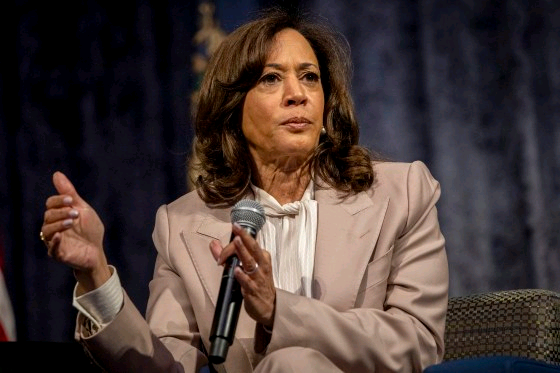
Kamala Harris is taking a more critical look at the American political establishment, arguing that neither Democrats nor Republicans have done enough to address the economic pressures facing working people. Her message represents an effort to move beyond the familiar partisan arguments that dominate Washington and focus instead on what she sees as a deeper failure: an economy that too often leaves ordinary Americans struggling to keep up.
The former vice president made the argument during an appearance before Arkansas Democrats, where she called for a revival of the American dream and delivered a broader critique of the country’s political and economic direction. Her remarks came as affordability remains a major concern for voters and as both parties prepare for another highly competitive political cycle.
Harris’s approach is notable because she did not simply place responsibility on Republicans. She also acknowledged shortcomings within her own party and among Democrats who, in her view, accepted economic assumptions that failed to deliver broadly shared prosperity.
That criticism could become an important part of Harris’s political identity going forward. Rather than presenting the economic debate as a simple contest between Democrats and Republicans, she is attempting to argue that both parties have, at different times, fallen short of what American workers need.
A different economic argument
For decades, economic debates in the United States have largely been divided along familiar ideological lines. Republicans have generally emphasized lower taxes, private investment, business growth and market-oriented policies, while Democrats have traditionally placed greater emphasis on government programs, worker protections, unions and social spending.
Harris is suggesting that the country needs to look beyond that division.
Her argument is not that the two parties have identical economic philosophies. They clearly do not. Instead, the broader point is that economic growth by itself does not necessarily guarantee that working families will feel financially secure.
That distinction is increasingly important at a time when many Americans judge the economy not by headline economic statistics but by the cost of housing, food, healthcare, transportation and education.
A strong economy means little to a family that still cannot comfortably afford rent or a mortgage. A low unemployment rate does not necessarily provide security for someone working multiple jobs without adequate benefits. And rising stock markets do not automatically translate into financial stability for households that have little or no investment wealth.
Those frustrations have created political opportunities for candidates willing to speak directly about affordability.
Harris turns criticism inward
One of the more significant elements of Harris’s message is her willingness to acknowledge that Democrats have not always offered convincing answers to working-class concerns.
She has previously argued that Democrats rejected the traditional idea of trickle-down economics, while acknowledging that some Democrats nevertheless accepted assumptions associated with that approach. That criticism reflects a growing debate within the Democratic Party over whether it has become too closely associated with highly educated and affluent voters while losing some of its historic connection to working-class Americans.
That debate became particularly intense after the 2024 presidential election.
Democratic strategists and politicians have spent considerable time examining why the party struggled with voters who traditionally formed part of its coalition. Economic concerns were central to that discussion, particularly the perception that Democratic policies did not sufficiently address the everyday cost of living.
Harris’s latest message appears to recognize that political reality.
Rather than simply insisting that Democrats have the better economic record, she is positioning herself as someone willing to admit where the party has failed and argue for a different direction.
Republicans face criticism too
Harris’s criticism does not stop with Democrats.
Republicans, particularly under President Donald Trump, have promoted a different economic vision built around tax policy, trade restrictions, domestic production and a more aggressive approach to protecting American industries. Trump’s economic agenda has increasingly relied on tariffs, while Republicans have traditionally emphasized tax reductions and market-based growth.
But Harris’s argument is that policies should ultimately be judged by whether they improve the lives of ordinary workers.
Tariffs, for example, may be presented as a way to protect American manufacturing, but they can also increase costs for businesses and consumers. Tax cuts may encourage investment, but the benefits do not necessarily reach every household equally.
That tension lies at the heart of the American economic debate.
Harris is attempting to make the worker—not Washington, Wall Street or corporate America—the central figure in that debate.
The affordability problem
Perhaps the biggest challenge for any politician discussing the economy is affordability.
Americans have continued to express frustration over prices, even when broader economic indicators show signs of strength. Political campaigns increasingly understand that voters are less interested in abstract arguments about GDP and more interested in whether their paychecks cover their monthly expenses.
Recent political reporting has highlighted how affordability has become a major issue for Democrats, particularly as voters continue to question whether either party can deliver meaningful relief.
Housing is one of the clearest examples.
For younger Americans, buying a home can seem increasingly distant. High prices, borrowing costs and limited supply have created barriers that cannot easily be solved with campaign slogans.
Healthcare presents another challenge. Families can face enormous expenses even when they have insurance, while prescription drugs and medical services remain politically sensitive issues.
Food and transportation costs also affect household budgets every day.
For Harris, the larger question is whether America’s economic system is producing prosperity that reaches beyond those already positioned to benefit from it.
Rebuilding the American dream
Harris has framed her economic message around the idea of reviving the American dream. At the Arkansas Democratic Party dinner, that theme was central to her broader argument about the country’s future.
The phrase carries significant political weight.
For generations, the American dream has meant that people who work hard should have a realistic opportunity to build a better life. That has traditionally included owning a home, raising a family, sending children to college, retiring with dignity and achieving greater financial security than the previous generation.
For many Americans, however, that promise feels increasingly difficult to achieve.
Harris is attempting to connect with that frustration by arguing that economic policy should be measured against the experiences of working families.
It is a message that could resonate beyond traditional Democratic voters if she can make it credible.
A difficult political balancing act
There is also a political risk in criticizing both parties.
Harris remains a prominent Democratic figure, and her audience includes people who expect her to defend the party. Republicans, meanwhile, are unlikely to accept the argument that they share responsibility for economic problems in the same way Democrats do.
Critics from both sides could therefore accuse her of oversimplifying complex economic issues.
Yet the strategy also offers an advantage.
Americans are increasingly skeptical of politicians who appear unwilling to acknowledge mistakes. By accepting some responsibility for Democratic shortcomings while criticizing Republican policies, Harris can attempt to present herself as more independent-minded.
That could be especially important if she remains interested in a future presidential campaign.
Her economic message would then need to be more than a criticism of the past. She would have to explain exactly what she would do differently.
The road ahead
Harris’s economic argument comes at a moment when Democrats are debating how to reconnect with working-class voters and Republicans are attempting to maintain their own coalition around issues such as trade, immigration, taxes and cultural politics.
The competition for working Americans is likely to remain one of the defining political battles of the next several election cycles.
Harris appears to understand that winning that battle requires more than criticizing Donald Trump.
It also requires Democrats to answer difficult questions about their own record.
Why do so many workers feel financially insecure despite years of economic growth? Why has homeownership become so difficult for younger generations? Why do wages often feel insufficient when compared with everyday expenses? And what should government actually do to make economic opportunity more accessible?
Those questions cannot be answered with partisan slogans alone.
Harris’s decision to criticize both Democrats and Republicans reflects an attempt to place those concerns at the center of the political conversation. Her argument is essentially that American workers should not have to choose between two parties if neither one is prepared to make their economic security a central priority.
Whether that message becomes a lasting political strategy remains uncertain. But the underlying concern is unlikely to disappear.
For Harris, the challenge now is to turn criticism into a credible economic vision—one that convinces voters that the American dream is not simply a nostalgic phrase, but something that can still be achieved by people who work hard and play by the rules.
That may ultimately determine whether her new economic message becomes a meaningful political reset or simply another speech in an increasingly crowded debate over America’s economic future.
Leave a Reply