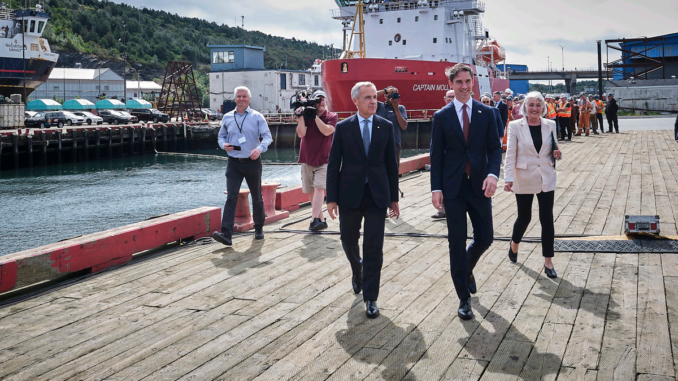
The worsening trade relationship between the United States and Canada is increasingly being defined by tariffs, retaliation and political frustration. But Canadian Prime Minister Mark Carney has offered a reminder that the relationship between the two neighbors is about far more than the movement of goods across their shared border.
One of the clearest examples came Monday, when Carney announced that Canada would invest more than C$11 billion to build six new icebreakers for the Canadian Coast Guard. The vessels will be constructed by Quebec-based Chantier Davie and will replace aging Canadian icebreaking ships.
The announcement came at an especially significant moment. U.S.-Canada trade negotiations have broken down, Washington has imposed new tariffs on Canadian products, and Carney has promised dollar-for-dollar retaliation beginning September 8.
Against that backdrop, the icebreakers represent more than a major Canadian infrastructure project. They highlight an area where Canada’s geography, industrial capabilities and Arctic experience give it strategic importance to the United States.
The Arctic is becoming increasingly important to North American security and economic planning. As climate change reduces sea ice in parts of the region, shipping routes and access to natural resources are receiving greater attention. At the same time, Russia and China have expanded their activities in the Arctic, increasing pressure on North American governments to strengthen their presence.
That creates a practical problem for Washington.
The United States has a limited fleet of polar-capable icebreakers, even as it seeks to increase its Arctic capabilities. Canada, meanwhile, possesses an enormous Arctic coastline and decades of experience operating in northern waters.
Carney’s icebreaker announcement therefore sends an important message: Canada’s value to the United States cannot be measured simply by the trade balance.
The two countries share one of the world’s longest international borders and have deeply integrated economies. Their relationship also includes energy, critical minerals, defense, intelligence, transportation, manufacturing and Arctic security.
In other words, even when Washington and Ottawa disagree over tariffs, they remain deeply connected.
Carney’s decision to emphasize icebreakers at this particular moment was significant.
The Canadian government had just walked away from trade negotiations after concluding that new American demands were unacceptable. Carney said the proposed U.S. terms were unfair and economically damaging to Canada, arguing that Washington was asking for too much while offering too little.
The following day, he appeared alongside the announcement of the massive shipbuilding investment.
The message was straightforward: Canada intends to strengthen itself rather than simply wait for Washington to determine its economic future.
The icebreaker program will also create opportunities for Canadian steel and shipbuilding, supporting domestic industrial capacity. That fits into Carney’s broader argument that Canada needs to become more economically resilient and less dependent on the American market.
But the decision also demonstrates why Canada remains strategically important to the United States.
For years, the Arctic received less public attention than other geopolitical regions. That is changing.
Russia maintains a significant Arctic military presence, while China has sought greater economic and scientific involvement in the region. The United States and Canada consequently face a common challenge: maintaining sovereignty, surveillance, transportation and emergency-response capabilities across a vast and difficult environment.
Icebreakers are essential to that effort.
These ships are not ordinary commercial vessels. They are designed to operate in waters covered by thick ice, allowing governments to reach remote areas, support northern communities, maintain access to strategic locations and assist other ships.
For Canada, a stronger icebreaker fleet means greater ability to patrol and operate across its Arctic territory.
For the United States, stronger Canadian Arctic capabilities can also contribute to the security of the broader North American region.
That makes cooperation between the two countries valuable even when their political leaders are engaged in bitter economic disputes.
The current conflict can make it easy to forget how interconnected the American and Canadian economies remain.
Canadian energy supplies play an important role in the U.S. economy. American manufacturers depend on Canadian inputs, while Canadian industries depend heavily on access to U.S. consumers. Automotive production is particularly integrated across the border.
A disruption in one country can therefore quickly affect workers and businesses in the other.
The latest tariffs have already raised concerns about industries that rely heavily on cross-border supply chains. The dispute has also increased uncertainty for companies trying to make long-term investment decisions.
Carney has argued that Canada is prepared to respond while also seeking new markets and investment partners.
That does not mean Canada can simply replace the United States overnight. The American market remains enormously important to Canadian businesses.
But the longer the dispute continues, the stronger the incentive becomes for Canada to diversify.
For President Donald Trump, the central question is whether tariffs can achieve the political and economic concessions his administration wants from Canada.
That strategy carries risks.
Canada has already announced plans for retaliatory tariffs, and Canadian officials have warned that additional measures could follow.
The consequences could reach American consumers and companies as well as Canadian exporters.
And beyond trade, Washington must consider the strategic relationship.
The United States does not simply have a trading partner to its north. It has a neighbor that shares the Arctic, cooperates on continental defense and occupies an enormous geographic position between the American mainland and the increasingly contested northern region.
That reality makes the relationship considerably more complicated than a dispute over tariffs.
Carney’s icebreaker announcement can therefore be viewed as part of a broader Canadian strategy.
Canada is signaling that it intends to invest in its own capabilities while maintaining the ability to cooperate with the United States where interests overlap.
That is particularly important in the Arctic.
The two countries may disagree over tariffs, automobiles, agriculture and trade policy, but neither benefits from a weak North American security structure.
The C$11 billion investment also demonstrates that Canada is willing to spend heavily to strengthen its northern capabilities. Reuters reported that the six vessels will replace aging heavy and medium Canadian Coast Guard icebreakers.
This is not simply about ships. It is about Canada’s ability to operate independently in an increasingly important strategic region.
The growing U.S.-Canada trade conflict has created an unusual political moment.
For decades, the two countries largely treated their economic relationship as a foundation of stability. Now, that assumption is being challenged.
Carney’s approach is increasingly based on the idea that Canada must protect its interests even if doing so creates friction with Washington.
His government has made clear that it remains willing to negotiate, but only if the United States returns with what Canada considers a fair approach.
The icebreaker announcement reinforces that position.
Canada is not merely asking the United States to recognize what Canada sells to America. It is asking Washington to recognize what Canada contributes to the continent’s security, infrastructure and strategic future.
That contribution could become even more valuable as competition in the Arctic grows.
The trade war may dominate headlines today, but the relationship between the United States and Canada extends far beyond tariffs. Energy, critical minerals, manufacturing, defense and Arctic security all bind the two countries together.
And in the increasingly contested waters of the far north, one lesson is becoming difficult to ignore: **the United States may need Canada just as much as Canada needs the United States.**
Leave a Reply