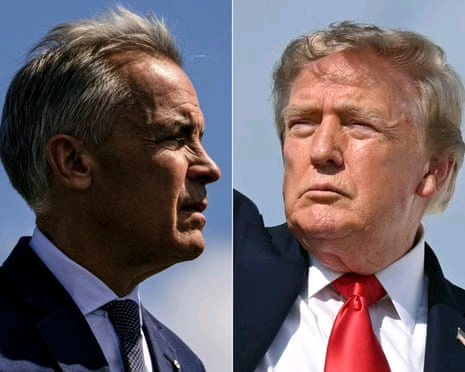
Few Canadian prime ministers have entered office facing a relationship with the United States as uncertain as the one confronting Mark Carney. The former central banker became prime minister at a moment when Canada’s traditional assumptions about its closest ally were being tested by President Donald Trump’s aggressive trade policies, tariff threats and repeated challenges to the nature of the Canada-U.S. relationship.
Carney’s response has been notable not only for the policies his government has pursued, but also for the language he has chosen to describe Canada’s changing position in the world.
His speeches have increasingly become political events in their own right. They are carefully constructed, economically detailed and, at times, unusually blunt about the transformation taking place between Ottawa and Washington. His message is consistent: Canada cannot simply wait for the old relationship with the United States to return. It must strengthen its domestic economy, diversify its international partnerships and defend its sovereignty.
That argument has given Carney’s public appearances a significance far beyond traditional political speeches.
His August 22 address on the collapse of trade negotiations with Washington was perhaps the clearest example. Carney told Canadians that his government was walking away from what it considered an unacceptable deal and would pursue a different economic path. He said Canada could not control the political climate coming from Washington but could determine its own response.
The speech immediately became part of the larger political confrontation with Trump.
Carney’s political style is different from Trump’s.
Trump’s political communication is often built around confrontation, repetition, personal attacks and dramatic declarations. Carney, by contrast, has generally presented himself as measured, analytical and deliberate.
That difference has become strategically important.
Carney does not need to match Trump’s volume to challenge him. Instead, he has attempted to frame the dispute as a question of national sovereignty, economic resilience and Canada’s long-term interests.
In his August 22 remarks, Carney argued that the United States had changed and that Canada had recognized this reality earlier than many others. He described a relationship in which tariffs and economic integration had increasingly become instruments of pressure.
The significance of that argument goes beyond trade.
For decades, Canadian governments largely treated close economic integration with the United States as an unquestioned foundation of national prosperity. Carney is not arguing that Canada should abandon its relationship with America. Instead, he is saying that Ottawa must prepare for a world in which dependence on one market carries greater risks.
That is a major political shift.
One of the most consequential ideas in Carney’s speeches is that Canada cannot simply wait for a return to the old status quo.
His government has repeatedly emphasized building economic strength at home while expanding Canada’s relationships abroad. On August 21, Carney said the government had been working to diversify partnerships and maintain Canada’s flexibility, independence and sovereignty.
That message has resonated because it transforms the trade dispute from a temporary disagreement into something larger.
Instead of asking only how Canada can persuade Trump to reduce tariffs, Carney is asking Canadians to consider what their country should look like if the United States becomes a less predictable economic partner.
That is politically powerful.
It allows Carney to present difficult decisions not simply as reactions to Trump, but as part of a broader national strategy.
The collapse of trade negotiations provided Carney with his strongest opportunity yet to make that argument.
The talks had appeared to make progress, but disagreements over tariffs and other issues ultimately proved too significant. On August 21, Carney announced that negotiations were being suspended after the latest U.S. proposals were judged unfair and economically unacceptable by his government. Canada said it would respond to new American tariffs with dollar-for-dollar measures.
The following day’s address gave Carney an opportunity to explain the decision directly to Canadians.
He did not portray the move as a victory. Instead, he acknowledged the seriousness of the economic challenge while arguing that accepting a bad agreement would create an even greater long-term problem.
That distinction matters.
Political leaders often face pressure to announce deals simply because agreements are politically easier to defend than confrontation. Carney instead argued that Canada’s objective should be the best possible agreement rather than an agreement at any price.
The message was unmistakable: Ottawa would negotiate, but it would not surrender on issues it considered fundamental
The word “sovereignty” has taken on greater importance in Carney’s rhetoric.
That is partly because Trump’s policies have generated concerns in Canada about whether economic pressure could eventually become political pressure.
Carney’s government has insisted that certain issues—including Canadian sovereignty, French-language protections and cultural policy—are not bargaining chips. His August 22 remarks made that position particularly clear.
This has helped transform the trade confrontation into a question of Canadian identity.
For many Canadians, the dispute is no longer simply about tariffs on particular products. It is about whether Canada’s government can make decisions independently when facing pressure from the much larger economy next door.
That framing has obvious political benefits for Carney.
It places him in the role of defending the country’s interests against external pressure, while giving his government an argument for policies that might otherwise be difficult to sell.
Carney’s speeches also challenge Trump by refusing to engage entirely on Trump’s preferred terms.
Trump has repeatedly used dramatic rhetoric to pressure foreign governments. Carney’s response has been to emphasize facts, economic relationships and Canada’s ability to withstand pressure.
In his August 22 speech, for example, Carney highlighted Canada’s importance to the American economy. He pointed to Canada’s role as a major supplier of energy and as a major customer for American products. He also argued that tariffs ultimately impose costs on consumers.
That approach gives his rhetoric a different kind of force.
Rather than simply saying that Canada will retaliate, Carney tries to explain why the United States itself has an interest in maintaining a stable relationship.
It is an attempt to turn Canada’s vulnerability into leverage.
The strategy is not without risks, but politically it has allowed Carney to project confidence without appearing reckless.
The impact of Carney’s speeches is also being felt inside Canada.
The trade conflict has created an unusual political environment in which defending Canadian economic interests has become a broader national issue. Canada’s federal government has emphasized a “Team Canada” approach, working with provincial and territorial leaders as it navigates the dispute.
That approach can reduce the ability of domestic political opponents to portray the government’s response as merely partisan.
If premiers, businesses, workers and political leaders can be brought into a common conversation about Canada’s economic future, Carney can argue that his policies reflect a national response rather than the agenda of one political party.
At the same time, there is a danger.
A tough position toward Washington may be popular while Canadians believe the country is defending itself. But if tariffs begin producing significant job losses, higher prices or weaker incomes, political support could become more difficult to maintain.
Reuters reported on August 26 that Carney currently enjoys strong support for his approach, while economists and political observers have warned that prolonged economic pain could eventually test that support.
That is the central political dilemma facing the prime minister.
The most important feature of Carney’s rhetoric may be that he rarely presents the trade dispute as the entire story.
Instead, he uses the crisis to advance a larger vision.
That vision includes expanding Canada’s export markets, strengthening domestic infrastructure, removing internal trade barriers and attracting international investment.
In his August 21 statement, Carney pointed to Canada’s existing trade agreements and argued that the country has access to a large number of consumers beyond the United States. His government has also emphasized infrastructure investment and the development of new export markets.
Whether every target can be achieved remains uncertain.
But politically, the argument is important because it gives Canadians something to look toward rather than simply something to resist.
Carney is effectively saying that the Trump era should force Canada to become less economically dependent and more strategically confident.
Yet political earthquakes can create aftershocks.
Canada remains deeply integrated with the American economy. The two countries share supply chains, energy networks, manufacturing systems and enormous volumes of cross-border commerce.
A prolonged confrontation therefore carries costs for both sides.
The Associated Press has noted that the two economies have hundreds of billions of dollars in annual trade and remain deeply connected across industries including energy, agriculture and manufacturing.
That means Carney’s challenge is not simply to sound tough.
He must demonstrate that his government’s strategy can protect Canadian workers while avoiding unnecessary economic damage.
That will be harder than delivering a powerful speech.
A speech can define a moment. Economic policy determines whether that moment becomes a turning point.
Carney’s speeches have become political earthquakes because they are doing something more significant than communicating government policy.
They are changing the way Canadians are being encouraged to think about their country’s place in the world.
The old assumption was that Canada’s economic security was inseparable from close integration with the United States. Carney’s message is that the relationship remains important, but Canada must have alternatives.
That is a profound change in political thinking.
His rhetoric also gives Canadians a language for discussing independence without necessarily advocating isolation.
Canada can remain a close neighbor and trading partner of the United States while simultaneously expanding relationships with Europe, Asia and other markets.
That is the balance Carney is attempting to strike.
Whether Carney ultimately succeeds will depend on what happens after the speeches.
If Canada manages to diversify its economy, attract investment and negotiate from a stronger position, his rhetoric could eventually be remembered as the beginning of a major transformation in Canadian economic policy.
If the trade conflict produces prolonged economic pain without delivering meaningful alternatives, critics will argue that the government’s language was stronger than its strategy.
For now, however, Carney has succeeded in changing the political conversation.
His speeches have made Canadian sovereignty, economic independence and diversification central themes of the country’s relationship with Washington.
And by refusing to simply answer Trump’s rhetoric with louder rhetoric, he has created a political contrast that is difficult to ignore.
Trump’s approach has been to apply pressure and demand concessions. Carney’s response has increasingly been to tell Canadians that their country must build the capacity to withstand that pressure.
That is why his speeches matter.
They are not merely statements about the latest tariff dispute. They are arguments about what Canada should become in a world where its most important ally may no longer behave as predictably as it once did.
For Carney, the challenge is now to turn those words into results.
The trade negotiations may have collapsed, but the larger political debate has only begun. And as Canada confronts an increasingly complicated relationship with the United States, Carney’s speeches are helping define the choices that will shape the country’s next chapter.
Leave a Reply