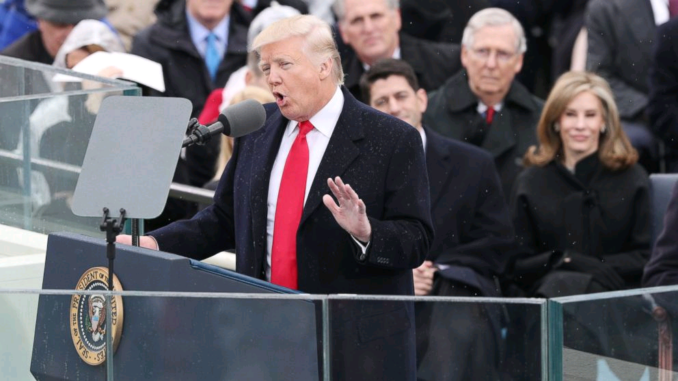
President Donald Trump used a high-profile primetime address in July to place election security at the center of the national conversation, warning Americans that the country’s voting infrastructure remains vulnerable to manipulation and foreign interference. The speech, delivered from the White House, revived some of Trump’s longstanding claims about the integrity of American elections while introducing allegations based on newly declassified intelligence and government documents.
Trump’s address came at a politically sensitive moment, with the 2026 midterm elections approaching and election security already emerging as one of the most divisive issues in American politics. In the speech, he argued that weaknesses in electronic voting and ballot-counting systems could threaten public confidence in future elections. The White House subsequently highlighted documents concerning alleged foreign interference, voter data and vulnerabilities in election infrastructure.
The president’s message was forceful: Americans, he argued, should not simply assume that every part of the electoral system is secure. Trump pointed specifically toward voting technology and alleged foreign access to American voter information. His remarks were immediately met with sharply different reactions. Supporters described the speech as an important warning about weaknesses that deserve greater scrutiny, while critics accused the president of recycling misleading claims and undermining confidence in elections.
The debate illustrates how difficult it has become to separate legitimate concerns about election cybersecurity from political arguments about election legitimacy.
A Speech Centered on Election Security
Trump’s decision to devote a primetime address to election security was significant. Presidential addresses are generally reserved for moments of major national importance, making the decision to focus national attention on voting systems particularly consequential.
Before the speech, administration officials indicated that Trump would discuss newly declassified material relating to election interference and alleged vulnerabilities in voting machines. Reuters reported that the president was expected to argue that voting infrastructure could be susceptible to manipulation while also revisiting allegations surrounding the 2020 election.
The White House presented the address as an effort to expose information that officials believed had previously been withheld from the public. Administration statements said the documents pointed to foreign election interference and vulnerabilities within U.S. election infrastructure.
That framing was central to Trump’s argument. Rather than presenting election security as a narrow technological issue, he connected it to national sovereignty, foreign influence and public trust.
For Trump and his supporters, the underlying question was whether Americans can be certain that their votes are being accurately recorded and counted. For critics, the more immediate concern was whether repeatedly emphasizing alleged vulnerabilities without demonstrating widespread manipulation could itself damage confidence in elections.
Voting Machines Become a Political Flashpoint
One of the most prominent subjects surrounding the address was electronic voting equipment.
Trump has repeatedly criticized voting machines, arguing that electronic systems can potentially be hacked or manipulated. During the July address, he again raised concerns about vulnerabilities in voting technology. FactCheck.org reported that Trump warned about weaknesses in election infrastructure but did not provide evidence demonstrating widespread election fraud.
There is an important distinction between saying that technology can have vulnerabilities and proving that those vulnerabilities have been exploited to change election outcomes.
Virtually every complex technological system has potential weaknesses. Election administrators, cybersecurity researchers and voting-security specialists have spent years examining ways to protect voting equipment, election-management systems and voter-registration databases.
The existence of a vulnerability, however, does not automatically establish that an election was compromised.
That distinction became one of the central points of disagreement following Trump’s speech.
Critics argued that the president moved from legitimate discussions about cybersecurity to broader suggestions that American elections themselves could not be trusted. Supporters countered that acknowledging vulnerabilities is necessary precisely because election officials need to identify weaknesses before hostile actors can exploit them.
The challenge for voters is determining where evidence ends and political interpretation begins.
Foreign Interference Takes Center Stage
Trump also emphasized the possibility of foreign involvement in American elections.
Foreign interference is not an imaginary threat. U.S. intelligence agencies have documented attempts by foreign governments to influence American political activity, including efforts involving Russia and other countries. The question is not whether foreign actors may attempt to interfere, but how effective those efforts are and whether they actually alter votes or election outcomes.
Trump’s administration pointed toward newly declassified documents involving China and other alleged foreign activities. The White House said the material demonstrated that foreign adversaries had obtained American voter information and that election infrastructure faced serious risks.
But independent assessments and fact-checking organizations challenged some of the broader conclusions drawn from the material.
CBS News reported that Trump made claims about Chinese access to voter data, noncitizen voting and voting machines that required significant context.
That distinction matters because voter data and voting systems are not necessarily the same thing. A foreign government obtaining voter-registration information does not, by itself, demonstrate that votes were altered.
Likewise, evidence that election technology could theoretically be attacked does not establish that an attacker successfully changed the outcome of an election.
The 2020 Election Still Looms Over the Debate
Perhaps the most politically significant aspect of Trump’s speech was its connection to the 2020 presidential election.
Trump has continued to argue that the election he lost to Joe Biden was affected by widespread irregularities. Courts, election officials and multiple reviews rejected claims that widespread fraud changed the result.
The July address nevertheless revived many of the themes associated with Trump’s post-2020 campaign over election integrity. Reuters reported that the president’s speech renewed his longstanding attacks on election security despite intelligence assessments that found no evidence that China affected the outcome of the 2020 vote.
That history made the speech especially controversial.
For Trump’s supporters, revisiting the subject was justified because they believe unanswered questions remain about election administration and foreign influence.
For his critics, bringing the 2020 election back into a national address was an attempt to reopen a dispute that has already been examined extensively.
The controversy is not simply about what happened in 2020. It is also about what Americans should expect when future elections produce results that one side does not like.
Why Election Trust Matters
Democratic elections depend on more than ballots and voting machines. They depend on public confidence.
If voters believe that their ballots are being accurately counted, they are more likely to accept election results even when their preferred candidate loses. If large numbers of voters believe the system is rigged, however, every close election can become a source of political instability.
That is why Trump’s speech generated concern among election experts.
The president has a powerful platform. When he says that the nation’s election infrastructure is vulnerable, millions of Americans listen. His words can encourage legitimate scrutiny, but they can also amplify unverified claims.
FactCheck.org noted that Trump warned of what he described as serious vulnerabilities while failing to demonstrate that widespread fraud had actually occurred.
That distinction is critical.
Election security experts can acknowledge that voting systems must be protected while rejecting unsupported claims that the systems have been systematically manipulated.
Both things can be true at the same time: election infrastructure requires constant cybersecurity protection, and there may be no evidence that vulnerabilities have been used to overturn an election.
A Larger Fight Over Federal Power
The speech also fits into a broader political battle over who should control American elections.
Under the U.S. constitutional system, states play a central role in administering elections. Election procedures can therefore differ significantly from one state to another.
Trump’s broader election agenda has sought greater federal involvement in issues such as voter eligibility, election administration and voting procedures.
That approach has produced legal and political battles.
The controversy intensified in August when the Supreme Court allowed part of Trump’s effort to restrict mail-in voting to proceed while litigation continued over other elements of his executive order. Reuters reported that the court’s decision involved a 6-3 ruling concerning an injunction against restrictions related to mail voting.
The developments demonstrate that Trump’s election-security campaign extends well beyond speeches. It has increasingly involved executive action, litigation and disputes between the federal government and states.
Supporters See a Necessary Warning
Trump’s supporters view his approach differently.
They argue that election officials should never dismiss cybersecurity concerns simply because discussing them is politically uncomfortable. In their view, the president is forcing Americans to confront weaknesses that have been overlooked for too long.
They point to the increasing sophistication of cyberattacks, foreign influence campaigns, artificial intelligence and digital misinformation as reasons for greater vigilance.
From this perspective, asking whether voting systems are secure is not an attack on democracy. It is an essential part of protecting democracy.
Supporters also argue that transparency is preferable to secrecy. If intelligence agencies possess information about election vulnerabilities, they believe the public should eventually be informed.
That argument has broad appeal, particularly at a time when Americans are increasingly concerned about cyber threats.
Critics Fear the Damage to Public Confidence
Critics, however, see a different danger.
They argue that repeatedly emphasizing unproven election-fraud claims can create a self-reinforcing cycle in which voters become convinced that elections are illegitimate before voting even begins.
That could have serious consequences.
A voter who believes the system is rigged may decide that participating is pointless. A candidate who loses may refuse to concede. Political supporters may reject certified results. Election workers may face increased harassment and threats.
In this sense, critics argue that election misinformation can become a security threat of its own.
Recent reporting has highlighted growing concerns among political leaders and election experts about the potential for election-related disinformation, including the use of artificial intelligence and fabricated media.
The irony is that a campaign intended to protect election integrity could, if handled irresponsibly, weaken public trust in the very system it claims to defend.
The Challenge Ahead
The controversy surrounding Trump’s address is unlikely to disappear.
Election security will remain a major issue as Americans approach the midterm elections. Voting machines will continue to be examined. Voter-registration databases will remain targets for cybersecurity efforts. Foreign governments will continue attempting to influence American politics.
The appropriate response is neither complacency nor panic.
Election officials need resources to protect voting infrastructure. Cybersecurity specialists need access to systems so they can identify weaknesses. Voters deserve transparent explanations about how their ballots are protected and counted.
At the same time, serious allegations require serious evidence.
A claim that an election system is vulnerable should lead to investigation. It should not automatically be transformed into a claim that an election was stolen.
That distinction is especially important in a polarized political environment.
A Speech With Consequences Beyond Election Day
Trump’s primetime address was ultimately about more than voting machines.
It was about trust.
Trust in election officials. Trust in technology. Trust in intelligence agencies. Trust in government institutions. And, perhaps most importantly, trust in the democratic process itself.
Trump has made election integrity a defining political issue, and his July speech gave that campaign an unusually large national platform. The White House presented the address as an effort to expose foreign interference and vulnerabilities that officials believe threaten American elections.
Critics saw the same speech as another chapter in Trump’s longstanding effort to cast doubt on election results and promote claims that lack sufficient evidence.
The truth is that election security deserves serious attention. American voting systems, like any technological infrastructure, must be continuously tested, audited and protected. Foreign interference is a genuine national-security concern, and voter information must be safeguarded.
But protecting elections also means protecting voters from misinformation.
The strongest election system is not one that claims to have no vulnerabilities. It is one that identifies weaknesses, fixes them, independently audits results and provides enough transparency for citizens to understand why they can trust the outcome.
Trump’s address has therefore opened a debate that goes well beyond one presidential speech. The question facing Americans is not simply whether voting systems have vulnerabilities. The deeper question is whether the country can confront those vulnerabilities honestly without turning legitimate security concerns into political weapons.
As the next elections approach, that balance may prove just as important as the technology itself. The credibility of American democracy will depend not only on how votes are cast and counted, but also on whether citizens believe the process remains worthy of their confidence.
Leave a Reply