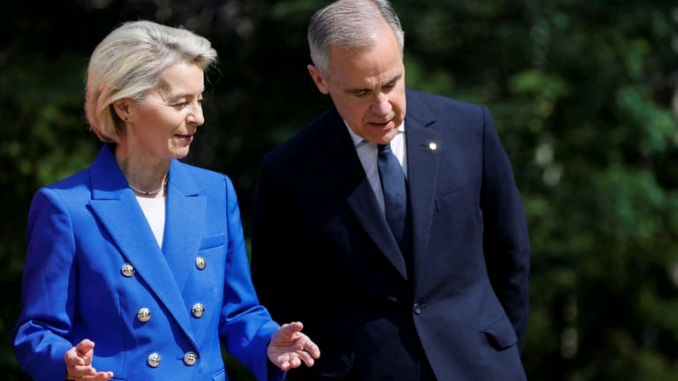
Canadian Prime Minister Mark Carney is set to take his increasingly international economic and diplomatic agenda to Europe next month, where he will attend the European Union’s annual State of the Union address and deliver his own speech to the European Parliament.
Carney is expected to travel to Strasbourg, France, on Sept. 16 to attend European Commission President Ursula von der Leyen’s annual State of the Union address before European lawmakers. He is then expected to address the European Parliament himself on Sept. 17. The visit comes at an important moment for Canada, as Ottawa faces renewed trade tensions with the United States and looks to strengthen relationships with other major economic partners.
The trip is more than a ceremonial appearance. It reflects the growing importance both Canada and the European Union are placing on their relationship at a time when the global economic and political order is becoming increasingly uncertain.
For Carney, the European visit provides an opportunity to reinforce his government’s message that Canada needs a broader range of economic, security and diplomatic partnerships. For the EU, having the Canadian prime minister present at one of its most important annual political events offers a chance to highlight its own relationship with a country that shares many of its democratic and economic interests.
A significant invitation
The State of the Union address is one of the European Union’s most closely watched annual political events. Von der Leyen uses the speech to outline the EU’s priorities and challenges for the year ahead, speaking directly to the European Parliament in Strasbourg.
Carney’s presence as a guest gives the occasion an additional international dimension.
European Parliament President Roberta Metsola has described Carney as a guest of honor and welcomed the opportunity to deepen ties between Canada and the European Union. Carney’s planned appearance also comes with the expectation that he will address European lawmakers directly the following day.
That sequence matters politically. Carney will not simply be watching European leaders discuss the future of the bloc. He will have a platform of his own to present Canada’s position on international trade, security, democratic cooperation and the changing global economy.
The timing could hardly be more significant.
Canada’s relationship with the United States is under pressure
Carney’s European trip comes as relations between Canada and the United States are experiencing another period of serious tension.
Trade negotiations between Ottawa and Washington broke down last week, with both sides taking increasingly aggressive positions. Canada has responded to U.S. tariffs with retaliatory measures, while President Donald Trump has threatened further increases on Canadian vehicles and other products.
According to recent reporting, Canada plans to impose tariffs on more than 700 American imports beginning Sept. 8, with the measures valued at about $20 billion. Trump has also threatened to raise tariffs on Canadian cars and trucks to 50 percent from Jan. 1, 2027.
The dispute is particularly important because the United States remains Canada’s overwhelmingly dominant trading partner. For decades, geography and deep economic integration have made the American market central to Canada’s economic strategy.
But Carney has increasingly argued that Canada cannot rely on that relationship alone.
The deterioration in Canada-U.S. trade has therefore given new urgency to Ottawa’s efforts to expand its connections with Europe, Asia and other major markets.
Europe represents one of the most attractive alternatives.
A closer Canada-EU partnership
Canada and the European Union already have a major trade relationship through the Comprehensive Economic and Trade Agreement, commonly known as CETA.
But Carney’s government now wants to explore how much further that relationship can go.
The Canadian prime minister has recently spoken about building a much stronger economic and security partnership with the European Union. His government is particularly interested in cooperation involving critical minerals, energy, defence, technology and investment.
Those areas are important to both sides.
Canada has significant supplies of critical minerals such as lithium, nickel and graphite. These resources are increasingly valuable as European countries seek to reduce their dependence on China for key industrial materials.
For Europe, developing reliable supply chains with Canada could strengthen its economic security.
For Canada, closer European ties could create new markets and investment opportunities while reducing its dependence on the United States.
The relationship is therefore not simply about replacing American trade. It is about building a more diversified economic network.
Critical minerals could become a major area of cooperation
Critical minerals are likely to be one of the most important subjects in Canada’s discussions with Europe.
The global competition for lithium, nickel, graphite and rare earth elements has intensified because these resources are essential to electric vehicles, batteries, renewable energy systems, advanced manufacturing and defence technologies.
Canada has considerable reserves and has been seeking ways to attract investment into its mining and processing industries.
The European Union, meanwhile, is looking for more dependable suppliers outside China.
That creates a natural area of cooperation.
Canada could provide Europe with access to resources, while European companies could bring capital, technology and expertise to Canadian projects.
A stronger partnership could also involve processing and manufacturing rather than simply exporting raw materials.
That would fit with Carney’s broader emphasis on building stronger domestic industries and ensuring Canada captures more economic value from its natural resources.
Defence is another important link
The Canada-EU relationship is also becoming more significant in defence.
European governments have dramatically increased their focus on defence capabilities as a result of Russia’s war against Ukraine and growing uncertainty about the future of transatlantic security arrangements.
Canada has traditionally been closely tied to the United States through NATO, but Ottawa is increasingly seeking additional partnerships.
The EU has also created mechanisms designed to strengthen European defence production and cooperation with trusted partners.
Canada’s participation in European defence initiatives has created another potential bridge between Ottawa and Brussels.
That makes Carney’s September visit relevant beyond trade.
It could help establish a broader framework in which Canada and Europe cooperate on security, defence industries, critical infrastructure and strategic supply chains.
Carney’s message to European lawmakers
When Carney addresses the European Parliament, European lawmakers will likely be watching closely for clues about Canada’s future foreign-policy direction.
The Canadian prime minister has repeatedly promoted the idea that middle powers need to work together in a world where larger countries increasingly use economic strength as political leverage.
That argument has particular resonance in Europe.
The European Union itself is attempting to protect its economic interests while maintaining strategic relationships with the United States and other major powers.
Canada’s experience with Washington gives Carney an opportunity to make the case for greater cooperation among democratic middle powers.
His speech could therefore focus on resilience, trade diversification, economic security and the importance of defending a rules-based international system.
The message is likely to be carefully calibrated.
Canada does not want to abandon its relationship with the United States. The two countries remain deeply connected economically, militarily and geographically.
Instead, Carney appears to be arguing that Canada’s national interests require more options.
Europe is one of those options.
Europe also has something to gain
The relationship is not one-sided.
European governments have their own reasons for strengthening ties with Canada.
The EU faces a complicated global environment. It must manage competition with China, uncertainty in its relationship with the United States, the continuing war in Ukraine and pressure to build greater economic and military independence.
Canada offers several advantages.
It is a stable democracy with extensive natural resources, a sophisticated financial system, advanced industries and a strong defence relationship with European countries.
It also shares many of Europe’s political values.
Those similarities make Canada a relatively comfortable partner for European governments looking to diversify their economic and strategic relationships.
The EU is therefore likely to view Carney’s visit as an opportunity rather than merely a diplomatic courtesy.
A summit is also on the horizon
Carney’s September appearance will not be the end of the Canada-EU engagement.
A Canada-EU summit is planned for later in the year, with reporting indicating that Ottawa and Brussels are preparing for further discussions on economic and security cooperation.
That means the September visit could serve as an important political lead-in.
Carney can use his time in Strasbourg to strengthen relationships with European leaders and lawmakers before more detailed negotiations take place.
The discussions could cover trade, investment, energy, critical minerals, defence, technology and international security.
If both sides can translate political enthusiasm into concrete agreements, the relationship could become one of the most important elements of Canada’s foreign economic strategy.
Canada is not seeking EU membership
The growing relationship should not be confused with Canada seeking to become an EU member.
Canada remains geographically outside Europe and has no current pathway to EU membership.
Instead, Ottawa is pursuing a closer strategic partnership while maintaining its independence.
That distinction is important.
The goal is to develop a relationship that gives Canada greater access to European markets and institutions without requiring membership in the European Union.
For European governments, such an arrangement could also be attractive because it would allow them to strengthen cooperation with Canada without fundamentally changing the structure of the bloc.
The result could be a model of partnership that goes beyond traditional free-trade relations.
A message to Washington
Perhaps the most politically significant aspect of Carney’s European visit is the message it sends to Washington.
For years, Canada’s economic strategy was built around the assumption that the United States would remain its overwhelmingly dominant market.
That assumption is now being challenged.
Carney’s decision to strengthen ties with Europe does not necessarily represent a rejection of the United States. Instead, it demonstrates Canada’s willingness to develop alternatives if its relationship with Washington becomes increasingly unpredictable.
That could give Ottawa greater negotiating leverage.
If Canada can expand its trade relationships elsewhere, it becomes less vulnerable to sudden disruptions in U.S. policy.
The European Union cannot replace the United States as Canada’s primary trading partner overnight, and there are obvious limits to how quickly trade can be redirected.
But diversification does not require replacing one market with another.
It requires creating enough alternatives that Canada is not dependent on a single economic relationship.
A pivotal moment for Carney
For Carney personally, the September visit will be another test of his ability to translate his international experience into political influence.
Before becoming prime minister, Carney built a reputation as a prominent central banker and economic policymaker. His understanding of international financial systems has shaped much of his approach to Canada’s economic challenges.
Now he is attempting to use that experience in a political environment defined by tariffs, geopolitical competition and uncertainty.
Europe gives him a receptive audience.
European leaders have their own concerns about economic coercion, supply-chain vulnerabilities and strategic dependence. Many of the issues Canada is confronting are issues Europe is also trying to address.
That creates common ground.
Carney’s challenge will be turning that common ground into practical results.
A speech can strengthen diplomatic relationships, but trade agreements, investment commitments and defence partnerships require sustained negotiations.
The road ahead
Carney’s appearance at the EU State of the Union address comes at a moment when Canada is redefining its place in a changing international system.
The United States will remain essential to Canada’s economy and security. But Ottawa is increasingly determined to avoid putting all of its strategic interests in one basket.
Europe offers an obvious partner.
The September visit will provide Carney with a high-profile platform to reinforce Canada’s commitment to closer European ties and explain why cooperation among democratic middle powers matters at a time of growing geopolitical uncertainty.
His presence alongside von der Leyen in Strasbourg will also be closely watched as a symbol of how quickly Canada-EU relations have evolved.
For Europe, Carney’s visit is an opportunity to welcome a like-minded partner at a difficult time.
For Canada, it is a chance to demonstrate that the country has alternatives and that its international relationships can extend well beyond Washington.
The immediate focus will be on Carney’s meetings, his speech and the issues discussed with European officials. But the larger significance will likely be measured over the months and years that follow.
If Canada and the European Union can convert their current political momentum into deeper trade, investment, defence and strategic cooperation, Carney’s September visit could become an important milestone in Canada’s effort to build a more diversified and resilient international strategy.
With trade tensions with the United States still unresolved, the message from Ottawa is increasingly clear: Canada intends to strengthen its ties with partners it considers reliable, and Europe is moving rapidly toward the center of that strategy.
Carney’s appearance at the EU’s State of the Union address will therefore be more than a diplomatic photo opportunity. It will be a visible sign of Canada’s changing approach to the world—and of Europe’s growing importance in that new strategy.
Leave a Reply