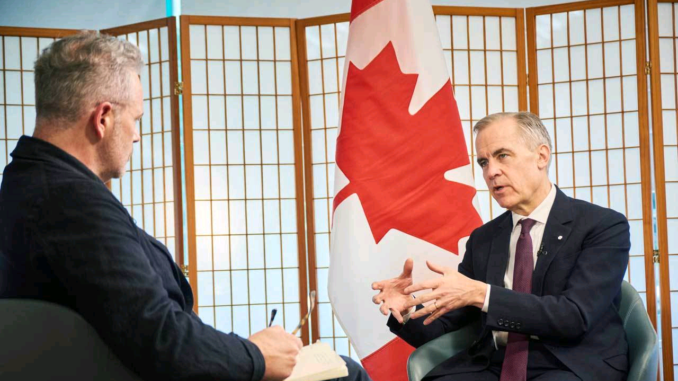
For Mark Carney, few challenges are more difficult than confronting the United States while knowing that Canada cannot simply walk away from its most important economic partner.
That is the central dilemma facing the Canadian prime minister as his government enters one of the most difficult periods in Canada-U.S. relations in decades. Carney has made it clear that Canada will not accept trade terms it considers unfair, even when those terms are being demanded by a much larger neighbour with enormous economic power. At the same time, he knows that geography, supply chains, investment and decades of commercial integration make the United States impossible to ignore.
The result is a high-stakes balancing act. Carney must demonstrate strength without turning the dispute into a permanent rupture. He must defend Canadian sovereignty without allowing economic retaliation to inflict unnecessary damage on Canadian workers and businesses. And he must persuade Canadians that standing up to President Donald Trump is worth the potential economic pain.
That balance is becoming harder to maintain.
Recent trade negotiations between Ottawa and Washington collapsed, prompting Canada to announce retaliatory tariffs on U.S. goods. The move came after Washington imposed new tariffs affecting Canadian exports, including a 50% tariff on certain goods. Carney responded by promising dollar-for-dollar retaliation while maintaining that Canada remains willing to negotiate a mutually beneficial agreement.
That combination of firmness and openness may ultimately define Carney’s approach.
Canada cannot afford to choose between principle and pragmatism
Carney’s political challenge is unusually complicated because both sides of his argument are valid.
Canada has every reason to defend its economic interests. Allowing another country to impose increasingly aggressive trade conditions without responding could undermine confidence in Canada’s ability to protect its industries and workers. For Carney, accepting every demand from Washington would also create a dangerous precedent.
But there is another reality that cannot be ignored.
The Canadian economy is deeply connected to the United States. According to Reuters, roughly 70% of Canada’s exports go to the American market. That dependence gives Washington enormous leverage and makes a prolonged trade war particularly risky for Canadian businesses.
Canadian manufacturers, farmers, energy producers and exporters cannot simply replace the American market overnight.
That is why Carney’s challenge is not merely about winning a political argument with Trump. It is about protecting Canada’s long-term interests while minimizing the economic consequences of confrontation.
A leader can afford to walk away from a bad deal. It is much harder to walk away from your biggest customer.
Trump has changed the rules of the relationship
For decades, Canada and the United States operated under an assumption that economic integration was mutually beneficial and relatively stable. Companies built supply chains across the border. Manufacturers depended on components moving between the two countries. Farmers relied on access to consumers on both sides of the border.
That relationship has not disappeared, but the assumptions supporting it have been shaken.
The current trade dispute has demonstrated that economic integration can also become a source of vulnerability. The Associated Press recently described the situation as a severe test of one of the world’s closest and most durable alliances.
Carney has clearly recognized that reality.
His government has increasingly talked about diversification, stronger relationships with Europe and Asia, and reducing Canada’s dependence on the United States. That strategy makes economic sense in the long run. If Canada has more trading partners, Washington will have less ability to use Canadian dependence as leverage.
But diversification takes time.
It requires infrastructure, investment, new agreements, new customers and companies willing to change established business models. A Canadian exporter that has spent decades building relationships in the United States cannot suddenly redirect its entire operation toward Europe or Asia simply because political relations with Washington have deteriorated.
This is where Carney’s balancing act becomes particularly difficult.
He needs to prepare Canada for a future in which dependence on America is reduced, while simultaneously protecting the economic relationship that still matters most today.
Standing up to Trump has political benefits
Carney also has a domestic political incentive to remain firm.
Canadians have shown significant support for the government’s decision to take a harder line with Washington. An Angus Reid Institute poll released this week found that 76% of Canadians believed the government was right to walk away from the latest trade negotiations. At the same time, however, two in five Canadians expressed concern about their jobs.
Those numbers reveal the contradiction at the heart of the crisis.
Canadians may want their government to stand up to Trump, but they do not necessarily want to pay a large economic price for doing so.
That distinction will become increasingly important if tariffs begin to translate into higher prices, layoffs, reduced investment or factory closures.
For now, Carney can point to national unity and public support as evidence that his strategy is working politically. Opposition parties have also largely supported the government’s determination to defend Canadian interests.
But political support can be fragile.
A consumer who applauds a tough response to Washington may feel differently if the cost of groceries rises. A worker who supports Carney’s rhetoric about Canadian sovereignty may become less enthusiastic if a factory closes because exports to the United States have become too expensive.
That is why the next phase of the dispute will test Carney more severely than the opening exchanges.
The danger of turning a negotiation into a permanent confrontation
There is a significant difference between being prepared to fight and allowing a fight to become permanent.
Carney appears to understand that distinction. Even after the collapse of negotiations, he has continued to emphasize that the bonds between Canadians and Americans remain strong and that a mutually beneficial agreement is possible.
That message matters.
The United States is not simply another trading partner. Canada and America share a border, extensive security arrangements, deeply integrated industries and millions of personal relationships.
The relationship extends far beyond tariffs.
Canadian energy supports American consumers and industries. American companies employ Canadians. Canadian manufacturers depend on American suppliers, while American manufacturers rely on Canadian materials and components. Agriculture, transportation, technology and financial services are all connected across the border.
A prolonged breakdown would hurt both sides.
That gives Carney something important to work with: leverage does not always come from being bigger. Sometimes it comes from being indispensable.
Canada may be smaller economically, but it remains deeply embedded in the American economy.
Carney’s task is to remind Washington of that interdependence without pretending that Canada has equal economic power.
The risk of overestimating Canada’s alternatives
Diversification is an important part of Carney’s strategy, but it should not become an illusion.
Canada can develop new markets. It can deepen trade relationships with Europe and Asia. It can encourage domestic investment and strengthen internal trade. It can build infrastructure that allows Canadian goods to reach global markets more efficiently.
But none of those options can immediately replace the United States.
That reality should shape the government’s strategy.
The smartest approach may not be to abandon the American market but to make Canada less vulnerable to American political decisions. There is an important difference.
Canada does not need to stop trading with America. It needs to ensure that a future American administration cannot threaten the Canadian economy without facing meaningful consequences of its own.
That means building alternatives while preserving the existing relationship.
It is a strategy that requires patience rather than dramatic gestures.
Carney’s background may shape his response
Carney’s experience as a central banker gives him a different perspective from many political leaders.
His career has involved navigating financial crises, managing uncertainty and communicating confidence when markets are nervous. Those skills are useful in a trade confrontation where psychology can be almost as important as policy.
Businesses need predictability.
Investors need confidence.
Workers need reassurance.
Foreign governments need to understand where Canada stands.
Carney therefore has to communicate two messages simultaneously: Canada will not surrender its interests, but Canada is not seeking a permanent economic war with the United States.
That is a difficult message to deliver because political rhetoric often rewards simplicity. It is easier to say that Canada is standing up to Trump than to explain the complicated economic calculations behind every tariff and negotiation.
But the second message is ultimately more important.
The biggest test may come later
The immediate political environment appears to favour Carney. His decision to take a tougher stance against Washington has generated support, and the trade dispute has strengthened a sense of Canadian national unity.
The economic consequences, however, could take longer to emerge.
Reuters has reported warnings that the consequences of the trade conflict could eventually include job losses and factory closures, with as many as 90,000 Canadian jobs potentially at risk under some tariff scenarios.
If those warnings become reality, Carney’s political advantage could begin to disappear.
That would force him into an even more difficult position.
He would need to explain why the confrontation remains necessary, while also showing Canadians that his government has a credible plan to protect them from its consequences.
In other words, winning the argument will not be enough. Carney will eventually have to demonstrate results.
A relationship Canada cannot simply replace
The most important thing for Carney may be recognizing that standing up to America does not require turning away from America.
Canada can reject unfair demands without rejecting its neighbour. It can retaliate against tariffs while keeping diplomatic channels open. It can diversify its economy while continuing to trade heavily with the United States.
That middle ground is difficult, but it is probably the only sustainable path.
The collapse of recent negotiations does not necessarily mean the end of Canada-U.S. cooperation. The economic ties between the two countries are simply too extensive. Even as tensions rise, both governments have powerful incentives to find an eventual off-ramp. Analysts have noted that hundreds of billions of dollars in annual trade and highly integrated industries give both sides reasons to avoid an irreversible rupture.
Carney’s greatest challenge, therefore, is not proving that Canada can fight back.
It is proving that Canada can fight back intelligently.
He must convince Trump that Canada cannot be pushed around, while convincing Canadian businesses that the government understands the economic risks of confrontation. He must build new international partnerships without pretending those relationships can instantly replace the United States. And he must maintain domestic support while the costs of the trade dispute become clearer.
That is an extraordinary leadership test.
Carney is dealing with a partner that is larger, richer and capable of imposing enormous economic pressure on Canada. Yet the United States also has something to lose. The two economies are so interconnected that neither can completely escape the consequences of a prolonged conflict.
The wisest Canadian strategy may therefore be neither surrender nor separation.
It is resilience.
Carney needs to make Canada strong enough to say no when necessary, flexible enough to negotiate when possible and diversified enough that no single partner can hold the entire economy hostage.
For now, that balancing act is becoming the defining test of his leadership.
Standing up to Trump may be politically popular. Preserving America’s place as Canada’s most important economic partner while doing so will be much harder.
And ultimately, that is the real challenge facing Mark Carney: not choosing between Canada and America, but finding a way to defend Canadian interests without destroying the relationship that Canada still cannot afford to lose.
Leave a Reply