College football has always been big business in Texas, but the numbers attached to the state’s biggest coaching jobs have reached another level.
In 2026, two Texas-based head coaches are making more than $10 million annually, while several others are earning salaries that would have been considered extraordinary for a college coach only a few years ago. The figures reflect how dramatically the sport has changed as television revenue, conference realignment, recruiting competition, name, image and likeness opportunities, expanded postseason expectations and the transfer portal have transformed the job.
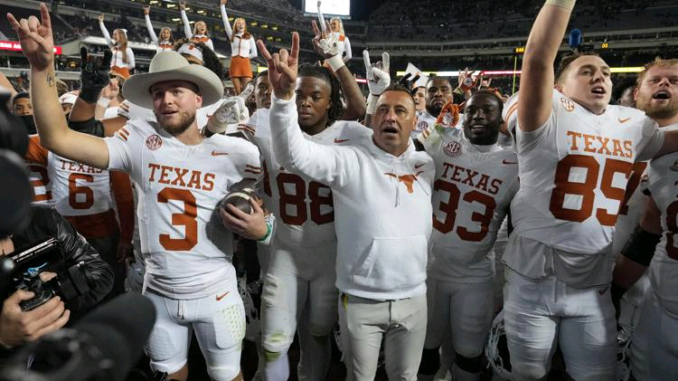
At the top of the Texas salary list is University of Texas head coach Steve Sarkisian, who is scheduled to make about $11.05 million in 2026 before incentives. Texas A&M coach Mike Elko follows at approximately $10.75 million. Those numbers put both coaches among the highest-paid head coaches in the country.
The money, however, is about more than simply winning football games.
Modern college football coaches at major programs are effectively running enormous organizations. They oversee staffs, recruiting operations, player development, fundraising relationships, public relations, transfer-portal strategy and increasingly complicated roster-management decisions. At schools in Texas, where football carries an unusually powerful cultural and financial presence,7 expectations are even higher.
Steve Sarkisian sits at the top
Sarkisian’s rise to the top of the Texas coaching salary rankings is closely connected to the transformation of the Longhorns under his leadership.
When he arrived at Texas in 2021, his original contract was worth $34.2 million over six years. His compensation has since grown substantially as the program has progressed.
For 2026, Sarkisian is scheduled to earn approximately $11.05 million before incentives. His salary is expected to increase in subsequent years, with his contract reportedly calling for annual compensation to rise beyond $12 million by the end of the deal.
That is an enormous number, but Texas is not paying Sarkisian simply to coach quarterbacks or design offensive plays.
The Longhorns expect him to compete for championships.
Texas moved from the Big 12 into the SEC, placing the program in arguably the most competitive conference environment in college football. Every season now carries enormous financial and competitive implications. A successful Texas team can generate national television exposure, recruiting momentum, ticket demand, merchandise sales and greater interest from donors and corporate partners.
Sarkisian’s offensive reputation also matters. His ability to develop quarterbacks and build an attractive offensive system has become an important part of Texas’ recruiting pitch.
In other words, the salary is an investment in the entire football operation.
Mike Elko has quickly entered the $10 million club
Texas A&M’s Mike Elko is another example of how quickly coaching salaries can rise when a program believes it has found the right person.
Elko returned to College Station in 2023 after previously serving as Texas A&M’s defensive coordinator. He inherited a program with enormous resources and equally enormous expectations.
His original deal called for approximately $7 million annually, excluding incentives. After a strong start to his tenure and a major improvement in the program’s trajectory, Elko received a six-year extension that pushed his 2026 compensation to roughly $10.75 million.
That jump illustrates one of the central realities of modern college football: successful coaches become extremely expensive to retain.
Texas A&M cannot afford to lose a coach it believes can consistently compete in the SEC. The Aggies operate in a conference where Alabama, Georgia, LSU, Texas and other programs have demonstrated their willingness to spend heavily on coaching, recruiting and player personnel.
Elko’s value is therefore connected not only to his win-loss record but also to his ability to establish stability.
That matters in an era when coaches can leave quickly and players can transfer with unprecedented ease.
Sonny Dykes remains one of Texas’ better-paid coaches
TCU head coach Sonny Dykes is another prominent name on the list.
Dykes has already taken the Horned Frogs to the highest level of the sport, leading TCU to an undefeated regular season and a College Football Playoff national championship appearance during the 2022 season.
His reported compensation has varied depending on the source and contract calculations. USA Today’s salary database previously listed his annual figure at roughly $7.04 million, while other recent salary listings place him around the $7 million mark.
That puts Dykes comfortably among the highest-paid coaches in the state.
TCU does not have the same enrollment or athletic-revenue profile as Texas or Texas A&M, but the football program has demonstrated that it can compete nationally.
The 2022 season changed perceptions of what TCU could accomplish. Dykes’ ability to build a winning program while competing against much larger brands gives the university a strong reason to maintain a substantial investment in its head coach.
Joey McGuire’s salary has climbed rapidly
Texas Tech’s Joey McGuire provides another example of the escalation happening throughout the state.
McGuire’s compensation is listed at approximately $6.5 million for 2026 in current salary rankings.
That figure represents a significant increase from the salary levels associated with the Texas Tech job only a few years ago.
McGuire arrived with a strong reputation as a recruiter and program builder. His background in Texas high school football gave him extensive relationships across the state, an especially valuable asset for a program competing for players against Texas, Texas A&M, TCU and other major programs.
Texas Tech also operates in a rapidly changing Big 12.
The Red Raiders have increased their investment in football because remaining competitive requires more than hiring a coach and hoping for improvement. Schools now have to spend aggressively on staff, facilities, recruiting and player retention.
McGuire’s salary reflects that reality.
Why are these coaches paid so much?
The obvious answer is winning.
But winning is only part of the equation.
A successful head coach can influence virtually every major revenue-producing component of a college athletic department. Football drives television exposure, attendance, merchandise sales, sponsorships and donor interest.
That makes the head coach an unusually valuable employee.
At Texas, for example, the football program is one of the most recognizable brands in American college athletics. The university is not simply competing with other schools for victories. It is competing for national attention.
The same is true at Texas A&M.
The Aggies have one of the largest and most passionate fan bases in college football. Their move into the SEC intensified the importance of having a coach capable of competing at the highest level.
The financial stakes are therefore enormous.
If a university pays a coach $10 million but believes that coach can help generate significantly more value through winning, exposure and sustained interest, the salary can be viewed as a business investment rather than simply an expense.
Recruiting has changed the coaching job
Another reason salaries have exploded is recruiting.
College football recruiting is no longer limited to evaluating high school prospects and signing them during the traditional recruiting cycle.
Coaches now have to manage high school recruiting, transfer recruiting and player retention simultaneously.
The transfer portal has created another layer of competition. A coach must constantly evaluate whether his roster has enough depth and whether key players are likely to remain with the program.
At the same time, NIL opportunities have changed the recruiting landscape.
Coaches do not personally control every aspect of NIL, but they are central to convincing players that a particular program offers the right combination of development, exposure, winning potential and financial opportunity.
That requires an extensive support system.
A head coach must manage coordinators, position coaches, recruiting personnel, analysts, strength staff and administrators. The modern program resembles a large organization more than the relatively simple football operations of previous generations.
The SEC effect cannot be ignored
Texas’ coaching salaries also make more sense when viewed through the lens of conference realignment.
Texas and Texas A&M are now SEC programs, and that means their financial competition is directly tied to some of the wealthiest athletic departments in college sports.
SEC schools routinely compete for the same coaches and players.
If one program increases its investment, another may feel pressure to respond.
The result is a coaching salary arms race.
Texas does not want to lose Sarkisian to another major program. Texas A&M does not want Elko becoming a target for another SEC school. Even programs outside the SEC, such as TCU and Texas Tech, must spend enough to remain competitive for recruits and coaching talent.
That helps explain why salaries that once seemed extraordinary are increasingly becoming normal at the top of the sport.
The pressure is just as large as the paycheck
There is another side to these massive salaries.
The expectations are enormous.
A coach making more than $10 million annually will not be judged simply on whether his team has a winning record. Fans expect conference championships, playoff appearances and, ultimately, national championships.
At Texas, anything short of competing for the biggest prizes can generate questions.
At Texas A&M, the expectations are similarly intense.
At TCU and Texas Tech, the challenge is slightly different. Those programs may not have the same financial resources as Texas and Texas A&M, but their coaches are still expected to build teams capable of competing with programs that spend aggressively.
The bigger the salary, the smaller the margin for error.
The coaching market is unlikely to slow down
The most important point about these salaries may be what they say about the future of college football.
The sport is becoming increasingly professional in structure, even as it remains rooted in the university system.
Players have greater financial opportunities. Conferences are generating enormous media-rights revenues. Athletic departments are expanding their support operations. Recruiting has become more sophisticated. And the best coaches have become increasingly valuable commodities.
Texas is at the center of that transformation.
Sarkisian’s $11.05 million salary and Elko’s $10.75 million figure demonstrate how much major programs are willing to invest in leadership. Dykes and McGuire show that the financial escalation extends beyond the two largest brands in the state.
There is also a broader strategic reason for these contracts: continuity.
In the transfer-portal era, stability has become difficult to maintain. Coaches can leave. Players can transfer. Staff members can move to other programs.
A long-term contract is therefore partly an attempt to create certainty.
Universities want coaches who can build systems rather than simply produce one successful season.
What these salaries really represent
It is easy to look at an $11 million coaching salary and conclude that the number is simply excessive.
But the economics of college football are far more complicated.
These coaches operate programs that generate enormous interest and revenue. They are responsible for recruiting and developing players, managing staffs, representing universities publicly and competing against some of the richest athletic departments in the country.
Their salaries reflect the value universities place on success.
Of course, a massive contract is never a guarantee of a championship. College football remains unpredictable, and even the highest-paid coach can have a disappointing season.
But Texas universities are clearly willing to pay enormous sums to improve their odds.
For now, Steve Sarkisian sits at the top of the state’s coaching salary hierarchy, with Mike Elko close behind. Sonny Dykes and Joey McGuire are also earning multimillion-dollar salaries that reflect the escalating cost of competing in major college football.
And if the recent trajectory is any indication, these numbers may look surprisingly modest before long.
The coaching arms race in Texas is not just about who can draw up the best game plan on Saturday.
It is about who can recruit the best players, retain the best talent, build the strongest staff, satisfy demanding fan bases and keep a program positioned to compete for championships.
In today’s college football economy, that responsibility comes with an extraordinary price tag.
Leave a Reply