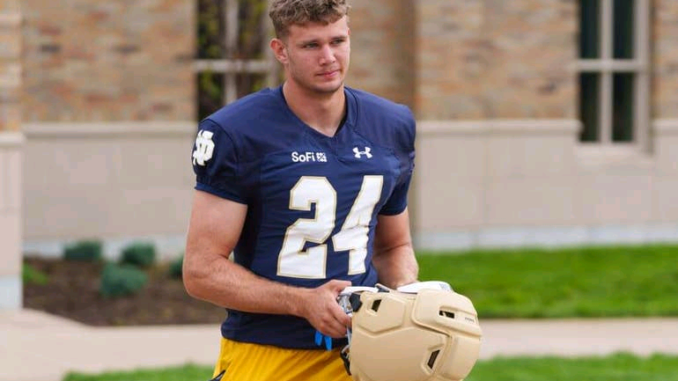
Football programs, signing a five-star freshman is an invitation to get that player onto the field as quickly as possible. Elite recruits are usually brought in with the expectation that they will compete immediately, challenge veterans and eventually become the foundation of the program.
At Notre Dame in 2026, however, the equation is different.
The Fighting Irish have reached a point where an elite freshman can arrive in South Bend with enormous expectations and still find himself fighting for a limited number of meaningful snaps. That is not necessarily a sign that the freshman class has disappointed. In fact, it may be one of the strongest indications that Marcus Freeman’s program has taken another step forward.
Notre Dame enters the 2026 season with remarkable depth across its roster. Recent reporting from fall camp has highlighted just how difficult it has become to separate players at several positions, with Freeman acknowledging that multiple groups remain intensely competitive because there are simply so many capable players.
That creates an unusual situation for the Irish.
The question is no longer simply whether Notre Dame has enough talent. It is whether there are enough snaps for all of that talent.
Five-star status does not guarantee a starting job
Recruiting rankings create expectations long before players ever put on a college uniform. A five-star recruit is generally viewed as someone capable of becoming an immediate difference-maker.
Notre Dame’s 2026 recruiting class reflects the success of the program’s recent recruiting efforts. The class has been ranked among the nation’s best and includes multiple five-star prospects, along with a large group of four-star players.
But recruiting rankings only tell part of the story.
Once a player arrives on campus, coaches have to evaluate far more than athletic ability. Knowledge of the playbook, physical development, blocking technique, tackling consistency, ball security, practice habits and overall reliability all influence playing time.
That is particularly important at Notre Dame this year because the Irish are not entering the season with a roster desperate for young players to fill holes.
They have veterans.
They have experienced transfers.
They have players who have spent one or more seasons developing within the program.
And now they have another talented freshman class trying to break into the rotation.
That is a completely different challenge from what many elite recruits experience when they arrive at a program with obvious weaknesses.
Depth is changing the freshman equation
Notre Dame’s current roster illustrates the depth Freeman has built.
The official 2026 roster contains experienced players at virtually every major position, while also featuring a large group of freshmen waiting for their opportunities.
At defensive line, for example, Notre Dame has veteran players competing alongside young talent. The Irish also strengthened the position through the transfer portal, including former Alabama five-star Keon Keeley and former Pittsburgh defensive lineman Francis Brewu.
That matters because defensive line is one of the areas where freshmen often need time to adjust to college football.
A highly rated freshman may have extraordinary physical tools, but he is still competing against players who have already experienced college practices, strength programs and game situations.
The same principle applies throughout the roster.
If a veteran player is consistently making fewer mistakes and performing at a high level, there may be little reason for Notre Dame to rush a freshman onto the field simply because of his recruiting ranking.
That is the luxury of depth.
Rodney Dunham could represent the biggest test
Among Notre Dame’s 2026 freshmen, Rodney Dunham is one of the names that naturally attracts attention.
The defensive lineman arrived with a five-star reputation and was regarded as one of the top prospects in the recruiting class. Notre Dame’s official signing-day materials list him among the program’s incoming freshmen.
Dunham has the type of physical profile and recruiting pedigree that makes fans want to see him immediately.
But defensive line is also one of the deepest areas on the roster.
That means the coaching staff can take a long-term approach.
Instead of asking whether Dunham is talented enough to play, the more relevant question may be whether playing him extensively right away is necessary.
There is an important distinction.
A freshman can be good enough to play without necessarily being one of the best options at his position on day one.
Notre Dame can afford to develop a player gradually if experienced alternatives are available. Dunham can contribute in specific packages, receive meaningful opportunities and continue developing without being forced into a massive workload before he is ready.
That could ultimately benefit both the player and the program.
The same story could unfold at other positions
Dunham is not the only freshman who could face this situation.
Notre Dame’s 2026 roster includes freshmen at wide receiver, running back, linebacker, cornerback, safety, offensive line, tight end and quarterback.
That is an enormous number of young players competing for opportunities.
At wide receiver, for instance, the Irish have experienced players already established on the roster. The presence of veterans means freshmen such as Dylan Faison, Kaydon Finley, Devin Fitzgerald and Bubba Frazier will have to earn opportunities rather than simply inherit them.
The situation is similar at running back, where Notre Dame has several players competing for touches.
A freshman running back can be incredibly talented and still struggle to receive a large workload when the coaching staff trusts experienced backs.
The same can be said for the secondary.
Young defensive backs often need time to learn how to handle college receivers, communicate within complex coverages and avoid the mental mistakes that can turn a routine play into a touchdown.
Notre Dame’s depth allows Freeman and his defensive staff to be selective.
If a freshman is ready, he can play.
If he needs more time, there is less pressure to throw him into the fire.
Quarterback is an especially interesting situation
The quarterback position offers another example of how unusual Notre Dame’s roster situation has become.
CJ Carr enters the 2026 season as an established piece of the Irish offense, while freshmen Noah Grubbs and Teddy Jarrard are also listed on the roster.
For Grubbs and Jarrard, simply being highly regarded prospects does not automatically create an opportunity.
Quarterback is different from almost every other position because there is typically one primary starter. Even if two freshmen are talented enough to play at the college level, there may not be a realistic path to regular game snaps unless the circumstances change.
That makes patience especially important.
The goal is not necessarily to get every talented freshman onto the field immediately.
The goal is to make sure those players are developing so that when their opportunity arrives, they are ready to take advantage of it.
Playing time is not the same as development
This is an important point for Notre Dame fans to remember.
A freshman’s value should not be measured exclusively by the number of snaps he receives during his first season.
Some players make immediate impacts.
Others spend their first year learning.
Both paths can lead to successful careers.
In fact, a freshman who plays a limited role in 2026 could become one of Notre Dame’s most important players in 2027 or 2028.
The modern college football environment has made player development more complicated because the transfer portal provides alternatives when players believe they are buried on a depth chart.
That makes roster management increasingly important.
Notre Dame has to balance the desire to develop young players with the need to keep talented players engaged and committed to the program.
If a freshman sees limited playing time but understands that he has a clear developmental path, the situation can be manageable.
If he believes he has no realistic future on the field, the transfer portal becomes a much bigger factor.
Freeman’s challenge is a good one to have
Marcus Freeman’s job is now different from the job he inherited.
Programs trying to rebuild typically worry about finding enough talent.
Notre Dame increasingly has the opposite problem.
It has to determine how to distribute opportunities among a roster filled with capable players.
Recent reporting on fall camp described Notre Dame’s depth as one of the biggest takeaways from the preseason, with competition particularly strong at defensive tackle and linebacker.
That kind of competition can raise the standard across the entire team.
Veterans know they cannot become complacent.
Transfers understand that their previous accomplishments do not guarantee a starting position.
Freshmen learn that recruiting rankings do not automatically earn them playing time.
Everybody has to compete.
That is exactly the environment Freeman wants.
Notre Dame does not need to force the issue
There is also a strategic reason to avoid rushing freshmen.
Notre Dame has championship aspirations.
The Irish do not need to prove that their recruiting classes are successful by playing young stars simply because fans want to see them.
They need to put the best possible lineup on the field.
If an experienced player is better prepared to execute against a major opponent, that player should receive the snaps.
If a freshman eventually proves he is the better option, the coaching staff can adjust.
That competition should make Notre Dame stronger.
The best-case scenario is not that five-star freshmen dominate immediately.
The best-case scenario is that they push veterans, earn roles naturally and become increasingly important as the season progresses.
A slow start could actually be a positive sign
It would be easy to look at a five-star freshman playing limited snaps and conclude that something has gone wrong.
At Notre Dame in 2026, that conclusion could be misleading.
A freshman sitting behind an experienced starter may simply mean the roster is deep.
A freshman playing in specific situations may mean the coaching staff is carefully managing his development.
A freshman spending more time learning than playing may mean Notre Dame believes his future is more important than forcing immediate production.
There will certainly be moments when the young players earn larger roles.
Injuries will happen. Matchups will change. Players will improve. Coaches will discover new strengths.
College football seasons rarely follow the depth chart exactly as it appears in August.
That is why the freshman situation should be viewed as fluid.
The bigger picture for Notre Dame
Ultimately, Notre Dame’s 2026 freshman playing-time dilemma says something much bigger about the state of the program.
For years, elite recruiting has been about collecting enough talent to compete with the best teams in the country.
Now the Irish appear to have reached the point where the challenge is managing the talent they have accumulated.
The 2026 recruiting class is another example of that progress. Notre Dame signed a class with multiple five-star prospects and a substantial number of blue-chip players.
But talent alone does not win championships.
Development does.
Depth does.
Competition does.
And eventually, the ability to identify which players deserve the biggest moments matters most.
For Notre Dame’s five-star freshmen, the message entering 2026 is therefore relatively simple: be patient, keep improving and make the coaching staff’s decision difficult.
They may not all become immediate starters.
They may not all receive major workloads.
Some may spend Saturdays watching experienced teammates handle the biggest moments.
But that does not mean they are failing.
It may mean Notre Dame has finally built the kind of roster where elite freshmen have to earn their place rather than being handed one.
That is an unusual battle for a five-star recruit.
For Notre Dame, however, it is a problem the program should be happy to have.
Leave a Reply