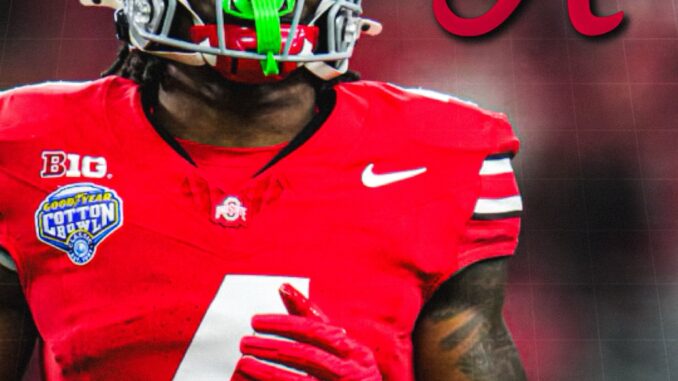
Ohio State wide receiver Jeremiah Smith has never been one to shy away from defending his reputation, and this week he made his feelings clear after a claim surfaced suggesting that the Alabama Crimson Tide stopped actively recruiting him because of Name, Image, and Likeness (NIL) concerns.
The highly regarded receiver quickly pushed back against the narrative, making it known that the story being circulated did not reflect his experience during one of the most closely followed recruiting battles in recent college football history. His response has reignited discussions about the role NIL plays in recruiting while also highlighting how easily narratives can take on a life of their own once they spread across social media.
Smith entered college football with enormous expectations after finishing as one of the top prospects in the nation. Throughout his recruitment, nearly every major program in the country pursued him, including Alabama, Georgia, Florida State, Miami, and Ohio State. His combination of elite speed, size, route-running ability, and athleticism made him one of the most sought-after wide receivers in his recruiting class.
When he ultimately chose Ohio State, many observers viewed it as another major recruiting victory for the Buckeyes, who have established themselves as one of the nation’s premier destinations for elite wide receivers. Ohio State’s track record of developing NFL-caliber talent at the position was a significant selling point, and Smith believed the program offered the best environment for his long-term growth.
Recently, however, renewed discussion about his recruitment emerged after comments suggested Alabama had backed away from pursuing Smith because of NIL-related issues. According to that claim, financial considerations allegedly influenced the Crimson Tide’s recruiting strategy and led the program to reduce its pursuit.
Smith wasted little time addressing the suggestion.
Rather than allowing speculation to continue, he publicly challenged the claim, indicating that the version of events being shared was inaccurate. His response made it clear that he did not believe Alabama’s recruitment ended because of NIL negotiations or financial disagreements.
Although Smith did not offer an exhaustive account of every conversation that took place during his recruitment, his comments were enough to cast doubt on a storyline that had quickly gained traction among fans and analysts.
His reaction reflects a broader issue within modern college football recruiting. Because so much of the recruiting process now unfolds in public through social media, podcasts, interviews, and message boards, conflicting stories often emerge after a player commits elsewhere.
In many cases, coaches, recruiting insiders, fans, and former players each offer different interpretations of why a prospect ultimately chose one school over another.
The rise of NIL has only added another layer of complexity.
Since athletes gained the ability to profit from their name, image, and likeness, recruiting conversations have changed dramatically. While coaching staffs continue to emphasize player development, facilities, academics, relationships, and opportunities to compete for championships, NIL has become an undeniable factor for many recruits.
That reality has fueled constant speculation whenever a top prospect changes schools or commits to a particular program.
As a result, many recruiting decisions are immediately linked to financial opportunities, even when players themselves insist other factors played a larger role.
Smith’s response serves as a reminder that recruiting decisions are rarely based on a single issue.
For elite athletes, choosing a college often involves weighing numerous factors. Relationships with coaches, offensive systems, NFL development, campus culture, proximity to family, academic support, and championship aspirations all play important roles.
While NIL opportunities certainly influence recruiting in today’s landscape, they are rarely the only consideration.
For Smith, Ohio State represented an ideal fit because of the program’s reputation for producing elite wide receivers.
Over the past several years, the Buckeyes have developed an impressive list of NFL stars at the position. Players such as Garrett Wilson, Chris Olave, Jaxon Smith-Njigba, Marvin Harrison Jr., and Emeka Egbuka all emerged from Ohio State before advancing to professional football.
That consistent record of success helped establish Ohio State as one of the nation’s premier destinations for receivers hoping to prepare for the NFL.
Smith has already demonstrated why many recruiting experts believed he could become the next player to follow that path.
His freshman season showcased remarkable maturity, explosive playmaking ability, and the confidence expected from one of the country’s top recruits. Despite facing experienced college defenses, Smith consistently created separation, made contested catches, and displayed the physical tools that made him such a coveted prospect coming out of high school.
Those performances have only strengthened his standing as one of college football’s brightest young stars.
Meanwhile, Alabama continues to recruit at an elite level under head coach Kalen DeBoer.
Although the Crimson Tide missed out on Smith, the program has remained one of the nation’s strongest recruiting powers, consistently signing highly ranked classes filled with future NFL talent.
Missing on an individual recruit, even one as talented as Smith, is simply part of the reality of modern recruiting.
Every elite program wins some recruiting battles and loses others.
The renewed discussion surrounding Smith’s recruitment also illustrates how stories can evolve long after commitments become official.
Years after a player signs with a school, new claims often emerge regarding what happened behind the scenes. Sometimes those accounts come from former staff members, recruiting analysts, or individuals close to various programs.
Other times, players themselves choose to correct what they believe are inaccurate versions of events.
That appears to be what happened in Smith’s case.
By publicly responding, he ensured his perspective became part of the conversation rather than allowing speculation to stand uncontested.
His willingness to address the topic also reflects the growing influence athletes now have over their own narratives.
In previous generations, players often had limited opportunities to respond directly to rumors. Today, social media allows athletes to speak instantly to millions of followers, clarifying misinformation or challenging reports they believe are inaccurate.
That shift has fundamentally changed how recruiting stories unfold.
Instead of relying solely on media reports or anonymous sources, fans increasingly hear directly from the athletes involved.
For Ohio State supporters, Smith’s response reinforces confidence that their star receiver remains focused on the present rather than revisiting recruiting battles from the past.
His attention appears firmly fixed on helping the Buckeyes compete for Big Ten championships, College Football Playoff appearances, and ultimately a national title.
As one of the team’s offensive leaders, Smith enters the upcoming season carrying enormous expectations. Opposing defenses are expected to build game plans specifically designed to limit his production, yet many analysts believe his combination of talent and work ethic will continue to make him one of the nation’s most dangerous offensive weapons.
His ability to respond confidently off the field mirrors the confidence he displays every Saturday on it.
Ultimately, the discussion surrounding Alabama’s recruitment of Jeremiah Smith serves as another example of how college football recruiting remains a subject of endless debate. With NIL continuing to reshape the sport, stories involving finances are likely to remain common whenever elite prospects make headline-grabbing decisions.
However, Smith’s public response reminds fans that recruiting is often far more complicated than a single explanation. Programs recruit for numerous reasons, athletes choose schools based on a variety of personal priorities, and the complete story is rarely known outside the people directly involved.
For Jeremiah Smith, what matters most now is not revisiting recruiting rumors but continuing to build on a remarkable start to his college career. Whether critics speculate about past recruiting decisions or not, his focus remains on performing at an elite level for Ohio State and proving why he was considered one of the most gifted prospects in recent memory.
Leave a Reply