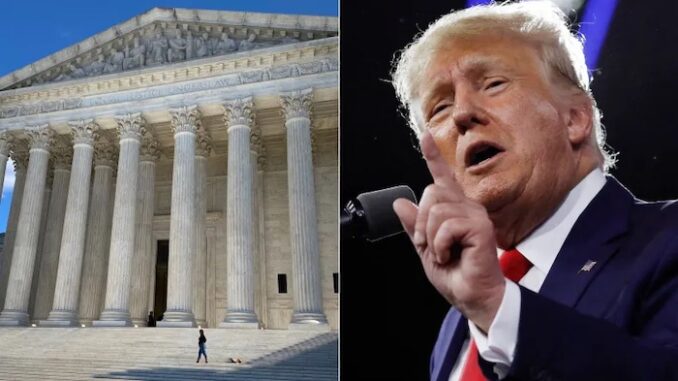
In one of the most consequential constitutional rulings of the year, the U.S. Supreme Court has struck down President Donald Trump’s executive order seeking to limit birthright citizenship for children born in the United States to undocumented immigrants and certain temporary visa holders. The decision marks a major setback for the administration’s immigration agenda and reaffirms a constitutional principle that has stood for well over a century.
The Court ruled 6-3 overall in Trump v. Barbara, although only five justices agreed that the Constitution itself directly protects birthright citizenship under the Fourteenth Amendment, while one justice reached the same outcome on statutory grounds. The ruling means President Trump’s executive order cannot be enforced, preserving the long-established understanding that nearly every child born on American soil is automatically a U.S. citizen.
The case centered on one of the most debated issues in American immigration policy. Shortly after returning to office in January 2025, President Trump signed an executive order declaring that children born in the United States to parents who were in the country illegally or temporarily would no longer automatically receive U.S. citizenship. The administration argued that such children were not “subject to the jurisdiction” of the United States as required by the Citizenship Clause of the Fourteenth Amendment.
That interpretation immediately sparked legal challenges from states, civil rights organizations, immigrant advocacy groups, and affected families. Multiple federal courts blocked the executive order before it could take effect, concluding that it conflicted with both the Constitution and long-standing Supreme Court precedent.
Those challenges ultimately reached the nation’s highest court, where the justices were asked to determine whether a president could redefine birthright citizenship through executive action.
Writing for the majority, Chief Justice John Roberts concluded that the executive order could not be reconciled with the text and history of the Fourteenth Amendment. The opinion emphasized that the Citizenship Clause has consistently been understood to grant citizenship to nearly every person born within the United States, with only a handful of recognized exceptions such as children born to foreign diplomats.
The Court also relied heavily on the landmark 1898 decision in United States v. Wong Kim Ark, which established that children born in the United States to foreign parents are American citizens under the Constitution. That ruling has served as the foundation for birthright citizenship for more than 125 years and has been repeatedly cited by courts across the country.
According to the majority, nothing in the Constitution permits a president to unilaterally narrow that guarantee through an executive order.
Although six justices agreed the executive order must be struck down, the legal reasoning was not unanimous. Five members of the Court concluded that the Fourteenth Amendment itself clearly guarantees citizenship to children born in the United States regardless of their parents’ immigration status. Another justice agreed that the order was unlawful but based that conclusion primarily on federal immigration statutes rather than the Constitution.
Three conservative justices dissented, arguing that the Citizenship Clause has been interpreted too broadly over time and should not automatically apply to children whose parents are in the country unlawfully or only temporarily. Their dissent reflects an ongoing constitutional debate that has existed in legal circles for decades, though it remains a minority view under current Supreme Court precedent.
The ruling represents a significant defeat for President Trump, who has made immigration enforcement a defining issue of both his presidential campaigns and his second administration. Ending or restricting birthright citizenship had long been one of his most ambitious immigration proposals, with supporters arguing it would discourage illegal immigration and so-called “birth tourism.”
However, critics maintained that the proposal directly contradicted the Constitution and threatened one of America’s oldest legal principles governing citizenship.
By rejecting the executive order, the Supreme Court effectively confirmed that any attempt to fundamentally change birthright citizenship would likely require a constitutional amendment or action by Congress consistent with constitutional limits—not unilateral action by the president.
Legal experts say the decision preserves stability in the nation’s citizenship laws. Had the executive order been upheld, hundreds of thousands of children born annually in the United States could have faced uncertainty over their citizenship status, affecting everything from passports and Social Security benefits to education and future employment opportunities.
The decision also avoids what many scholars warned could have become an administrative and legal nightmare. Government agencies would have faced the enormous task of determining a newborn’s citizenship based on the immigration status of parents, creating complicated legal questions and potentially inconsistent outcomes across the country.
Immigrant rights organizations welcomed the ruling, describing it as a victory for constitutional protections and equal treatment under the law. They argued that citizenship should never depend on the legal status of a child’s parents and praised the Court for preserving a principle that has defined American citizenship since the Reconstruction era.
Supporters of President Trump expressed disappointment with the outcome, arguing that the Court missed an opportunity to reconsider the meaning of the Fourteenth Amendment in light of modern immigration challenges. Some allies of the president have suggested Congress should explore legislative options, although constitutional experts note that any law conflicting with the Court’s interpretation would almost certainly face immediate legal challenges.
The case also highlights the continuing importance of the Supreme Court in resolving major constitutional disputes involving presidential authority. Throughout Trump’s second term, the administration has aggressively tested the limits of executive power across several policy areas, making the Court an increasingly central player in defining those limits.
For many constitutional scholars, the decision reinforces an enduring principle: while presidents possess significant executive authority, they cannot override constitutional guarantees through executive orders alone.
The ruling is expected to have lasting implications well beyond the current administration. Future presidents seeking to alter citizenship rules through executive action will now face a strengthened Supreme Court precedent reaffirming that birthright citizenship remains firmly rooted in the Fourteenth Amendment.
As political debate over immigration continues in Washington, the Supreme Court has delivered a clear message that one of the nation’s oldest constitutional protections remains intact. For now, children born on American soil will continue to receive U.S. citizenship regardless of whether their parents are undocumented immigrants or temporary visitors, preserving a legal tradition that has shaped American identity for generations.
The decision stands as one of the most significant constitutional rulings of the year, underscoring both the enduring power of the Fourteenth Amendment and the Supreme Court’s role as the final interpreter of the Constitution. While political battles over immigration are certain to continue, the Court has reaffirmed that fundamental questions of citizenship cannot be rewritten by executive order alone.
Leave a Reply