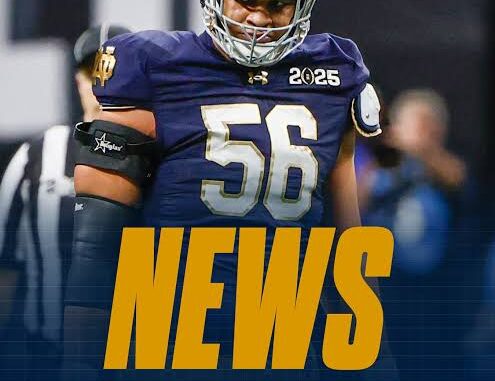
The excitement surrounding the start of Notre Dame’s fall training camp received a dose of reality when head coach Marcus Freeman provided an early injury update, confirming that standout offensive lineman Charles Jagusah will not participate at the beginning of camp. While the news is certainly disappointing for the Fighting Irish, Freeman made it clear that the coaching staff remains optimistic about Jagusah’s long-term outlook and is focused on ensuring he returns only when he is fully healthy.
As Notre Dame begins preparations for another highly anticipated season, every position group is under close evaluation. Among them, the offensive line has drawn significant attention, not only because of its importance to the team’s success but also because of the expectations surrounding Jagusah, who has been viewed as one of the program’s most promising young linemen.
Freeman addressed reporters during his opening media session for fall camp, outlining the team’s initial injury report while emphasizing that player health remains the top priority. Although several players are working through minor ailments common at the beginning of preseason practices, Jagusah’s absence was the most notable development.
The head coach did not indicate that the injury is expected to keep Jagusah out for an extended period, but he also declined to place a firm timetable on the offensive lineman’s return. Instead, Freeman stressed that the medical staff will continue monitoring his recovery and that the program will avoid rushing him back before he is ready.
That cautious approach has become increasingly common across college football. Teams competing for conference championships and College Football Playoff berths understand that preserving key contributors for the long season ahead often outweighs the benefits of having them participate in every preseason practice.
For Notre Dame, Jagusah’s importance extends beyond his physical abilities.
The former highly regarded recruit has steadily developed into one of the most talented offensive linemen on the roster. Coaches have consistently praised his combination of size, athleticism, strength, and football intelligence. Those qualities have positioned him as a player expected to contribute significantly to the Fighting Irish offensive line this season.
His absence from the opening days of camp naturally creates opportunities for other players.
One of the advantages of preseason practices is the opportunity for younger athletes and backups to receive valuable repetitions against top competition. Without Jagusah available, several offensive linemen will likely receive increased practice snaps as coaches continue evaluating depth throughout the unit.
Competition has long been one of Marcus Freeman’s core philosophies.
Rather than relying solely on preseason expectations, Freeman has encouraged players to earn playing time through consistent performance during practices. That approach means temporary absences often create opportunities for teammates to demonstrate their readiness.
The offensive line remains one of the most critical position groups for Notre Dame entering the season.
A productive offensive front influences nearly every aspect of a football team’s success. Strong offensive line play creates running lanes for the rushing attack, protects the quarterback during passing situations, and establishes the physical identity that Freeman has emphasized since becoming head coach.
Maintaining continuity along the offensive line can be challenging even under ideal circumstances. Injuries, position changes, and ongoing competition frequently require coaching staffs to adjust combinations throughout preseason camp.
The absence of an experienced player like Jagusah makes those evaluations even more important.
Freeman acknowledged that the coaching staff has confidence in the players currently available. He expressed belief that the offensive line possesses quality depth and that preseason competition will ultimately strengthen the group regardless of temporary setbacks.
That confidence reflects the work Notre Dame has invested in recruiting and developing offensive linemen over several recruiting cycles.
The Fighting Irish have built a national reputation for producing NFL-caliber offensive linemen. Numerous former Notre Dame players have gone on to successful professional careers, making the program an attractive destination for elite offensive line recruits.
Developing that tradition requires constant competition.
Each preseason camp becomes an opportunity for younger players to demonstrate that they are capable of maintaining the standard established by previous Notre Dame offensive lines.
Jagusah’s temporary absence may accelerate the development of several teammates who otherwise would have received fewer practice opportunities.
Freeman has repeatedly emphasized throughout his tenure that championship-caliber teams require depth at every position. Modern college football seasons are physically demanding, making it unlikely that any team will navigate an entire schedule without injuries.
Preparing multiple players to contribute is therefore considered essential.
The coaching staff will undoubtedly use the opening weeks of camp to evaluate numerous lineup combinations. Those experiments may ultimately prove valuable later in the season, regardless of when Jagusah returns.
Beyond the injury update, Freeman expressed enthusiasm about the team’s overall energy entering camp.
Players returned to campus following offseason conditioning with noticeable enthusiasm, reflecting months of preparation in the weight room and classroom. Coaches praised the team’s commitment during summer workouts and indicated that competition has already intensified across multiple position groups.
Notre Dame enters the season carrying substantial expectations.
The Fighting Irish have consistently remained among college football’s nationally recognized programs, and expectations surrounding the team remain high each year. Competing for a playoff berth requires strong performances from every position group, making offensive line health especially important.
Protecting the quarterback and establishing a reliable running game often begin with experienced linemen capable of winning battles at the line of scrimmage.
Jagusah was expected to play a major role in those efforts.
Although his absence to begin camp creates uncertainty, Freeman’s comments suggested the staff remains confident in both his recovery and the overall strength of the roster.
Medical staffs throughout college football increasingly emphasize long-term health rather than short-term availability. Advances in sports medicine, rehabilitation techniques, and injury prevention have encouraged coaches to avoid unnecessary risks with important players.
Freeman’s handling of Jagusah appears consistent with that philosophy.
Rather than focusing on immediate participation, the program appears committed to ensuring the offensive lineman is physically prepared before returning to full practice activities.
That patience may ultimately benefit both the player and the team.
Former players frequently note that attempting to return too early can increase the likelihood of setbacks or secondary injuries. Giving athletes adequate recovery time often leads to stronger performances once they rejoin full competition.
Notre Dame fans will naturally continue monitoring Jagusah’s status throughout camp.
Every practice report, injury update, and media availability will likely generate questions regarding his progress. However, Freeman has consistently avoided placing unnecessary pressure on injured players by setting artificial deadlines.
Instead, he has repeatedly emphasized that each athlete recovers differently and that medical professionals guide return-to-play decisions.
The early stages of fall camp also provide coaches with valuable information beyond individual player availability.
Position battles, leadership development, conditioning, communication, and team chemistry all begin taking shape during preseason practices. Even when key players miss time, the overall objective remains preparing the entire roster for the challenges of a demanding regular season.
For Notre Dame, maintaining focus despite early adversity has become part of the program’s culture under Freeman’s leadership.
The head coach has consistently encouraged players to view obstacles as opportunities for growth rather than excuses. That message resonates particularly during preseason camp, when unexpected injuries and roster adjustments are common throughout college football.
While Charles Jagusah’s absence is unquestionably disappointing, it does not diminish the optimism surrounding Notre Dame’s upcoming season. The Fighting Irish possess experienced coaching, talented recruits, and a roster built to compete at the highest level.
Freeman’s confidence in the team’s depth suggests he believes the offensive line can continue developing effectively while Jagusah recovers.
Ultimately, the most important takeaway from Freeman’s injury update is that Notre Dame is prioritizing player health above all else. The decision to hold Jagusah out at the start of camp reflects a long-term approach designed to maximize his contributions when the games matter most.
As fall camp progresses, all eyes will remain on the talented offensive lineman’s recovery. If he returns healthy and performs at the level many expect, this early setback may ultimately be remembered as only a brief pause in what could become an important season for both Charles Jagusah and the Fighting Irish.
Leave a Reply