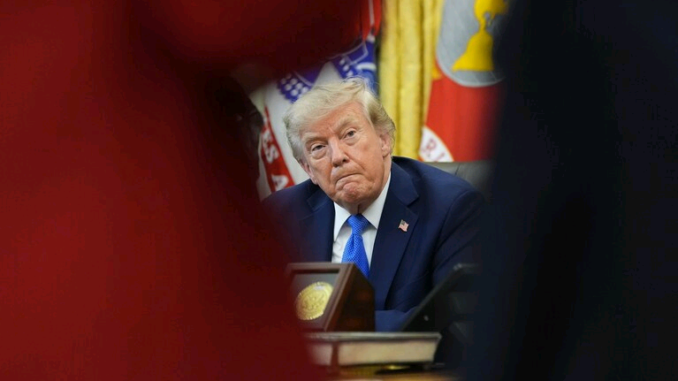
President Donald Trump has entered another defining legal battle as his administration continues to confront the courts over the limits of presidential power. With several major policies facing lawsuits, injunctions and appeals, the relationship between the White House and the judiciary has become one of the most important political and constitutional stories of Trump’s second term.
Trump has never been a president who willingly accepts political or legal resistance. His response to court challenges has generally been to fight harder, appeal decisions and insist that voters gave him a mandate to carry out the program on which he campaigned.
That determination is again being tested as the Supreme Court becomes increasingly involved in disputes surrounding his administration.
The central question is larger than any single policy. It is whether the president can use the considerable authority of the executive branch to move rapidly on issues such as immigration, trade, federal agencies and government operations, or whether courts and Congress can impose meaningful limits when those actions go beyond existing law.
For Trump, the answer is straightforward: he believes the presidency must have enough authority to govern effectively.
For his critics, however, the Constitution deliberately prevents any president from exercising unchecked power.
That disagreement has placed the Supreme Court in an unusually prominent position.
A Presidency Built Around Executive Action
Trump returned to the White House promising to move quickly.
After winning the 2024 election, he entered his second term with an ambitious agenda covering immigration enforcement, tariffs, government restructuring, energy policy, federal employment and executive authority.
The administration moved rapidly, issuing executive orders and implementing major policy changes.
But the speed of Trump’s approach also created legal vulnerabilities.
Opponents of his policies quickly turned to the courts, arguing that some administration actions exceeded presidential authority or violated existing federal law.
The resulting lawsuits have created a complicated situation for the White House. Some policies have survived legal challenges, while others have been temporarily blocked or subjected to lengthy litigation.
Trump has responded by portraying many of the cases as attempts to undermine the will of voters.
His supporters agree.
They argue that a president who has been elected on a clear platform should have sufficient freedom to implement that platform. They believe unelected judges should not be able to dictate national policy from the courtroom.
But the opposing argument is equally important.
The American constitutional system was designed to prevent elections from giving presidents unlimited authority. Winning an election provides political legitimacy, but it does not eliminate legal restrictions.
That is where the Supreme Court comes in.
The Supreme Court Is Not Simply Trump’s Opponent
One of the most important things to understand about Trump’s relationship with the Supreme Court is that it is not a simple story of the president versus nine justices.
Trump appointed three members of the Supreme Court during his first presidency, helping create the court’s current conservative majority.
Yet conservative judges do not automatically support every action taken by a Republican president.
The judiciary operates independently of the White House.
That independence has become increasingly visible during Trump’s second term.
The Supreme Court has issued decisions that have benefited the administration, but it has also imposed restrictions or allowed lower-court decisions limiting presidential action to remain in effect.
For Trump, that creates a complicated political reality.
The court may provide an avenue for the administration to overturn lower-court decisions, but it can also become the institution that ultimately establishes boundaries the White House cannot cross.
Immigration Remains a Major Constitutional Test
Immigration is one of the clearest examples of this struggle.
Trump made immigration enforcement a central part of his campaign and promised to carry out one of the most aggressive immigration programs in modern American history.
His administration has attempted to increase deportations, strengthen border enforcement and change longstanding immigration policies.
Those efforts have produced numerous legal challenges.
The most consequential disputes involve questions about presidential authority and constitutional rights.
One particularly significant controversy has involved Trump’s attempt to change the interpretation of birthright citizenship through executive action.
The administration argued that the executive branch had authority to change the way citizenship protections apply in certain circumstances.
Opponents argued that the president could not rewrite constitutional principles through an executive order.
The dispute demonstrated the fundamental tension between Trump’s desire to move quickly and the legal system’s requirement that presidential actions remain within constitutional boundaries.
The Supreme Court’s involvement has made the issue even more significant because a final ruling could influence the scope of executive authority for years to come.
Trade Policy Creates Another Challenge
Trump’s trade agenda has also placed his administration in the middle of a major legal fight.
Tariffs have been among the most important economic tools of Trump’s presidency.
The administration has used tariffs to pressure foreign governments, protect American industries and reshape the United States’ trade relationships.
Trump has argued that tariffs give him leverage in negotiations and help correct what he considers unfair trade practices.
But questions have emerged about the legal authority used to impose some of those tariffs.
The Supreme Court’s involvement in the tariff disputes has demonstrated how economic policy can become a constitutional question.
The issue is not simply whether tariffs are good or bad for the American economy.
It is whether the president has the authority to impose them under the specific laws invoked by the administration.
That distinction is crucial.
A president may have strong political reasons for taking an action, but political justification does not automatically create legal authority.
Trump has continued defending his tariff strategy, arguing that it serves American economic interests.
Critics contend that major economic decisions should be subject to congressional oversight.
Once again, the courts are being asked to determine where executive authority ends.
The Fight Over Independent Agencies
Another area of tension involves Trump’s efforts to exert greater control over federal agencies.
Trump has argued that the president should have more direct authority over executive officials because the president is ultimately responsible to voters.
This argument reflects a broader legal philosophy sometimes described as the “unitary executive” theory.
The basic idea is that the president should exercise substantial control over the executive branch because the Constitution places executive power in the presidency.
Supporters say stronger presidential control improves accountability.
If voters dislike what the government does, they know whom to blame.
Critics, however, warn that excessive presidential control could weaken independent institutions designed to operate without direct political interference.
The Federal Reserve is one example.
The central bank’s independence has long been considered important to maintaining confidence in monetary policy.
Any presidential attempt to remove or control Federal Reserve officials therefore raises questions that extend beyond Trump’s presidency.
The issue becomes whether the president can remove officials simply because they disagree with his policies or whether Congress can provide protections designed to preserve institutional independence.
The White House Ballroom Dispute
The controversy surrounding Trump’s proposed White House ballroom offers another example of the broader legal struggle.
The administration has argued that the project is important for accommodating large events and improving security and functionality at the White House.
But opponents have challenged the administration’s authority to move forward with the project without congressional authorization.
A federal appeals court has blocked above-ground construction while allowing certain underground work connected to security to continue.
The administration has indicated that it intends to seek Supreme Court intervention.
At first glance, the dispute may seem less consequential than immigration or tariffs.
But constitutionally, it raises an important question about the president’s authority over federal property.
If a president can make major changes to federal facilities without congressional approval, how far does that authority extend?
And if Congress has a role in authorizing such projects, can the executive branch bypass that process?
Those questions could matter long after Trump leaves office.
Trump Believes He Has a Mandate
At the heart of Trump’s resistance is his belief that the 2024 election gave him a mandate.
He campaigned openly on many of the policies now being challenged in court.
From immigration to tariffs, voters knew that Trump intended to pursue major changes.
Trump therefore sees legal challenges as more than technical disputes.
He often frames them as efforts to prevent the administration from delivering on promises made to voters.
That argument resonates strongly with his political base.
Many Trump supporters believe the federal government has become too slow and bureaucratic. They want a president who can make decisions quickly rather than spending years negotiating with Congress or waiting for agencies to act.
Trump’s aggressive governing style appeals directly to that frustration.
But the American constitutional system was not designed for speed alone.
It was designed around competing powers.
The Founding Fathers deliberately created a government in which major decisions could be slowed by disagreements among branches.
That system can be frustrating, but its supporters argue that the friction is intentional.
The Supreme Court Faces Its Own Test
The justices now face the difficult task of deciding how far presidential authority should extend.
They must consider Trump’s policies without becoming part of the political debate surrounding them.
That is easier said than done.
The Supreme Court’s decisions can have enormous political consequences, particularly when the president publicly criticizes the judiciary.
Yet the court’s legitimacy depends on maintaining the perception that decisions are based on law rather than political loyalty.
That makes the coming legal battles particularly important.
If the court consistently sides with Trump, critics may accuse the justices of giving the president excessive power.
If it repeatedly blocks the administration, Trump’s supporters may accuse the judiciary of obstructing the electoral mandate.
The justices therefore have to navigate an increasingly polarized political environment.
A Larger Battle Over the Presidency
Ultimately, Trump’s legal confrontations are about more than Donald Trump.
They are about the future power of the American presidency.
If courts approve broad interpretations of executive authority, future presidents—Democrats and Republicans alike—could inherit those powers.
If courts impose stronger restrictions, future administrations may have less freedom to act without congressional approval.
That is why Trump’s legal battles could have consequences lasting decades.
The decisions being made today may become precedents for presidents who have not yet been elected.
Trump’s supporters may see the fight as an attempt to restore power to the presidency.
His opponents may see it as a warning about the dangers of concentrating too much authority in one office.
Both perspectives point to the same underlying reality: the balance of power is being tested.
The Fight Is Far From Over
Donald Trump has shown little indication that he intends to retreat.
When courts challenge his administration, he appeals.
When policies face legal obstacles, his administration searches for alternative approaches.
When the Supreme Court becomes involved, the stakes become even higher.
The president’s willingness to continue fighting reflects both his political personality and his broader philosophy of government.
Trump believes the presidency should have the strength to act.
The courts insist that presidential action must remain within the law.
Congress maintains that some decisions belong to the legislative branch.
Between those competing positions lies the constitutional balance that has defined the United States for more than two centuries.
Trump’s second term is putting that balance under extraordinary pressure.
The Supreme Court may ultimately determine how far some of his policies can go, but the debate over presidential authority will not disappear with any single ruling.
The deeper question will remain: how powerful should an American president be?
Trump has made his answer clear.
He intends to push the limits.
The courts have made theirs clear as well.
They will decide whether those limits can legally be crossed.
And as the battles continue, the Supreme Court may become the institution that determines not only how much of Trump’s agenda survives, but also how much power future presidents will possess.
Leave a Reply