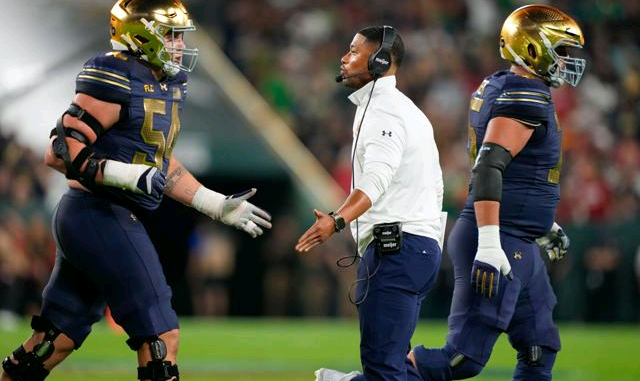
Under the bright lights of Lambeau Field, with a national audience watching and two proud football programs sharing one of the most iconic venues in the sport, Notre Dame delivered the kind of second-half performance that can shape the early narrative of a season.
The No. 4 Fighting Irish defeated Wisconsin 41-13 on Sunday night, overcoming a competitive opening half before taking complete control after halftime. The victory gave Notre Dame a strong start to the 2026 season, while Wisconsin was left to consider what went wrong after a promising first-half showing disappeared into a one-sided finish.
The final score suggested a comfortable Notre Dame victory, but the game was far more competitive early on. Wisconsin showed energy and physicality, refusing to be intimidated by Notre Dame’s lofty preseason expectations. At halftime, the Badgers were still within striking distance, trailing 13-10.
Then everything changed.
Notre Dame came out of halftime with a different level of urgency. The Irish began executing more consistently on offense, while the defense tightened and forced Wisconsin into mistakes. Notre Dame scored 28 unanswered points in the second half, turning a close contest into a decisive victory.
The opening minutes were not exactly what Notre Dame fans had envisioned.
The Irish entered the game ranked No. 4 nationally and carried significant expectations into the season opener. Wisconsin, meanwhile, had the advantage of playing in a stadium deeply familiar to its fan base, even though Notre Dame was officially the home team for the Shamrock Series contest.
Both teams initially struggled to establish rhythm.
Notre Dame eventually settled into the game and built a 10-3 advantage, but Wisconsin answered before halftime. The Badgers showed enough offensive life to keep the pressure on the Irish, and a 13-10 halftime score left plenty of questions about whether Notre Dame would be able to pull away.
For Wisconsin, the first half represented an opportunity.
For Notre Dame, it was a warning.
The Irish knew they would need to play cleaner, more physical football if they wanted to avoid allowing the Badgers to turn the game into a fourth-quarter battle.
They responded emphatically.
One of the biggest stories of Notre Dame’s victory was the performance of running back Aneyas Williams.
Williams finished with 90 rushing yards and two touchdowns, providing Notre Dame with a reliable weapon on the ground when the Irish needed to establish control.
His first touchdown came during a pivotal third quarter in which Notre Dame finally began to separate itself.
The Irish put together a 70-yard scoring drive, capped by Williams finding the end zone. The drive did more than add points to the scoreboard. It shifted the momentum decisively toward Notre Dame.
Wisconsin had been hanging around.
Suddenly, the Badgers were chasing.
Williams later added another touchdown in the fourth quarter, helping Notre Dame finish off what had become a dominant second-half performance.
His production was particularly important because Notre Dame entered the season with questions surrounding its running back rotation. Rather than relying on one player to carry the entire workload, the Irish used multiple backs and found enough production to keep Wisconsin’s defense under pressure.
Quarterback C.J. Carr also played an important role in Notre Dame’s victory.
Carr completed 19 of 29 passes for 239 yards and two touchdowns, providing a steady presence as the Irish offense gradually found its rhythm.
The numbers were not spectacular in the traditional sense, but Carr’s performance was effective.
Most importantly, he avoided letting Notre Dame’s early offensive struggles dictate the rest of the game.
As the contest progressed, Carr became increasingly comfortable. Notre Dame’s passing attack helped keep Wisconsin’s defense from simply loading the box against the running game, while short and efficient throws helped the Irish maintain possession and sustain drives.
Carr eventually connected with tight end James Flanigan for Notre Dame’s first touchdown of the night. Later, he found Nolan James for another score as the Irish put the finishing touches on the victory.
For a young quarterback beginning a highly anticipated season, it was a performance that should provide confidence.
While Notre Dame’s offense deserves plenty of credit, the defense may have delivered the most important momentum-changing play of the night.
In the third quarter, Notre Dame cornerback DJ McKinney intercepted a Wisconsin pass and returned it 55 yards for a touchdown.
The pick-six was devastating for Wisconsin.
The Badgers had just watched Notre Dame take the lead and were still searching for a response. Instead of getting the chance to answer, Wisconsin gave up seven more points almost immediately.
The defensive touchdown transformed the atmosphere.
Notre Dame’s confidence grew, while Wisconsin’s margin for error became almost nonexistent.
From there, the Irish defense continued to make life difficult for the Badgers. Notre Dame recorded two sacks, six tackles for loss and five pass deflections, according to a statistical review of the game.
The defense also benefited from a fumble recovery earlier in the contest.
That ability to capitalize on Wisconsin’s mistakes proved crucial.
Despite the lopsided final score, it would be unfair to suggest that Wisconsin was completely overwhelmed from the opening whistle.
The Badgers competed.
They trailed by only three points at halftime and showed flashes of offensive potential. Malachi Coleman was one of the bright spots for Wisconsin, finishing with 76 receiving yards on four catches.
Quarterback Colton Joseph also faced a difficult assignment against one of the nation’s top-ranked teams. He played all 61 offensive snaps for Wisconsin, although the Badgers ultimately struggled to maintain offensive consistency.
The biggest problem came after halftime.
Wisconsin was outscored 28-3 during the final two quarters.
Missed tackles, stalled drives and difficulty adjusting to Notre Dame’s offensive changes all contributed to the collapse. Wisconsin head coach Luke Fickell acknowledged after the game that his team struggled to adapt, particularly as Notre Dame increased its use of short passes and tempo.
That second-half drop-off will be one of the biggest areas Wisconsin must address moving forward.
Another encouraging element for the Irish was the performance of an offensive line facing plenty of scrutiny entering the season.
Notre Dame entered the game with some uncertainty up front, but the group ultimately gave Carr enough time to operate while creating opportunities for the running backs.
The Irish finished with 350 total yards, compared with Wisconsin’s 284. Notre Dame also held advantages in passing yards, 239-217, and rushing yards, 111-67.
Those numbers demonstrate that Notre Dame did not win simply because of one spectacular play.
The Irish gradually took control in multiple phases.
That is particularly encouraging for a team with aspirations beyond simply winning its opening game.
The setting made the game even more significant.
Lambeau Field is synonymous with football history, and having two major college programs meet there gave the contest an atmosphere unlike a typical Week 1 matchup.
The game was part of Notre Dame’s Shamrock Series, a tradition that takes the Fighting Irish to special venues around the country. The matchup had originally been scheduled for 2020 but was postponed before eventually being moved to the 2026 season.
For Wisconsin, playing at Lambeau added a special element to the season opener. For Notre Dame, winning there added another memorable chapter to the program’s history.
The crowd of more than 75,000 helped create an electric environment, according to attendance reporting.
It was the type of stage designed for a statement performance.
Notre Dame eventually delivered one.
It is still only one game, so it would be premature to declare Notre Dame a championship favorite based solely on the result.
However, the victory provided several encouraging signs.
The Irish showed they could respond to adversity.
They demonstrated offensive balance.
Their defense created turnovers and generated momentum-changing plays.
And perhaps most importantly, they did not panic when Wisconsin challenged them early.
Instead, Notre Dame adjusted.
That ability to improve during a game could prove extremely valuable as the schedule becomes more demanding.
Head coach Marcus Freeman will undoubtedly have areas he wants his team to clean up. The Irish did not play a flawless game, particularly during the opening half. But championship-caliber teams do not necessarily need to be perfect every week. They need to recognize problems and find solutions.
Notre Dame did exactly that against Wisconsin.
For Wisconsin, the loss is painful, but the season is far from over.
The first half demonstrated that the Badgers have the ability to compete against a highly ranked opponent. The challenge now is turning those flashes into four-quarter performances.
Wisconsin will need better tackling, more consistency on offense and improved decision-making.
Fickell emphasized after the game that the Badgers must learn from the experience rather than allow one difficult result to define their season.
That mentality will be important.
A season opener against the No. 4 team in the country is an extremely difficult assignment, and Wisconsin will have opportunities to recover.
Still, the second-half collapse cannot simply be ignored.
The Badgers will need to prove that the problems exposed by Notre Dame were correctable mistakes rather than signs of deeper issues.
By the time the final whistle sounded, Notre Dame had transformed a competitive game into a convincing 41-13 victory.
The Irish outscored Wisconsin 28-3 after halftime, showcasing the depth, physicality and adjustments that helped separate the two teams.
It was not always pretty.
It did not begin with Notre Dame dominating every possession.
But the Irish found another gear when it mattered most.
Williams provided the rushing punch. Carr delivered through the air. McKinney produced the game’s defining defensive touchdown. And Notre Dame’s defense steadily took the game away from Wisconsin.
For Notre Dame, the night ended with exactly what every highly ranked team wants from an opening weekend: a win, valuable lessons and growing confidence.
For Wisconsin, it ended with disappointment but also a clear picture of what needs to improve.
And for college football fans, the Lambeau Field showdown delivered a reminder of why games like this are so compelling.
Two historic programs walked into one of football’s most famous stadiums with something to prove.
By the end of the night, the Fighting Irish had made the louder statement.
The Irish rolled past the Badgers, turned a close first half into a dominant finish and opened their 2026 campaign with a victory that could become an important early chapter in their season.
Leave a Reply