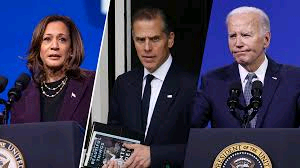
Hunter Biden’s recent criticism of Kamala Harris has reopened old political wounds surrounding the Biden presidency and added another layer of tension to an already complicated relationship between the former vice president and the Biden family.
In a recent interview with journalist Mehdi Hasan, Hunter Biden questioned Harris’s loyalty to his father, former President Joe Biden, and suggested that she was not sufficiently supportive of him during his presidency. When pressed on why he believed Harris had not been loyal, Hunter declined to provide details, saying the matter was private between the two of them.
The remarks have attracted attention because Hunter is not simply another political commentator. As Joe Biden’s son, he has been deeply involved in the former president’s personal and political life, particularly during the final years of the Biden administration. His increasingly outspoken public role has made his opinions on the people surrounding his father especially significant.
The comments also arrive at a time when the Biden family’s relationship with Harris is already under greater scrutiny. Questions about the final months of Biden’s presidency, his decision to seek reelection in 2024, and Harris’s eventual presidential campaign have continued to fuel debate within Democratic circles.
The central issue behind Hunter Biden’s criticism is his perception of Harris’s relationship with Joe Biden.
During the interview, Hunter was asked directly about whether Harris had been loyal to his father while serving as vice president. His answer was critical but deliberately limited. Rather than explain his accusation in detail, Hunter indicated that the specifics were something he would keep between himself and Harris.
That refusal to elaborate may have made the comments even more intriguing.
Hunter has increasingly used interviews and public appearances to offer his personal interpretation of the Biden years. His media presence has expanded considerably, with interviews covering politics, his father’s health, his own personal struggles and the events surrounding the end of Joe Biden’s presidency. The Wall Street Journal recently described his public activity as an expansive media campaign in which he has spoken more openly about subjects he previously avoided.
His criticism of Harris therefore fits into a broader pattern: Hunter appears increasingly willing to challenge the people and political decisions he believes affected his family.
The relationship between Biden and Harris was never simply a matter of political partnership.
Harris became Biden’s running mate in 2020 and served as vice president throughout his administration. She later became the Democratic presidential nominee after Biden withdrew from the 2024 race. Her campaign ultimately ended in defeat against Donald Trump.
The circumstances surrounding Biden’s withdrawal remain a major source of political controversy.
Harris has since offered her own account of those events. In her memoir, she reportedly described Biden and Jill Biden leaving the decision about whether he should seek another term entirely in their hands as “reckless.” She also acknowledged feeling anger and disappointment over Biden’s performance in the 2024 debate against Trump.
Those reflections provide important context for Hunter’s criticism.
From the Biden family’s perspective, Harris’s decision to acknowledge problems surrounding the 2024 campaign could be interpreted as criticism of Joe Biden. From Harris’s perspective, however, discussing those events may simply be part of explaining why her own presidential campaign unfolded as it did.
The disagreement illustrates how differently people inside the Democratic Party remember the final chapter of the Biden presidency.
Hunter Biden’s willingness to discuss political disagreements is not entirely new.
Since leaving the White House era behind, he has become increasingly vocal about his father’s presidency and the people he believes contributed to its difficulties. He has previously criticized individuals whom he believed played a role in encouraging or pressuring Joe Biden to abandon his reelection campaign.
His growing public profile has also included interviews with figures outside traditional Democratic circles. Earlier this year, he appeared on Candace Owens’s podcast, where the conversation focused heavily on his personal experiences, addiction recovery and the intense public scrutiny he has faced.
More recently, Hunter has discussed Democratic politics and possible future presidential candidates. In a September 2026 interview, he praised several Democratic governors, including Andy Beshear, J.B. Pritzker, Gavin Newsom and Josh Shapiro, while Harris was notably absent from that list. He also jokingly entertained the possibility of running for president himself.
That has prompted renewed discussion about Hunter’s political ambitions and whether he intends to become a more influential voice within the Democratic Party.
Despite Hunter’s criticism, his remarks do not necessarily signal the end of Harris’s political career.
In fact, Hunter himself reportedly acknowledged that Harris has a “deep, rich future in politics” and could remain a major figure in Democratic politics heading toward 2028.
That distinction is important.
Hunter’s criticism appears to focus more on his assessment of Harris’s relationship with his father than on an argument that she has no place in the Democratic Party.
Harris remains one of the most recognizable Democratic politicians in the United States. She served as vice president, became the Democratic presidential nominee in 2024 and has maintained a national political profile.
At the same time, her relationship with the Biden political operation is likely to remain complicated.
Much of the tension can be traced back to the 2024 presidential election.
Biden’s poor debate performance against Trump dramatically intensified questions about his age and ability to continue campaigning. Eventually, Biden ended his reelection campaign and endorsed Harris as his successor.
Harris inherited a difficult political situation. She had limited time to build a campaign and was forced to defend much of the Biden administration’s record while simultaneously trying to present herself as a candidate capable of offering something new.
She ultimately lost the election to Trump.
For Biden’s family, the defeat was deeply personal. For Harris, it became the defining failure of her national political career.
The competing interpretations of what went wrong have created fertile ground for disagreement.
Some Democrats argue that Biden should have withdrawn much earlier. Others believe his decision to remain in the race for so long made Harris’s eventual campaign unnecessarily difficult. Still others believe the party faced broader problems that could not be solved simply by changing candidates.
Hunter’s criticism adds the perspective of someone who was unusually close to Joe Biden during that period.
One reason Hunter Biden’s comments attract so much attention is that they blur the line between family opinion and political analysis.
Hunter is not a former cabinet secretary, campaign manager or Democratic strategist. He is the president’s son. His comments therefore come from a personal perspective rather than an official party position.
That does not make his views irrelevant, but it does mean they should be understood as his interpretation of events.
The Biden family has remained protective of Joe Biden’s legacy. Hunter has repeatedly defended his father against critics and has expressed frustration with people whom he believes treated the former president unfairly.
His latest comments about Harris can therefore be interpreted as part of a larger effort to defend his father’s record and challenge narratives that place responsibility for the Biden administration’s final political struggles primarily on Joe Biden and his inner circle.
Political Consequences
The immediate political impact of Hunter’s comments is uncertain.
Harris is unlikely to be seriously damaged by criticism from one member of the Biden family alone. Democratic voters, party officials and potential 2028 candidates will judge her based on a much wider range of factors.
Nevertheless, the comments could contribute to a broader conversation about divisions inside the Democratic Party.
The party continues to wrestle with questions about its future leadership, its response to the Trump administration and the lessons of the 2024 election.
For Harris, maintaining a political future may require separating herself from some of the baggage of the Biden years while preserving the accomplishments associated with the administration.
For the Biden family, meanwhile, protecting Joe Biden’s legacy remains an important priority.
That creates an unavoidable tension.
The more Harris discusses the mistakes of the Biden years, the more likely members of Biden’s family may feel compelled to defend him. And the more Hunter Biden criticizes Harris, the more attention returns to disagreements that Democrats might otherwise prefer to leave in the past.
It is also important not to overstate the significance of Hunter Biden’s comments.
There is evidence of disagreement, but that does not necessarily mean there is an open personal feud between Harris and the entire Biden family.
Hunter himself declined to explain the details behind his loyalty criticism, suggesting that there are private circumstances that the public does not know.
Similarly, Harris has not publicly responded to every criticism coming from members of the Biden family.
The relationship may therefore be more complicated than a simple political feud.
Politics frequently produces disagreements among former allies, particularly after an election defeat. The Biden-Harris partnership lasted four years, survived numerous political crises and ultimately ended with Harris inheriting the Democratic nomination.
It would be unsurprising for disagreements to remain.
Hunter Biden’s latest comments have reopened a debate that the Democratic Party has not fully resolved: who should be held responsible for the failures of the 2024 campaign, and how much should the party continue to identify itself with the Biden era?
For Harris, the challenge is to establish her own political identity.
For the Biden family, the priority appears to be defending Joe Biden’s reputation and challenging interpretations that portray the final months of his presidency as a story of political decline without acknowledging his administration’s broader record.
Hunter Biden has now inserted himself directly into that debate.
His criticism of Harris may not permanently alter Democratic politics, but it highlights the unresolved tensions surrounding one of the party’s most consequential transitions in recent history.
The Biden-Harris relationship was once presented as a partnership at the center of Democratic politics. Today, it is increasingly being examined through the lens of disagreement, disappointment and competing accounts of what happened during the final stage of Biden’s presidency.
As Democrats look toward the next presidential cycle, those unresolved questions could continue to shape the party’s internal conversations. Hunter Biden’s decision to speak openly about Harris ensures that the debate will not disappear quietly.
Instead, it may become another chapter in the continuing struggle over how the Biden presidency should ultimately be remembered—and what lessons Democrats should take from its dramatic conclusion.
Leave a Reply