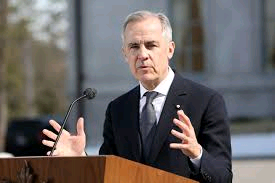
Canadian Prime Minister Mark Carney is urging his country to rethink one of the most deeply established assumptions in its economy: that close and largely predictable trade with the United States will always be the easiest path to prosperity.
As trade tensions between Ottawa and Washington intensify, Carney has argued that Canada must become stronger at home while building deeper economic relationships with countries beyond the United States. His message represents a significant shift in tone for a country whose economy has been closely intertwined with its southern neighbour for generations.
The issue has become especially urgent following a sharp escalation in the Canada-U.S. trade dispute. Canada has imposed retaliatory tariffs on billions of dollars of American imports after the United States increased tariffs on Canadian goods. Washington has now gone further by announcing bans on certain Canadian dairy products, alcoholic beverages and motorcycles, effective September 29.
For Carney, the dispute is evidence that Canada cannot afford to treat its access to the U.S. market as guaranteed.
Canada and the United States have one of the world’s most integrated economic relationships. Their shared border, interconnected industries and long history of trade have made cross-border commerce a normal part of everyday economic life.
Canadian companies have benefited enormously from access to American consumers, while U.S. businesses have relied on Canada for energy, raw materials, manufactured products and other goods.
That relationship has helped create supply chains that cross the border repeatedly. Automobiles and parts, energy products, agricultural goods, metals and industrial equipment all move between the two countries in enormous quantities.
For decades, this arrangement appeared relatively secure.
But Carney now argues that the very convenience of the relationship may have encouraged Canada to become too dependent on it.
Canada did not necessarily make a mistake by trading heavily with the United States. The problem was that the country had few incentives to develop alternatives while the relationship remained stable.
Now that stability is being questioned.
In an August speech, Carney said Canada had historically benefited from favourable trade conditions, including increasingly open access to the American market. He argued that the environment had changed and that Canada needed to chart a new course by strengthening its domestic economy and diversifying its international trading relationships.
Moving away from U.S. dependence will not be easy because America’s role in Canada’s economy is enormous.
Recent Canadian trade data illustrates the problem. In July, about 66.35% of Canadian exports went to the United States, even though that share had declined from previous levels as Canada attempted to expand its trade elsewhere. Canadian exports to the U.S. fell 6.6% in July, while exports to non-U.S. markets increased 7.4%.
Those figures demonstrate both the scale of Canada’s dependence and the early signs of diversification.
Even if Canada succeeds in increasing exports to Europe, Asia and other regions, replacing the American market would take years.
The United States is geographically close, economically enormous and connected to Canada through transportation infrastructure and established supply chains. Canadian companies do not have to completely rebuild their operations to sell to American customers.
Selling to distant markets can involve higher transportation costs, different regulations, new distribution systems and unfamiliar consumer preferences.
That is what makes Carney’s strategy ambitious.
The latest trade conflict has transformed the debate over diversification.
For years, Canadian policymakers could argue that maintaining close economic ties with the United States was simply practical. The benefits were obvious, and the risks seemed manageable.
But the current dispute has demonstrated how quickly trade policy can change.
Canada implemented retaliatory tariffs on approximately C$27 billion, or about US$20 billion, worth of American goods after Washington imposed additional tariffs on Canadian products. The United States has responded with further restrictions, including bans targeting Canadian dairy products, motorcycles and alcoholic beverages.
The escalation has created uncertainty for businesses that previously operated on the assumption that the border would remain relatively predictable.
For companies making long-term investment decisions, uncertainty can be almost as damaging as tariffs themselves.
A manufacturer deciding where to build a new factory needs to know what its costs will look like several years into the future. If access to a major export market can suddenly be restricted by government action, companies may reconsider their investment plans.
This is precisely why Carney has placed so much emphasis on economic resilience.
When politicians talk about trade diversification, it can sound as simple as finding new buyers.
In reality, it requires a much broader transformation.
Canada needs infrastructure capable of moving more goods to different parts of the world. That means ports, railways, highways, pipelines, electricity networks and other systems must be capable of supporting greater international trade.
The country also needs businesses that can compete in markets with different standards and consumer expectations.
Carney’s government has linked diversification to major infrastructure investment. In his August remarks, the prime minister said Canada was advancing hundreds of billions of dollars in major infrastructure projects and working to unlock new export markets. He also said Canada’s existing free-trade agreements provide preferential access to 1.5 billion consumers and that the government is working to expand that market access.
The goal is not to stop trading with America.
Instead, Canada wants to make sure that the U.S. is one major customer among many rather than a market upon which the country is overwhelmingly dependent.
One of Canada’s most important opportunities is Europe.
The European market offers Canada a large pool of wealthy consumers and businesses, while closer economic relations could help Ottawa reduce some of its dependence on Washington.
The European Union also provides opportunities in sectors where Canada has strong capabilities, including energy, agriculture, minerals, aerospace and advanced manufacturing.
However, expanding trade with Europe will take time.
Canadian companies must understand European regulations, develop distribution networks and compete against established suppliers from around the world.
There is also no guarantee that European demand can immediately replace American demand.
Still, diversification does not require Canada to replace the U.S. market overnight. Even a gradual increase in non-U.S. exports can reduce the economic damage caused by disruptions in American trade.
Carney has also emphasized Canada’s natural advantages.
Canada possesses enormous supplies of energy, minerals, agricultural products and other resources that are increasingly important to the global economy.
The country is a major producer of oil, natural gas, critical minerals, agricultural commodities and industrial materials.
Carney has argued that Canada should use those strengths to develop a wider network of international relationships.
That strategy could become particularly important as countries seek secure supplies of critical minerals and energy.
Canada’s geographical position also gives it access to the Atlantic and Pacific oceans, creating opportunities to serve European and Asian markets.
But exploiting those opportunities requires investment.
If Canadian producers cannot move goods efficiently to ports, or if infrastructure cannot handle increased export volumes, diversification will remain more of a political slogan than an economic reality.
The automotive industry provides one of the clearest examples of why Canada’s transition will be difficult.
Canadian and American automobile manufacturing are deeply connected. Parts and components move across the border as vehicles are produced.
A vehicle assembled in North America may involve suppliers from several locations before reaching a customer.
Changing that system would be expensive.
This is why Canada continues to have a strong interest in negotiating a stable trade relationship with the United States despite Carney’s diversification agenda.
Carney has said Canada remains prepared to reach a trade agreement with Washington if it benefits both countries and provides stability and credibility.
That position demonstrates that diversification is not the same thing as economic separation.
Canada can pursue new markets while continuing to defend its existing relationship with America.
No realistic Canadian economic strategy can ignore the United States.
The countries will remain neighbours. Their infrastructure will remain connected. Their companies will continue to invest in one another’s economies.
Carney himself has emphasized the mutual benefits of the relationship.
In an August speech, he pointed out that Canada supplies the United States with significant quantities of energy, including natural gas, electricity and crude oil. He also noted that Canada is a major customer for American products and that Canadian purchases support businesses across numerous U.S. states.
This interdependence is important because it means the trade relationship is not simply one-sided.
Both economies benefit from it.
The problem is that Canada is more exposed to the American market because of the size and structure of its export economy.
That imbalance gives Washington considerable leverage.
Carney’s strategy is therefore designed to reduce that leverage over time.
For Canadian companies, the trade dispute could force major changes.
Businesses that have spent decades focusing almost entirely on the United States may now need to consider customers in Europe, Asia and other regions.
That could create new opportunities.
A company that successfully enters a second or third international market becomes less vulnerable to political decisions in Washington.
At the same time, diversification carries risks.
Companies may need to spend money developing new relationships, adapting products, meeting different regulations and establishing new logistics networks.
Smaller businesses could find this especially difficult.
That means the Canadian government may need to provide financing, export assistance and infrastructure support to help businesses make the transition.
Carney’s argument is also deeply political.
The prime minister is presenting economic diversification as part of Canada’s broader effort to protect its sovereignty and determine its own future.
In his August statement, he said Canada had to maintain its flexibility, independence and sovereignty while building strength at home and diversifying partnerships abroad.
That message is likely to resonate with Canadians who are increasingly frustrated by American trade pressure.
The dispute has already contributed to stronger Canadian interest in buying domestic products and reducing reliance on American goods and services.
For Carney, the challenge is to convert that political sentiment into a practical economic strategy.
Canada cannot simply decide to diversify and immediately replace decades of economic integration with the United States.
The process will take years.
American consumers will remain important to Canadian exporters. Canadian consumers will continue buying American products. Cross-border investment will remain significant.
But the current crisis may have changed the way Canadian policymakers think about that relationship.
The question is no longer whether Canada should trade with the United States.
It is whether Canada should depend on the United States to the same extent it has in the past.
Carney’s answer appears to be no.
He has described building domestic strength and diversifying international trade as a central part of his government’s strategy rather than a temporary response to the current dispute. His government says non-U.S. exports are on track to double over the next decade.
Whether that target can be achieved remains to be seen.
Canada’s relationship with the United States is unlikely to disappear. Geography, history and economics make that impossible.
But the nature of the relationship could change.
For decades, Canadian prosperity was closely linked to easy access to the enormous American market. That arrangement delivered tremendous benefits, but it also created a vulnerability that has become increasingly visible during the current trade dispute.
Carney’s message is that Canada now needs alternatives.
That means strengthening domestic production, investing in infrastructure, opening new export routes and building stronger partnerships with countries beyond the United States.
The strategy will require patience. It will require businesses to take risks. It will require governments to make long-term investments rather than looking only for immediate political victories.
Most importantly, it will require Canada to accept that diversification has a cost.
But the alternative may be more expensive.
If Canada remains overwhelmingly dependent on a single foreign market, future political disputes could repeatedly expose its businesses and workers to sudden economic shocks.
By building a broader network of trade relationships, Canada can reduce that vulnerability.
Carney is therefore not necessarily calling for Canada to turn away from America. He is calling for Canada to become less dependent on America.
That distinction could define the country’s economic strategy for years to come.
The current trade war has demonstrated that the old assumptions about North American commerce can no longer be taken for granted. The era of effortless access to the U.S. market may be changing, and Canada is being forced to decide what comes next.
For Carney, the answer is clear: Canada must build more strength at home, develop more markets abroad and ensure that its economic future is not tied too closely to the decisions of its most powerful neighbour.
Leave a Reply