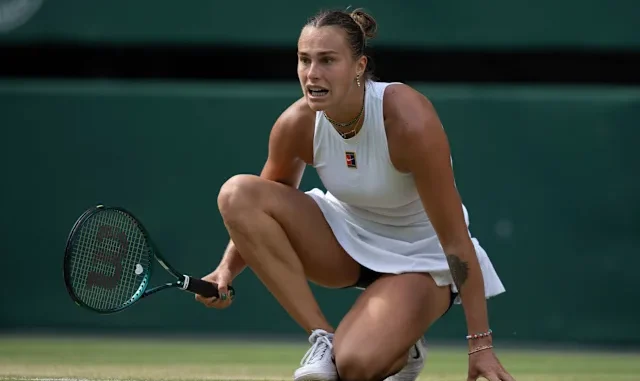
In professional tennis, there are moments when the toughest battles are not fought under the bright lights of a packed stadium but within the mind of an athlete determined to move on from disappointment. For World No. 1 Aryna Sabalenka, that moment arrived just days before the start of Wimbledon when she stepped onto Court No. 1 for an eye-catching practice session with none other than American star Jessica Pegula—the very player who had recently handed her one of the most painful defeats of the grass-court season.
The scene immediately caught the attention of fans and tennis analysts. It wasn’t just because two of the world’s best players were hitting together on one of Wimbledon’s most famous courts. It was because the practice session symbolized something much deeper. Rather than allowing heartbreak to linger, Sabalenka chose to confront it head-on.
Only a few days earlier, Pegula had defeated Sabalenka in the semifinals of the Berlin Open, ending the match with a dominant final set that left the Belarusian frustrated and searching for answers. The defeat was particularly difficult because Sabalenka had entered the tournament hoping to build momentum ahead of Wimbledon, the only Grand Slam where she has yet to capture a singles title.
Instead of carrying that disappointment into London, Sabalenka made a statement without saying much at all. She walked onto Court No. 1 with Pegula, racket in hand, ready to begin again.
For elite athletes, recovery isn’t only about healing the body. It is about rebuilding confidence, sharpening focus, and proving that one setback does not define an entire season.
That mindset has become one of Sabalenka’s greatest strengths throughout her career.
Known for her explosive power, fearless shot-making, and emotional intensity, Sabalenka has built a reputation as one of the toughest competitors on the WTA Tour. Yet even champions experience moments of vulnerability. The Berlin defeat raised questions about whether recent disappointments might affect her confidence entering one of the biggest tournaments of the year.
Rather than avoiding those questions, Sabalenka answered them with action.
The practice session with Pegula demonstrated the professionalism shared by the world’s best players. While fierce rivals during official competition, top players frequently train together before major tournaments because they understand the value of testing themselves against elite opposition.
Court No. 1 provided the perfect setting.
The pair spent close to an hour exchanging powerful groundstrokes, practicing serves, and working through various match scenarios. Spectators fortunate enough to watch witnessed the intensity and quality that have made both women consistent contenders at the highest level.
There was no sign of bitterness from either player.
Instead, there were smiles, conversations between points, and mutual respect—proof that fierce competition does not prevent professional admiration.
Their growing rivalry has become one of the most entertaining storylines in women’s tennis.
Whenever Sabalenka and Pegula meet, fans expect long rallies, powerful baseline exchanges, and dramatic momentum swings. Both possess aggressive styles that force opponents to play at an exceptionally high level.
Although Pegula earned the most recent victory, Sabalenka knows the rivalry is far from over.
If both continue advancing through the Wimbledon draw, another meeting could easily take place in the tournament’s latter stages.
That possibility only added extra intrigue to their practice session.
For Sabalenka, Wimbledon represents unfinished business.
Despite winning multiple Grand Slam titles elsewhere, success at the All England Club has remained just out of reach. She has produced deep runs in previous editions of the tournament, showcasing a game perfectly suited to grass courts. Her booming serve, aggressive returns, and ability to finish points quickly make her one of the most dangerous players in the field.
Yet the Wimbledon trophy continues to elude her.
That reality has fueled her determination throughout the grass-court season.
Every training session matters.
Every adjustment matters.
Every opportunity to improve becomes another step toward achieving a goal she has chased for years.
One aspect that continues to separate Sabalenka from many competitors is her willingness to confront adversity openly. Throughout her career, she has spoken honestly about the mental side of professional tennis, acknowledging that confidence can fluctuate and that emotional resilience requires constant work.
Instead of pretending losses do not hurt, she embraces the challenge of learning from them.
That attitude has played a significant role in her rise to the top of the rankings.
Many athletes struggle after painful defeats, allowing disappointment to carry over into future matches. Sabalenka has repeatedly shown an ability to reset mentally, return to training, and continue competing with belief in her abilities.
The session with Pegula reflected exactly that mentality.
Meanwhile, Pegula entered Wimbledon carrying confidence of her own.
The American had just secured one of her biggest victories of the season by defeating the world’s top-ranked player in Berlin. That performance reinforced her credentials as a legitimate contender capable of challenging anyone on tour.
Still, Pegula understands that past victories guarantee nothing at Wimbledon.
Grass courts reward adaptability, patience, and composure under pressure.
Like Sabalenka, she knows preparation is everything.
Their willingness to practice together also highlighted one of tennis’ unique traditions. Unlike many team sports where rivals rarely interact away from competition, professional tennis often brings opponents together during training sessions before major events.
The goal is simple.
Train with the best.
Improve through quality competition.
Arrive fully prepared when the tournament begins.
As fans watched the pair exchange powerful shots across Court No. 1, many couldn’t help but imagine another blockbuster meeting later in the fortnight.
Both women possess the experience, consistency, and talent to reach the final rounds.
If that happens, their Wimbledon clash would carry even greater significance after everything that unfolded in Berlin.
For Sabalenka, however, the biggest victory may have already occurred before the tournament even began.
By choosing to train with the player who had recently defeated her, she demonstrated remarkable maturity and resilience.
Rather than dwelling on what went wrong, she focused entirely on what comes next.
That mindset has become the hallmark of champions.
The greatest players understand that defeat is temporary unless it changes how they approach the future.
Sabalenka’s response suggests she has no intention of letting recent disappointment define her Wimbledon campaign.
Instead, she has transformed heartbreak into motivation.
As the Championships unfold, all eyes will be on the World No. 1 to see whether that determination translates into the deep run she has long desired.
Her journey at Wimbledon is about more than lifting another trophy.
It is about overcoming past disappointments, proving once again why she sits atop the world rankings, and showing that resilience remains one of the most powerful weapons any athlete can possess.
Whether Sabalenka ultimately captures her first Wimbledon title remains uncertain. Tennis has a way of producing surprises, no matter how talented the player.
What is certain, however, is that her preparation has already sent a powerful message to the rest of the field.
Heartbreak may have followed her from Berlin to London, but it did not stay with her for long.
On the famous grass of Court No. 1, alongside Jessica Pegula, Aryna Sabalenka chose to move forward—one rally, one practice session, and one determined step at a time.
Leave a Reply