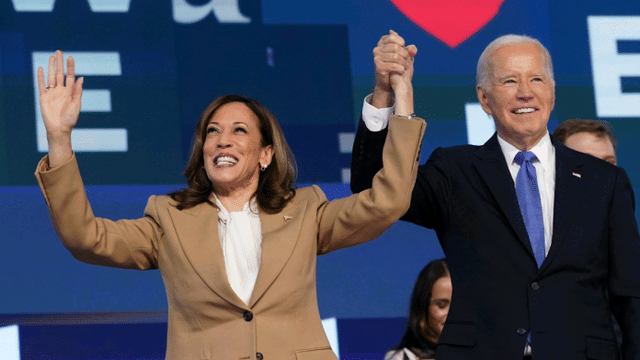
Former Vice President Kamala Harris has revealed the three U.S. presidents she considers among the most effective in American history, and former President Joe Biden was notably absent from her list.
Harris made the comments during an appearance at the National Urban League conference, where she was asked by Marc Morial to rank the three most effective presidents in American history. Although she initially joked that she did not want to take on such a difficult question, Harris eventually offered her choices: Franklin D. Roosevelt, John F. Kennedy and Barack Obama.
The answer immediately drew attention because Biden, under whom Harris served as vice president, did not make the list.
Harris placed Franklin D. Roosevelt, commonly known as FDR, at the top. She explained that she had recently watched an NPR program about Roosevelt and pointed to his response to the economic crisis facing the country during the Great Depression.
For Harris, Roosevelt’s presidency stood out because of the government’s expanded role in helping Americans during difficult economic times. She specifically referred to Social Security and Roosevelt’s broader approach to investing in people. She also mentioned his controversial proposal to expand the Supreme Court, which faced significant political opposition.
Harris described Roosevelt as an important president because of his belief that government had a responsibility to play a meaningful role in people’s lives, particularly during periods of national hardship.
Her second choice was John F. Kennedy. Harris also brought up Lyndon B. Johnson, Kennedy’s vice president, who became president following Kennedy’s assassination in 1963.
Rather than looking at Kennedy’s presidency in isolation, Harris highlighted what she viewed as a connection between Kennedy’s leadership and the legislative achievements that followed under Johnson. She pointed to the importance of public pressure in pushing government leaders to respond to major issues facing the country.
Harris then selected Barack Obama as her third choice. Her praise for Obama focused heavily on healthcare and the Affordable Care Act, one of the defining achievements of his administration.
She argued that the healthcare system had failed millions of Americans and said Obama’s effort to address the issue was significant despite the political opposition he faced. The audience responded positively when Obama was mentioned as Harris’s third selection.
The omission of Biden is particularly noteworthy given the political relationship between the two Democrats. Harris served as Biden’s vice president from 2021 until 2025 and became the Democratic Party’s presidential nominee in 2024 after Biden ended his reelection campaign.
At the time Biden withdrew from the race, Harris quickly became the party’s leading candidate and ultimately faced Donald Trump in the general election. Her political career has therefore been closely connected to Biden’s presidency, making her decision not to include him in her top three a point of interest for political observers.
Still, Harris was specifically asked to name the three most effective presidents in American history, rather than the presidents with whom she had the closest personal or political relationship. Her choices therefore appear to reflect her assessment of presidential impact rather than a direct statement about her relationship with Biden.
The omission has nevertheless generated discussion because of the changing relationship between Harris and the Biden administration after the 2024 election. Harris has previously spoken positively about Biden and defended him publicly while serving as his vice president. In July 2024, for example, she said she was proud to be Biden’s running mate and pushed back against calls for him to leave the presidential race.
Her latest comments come against the backdrop of a Democratic Party still debating the successes and failures of the Biden years. Biden’s presidency included major legislation on infrastructure, climate investment and healthcare, but it was also marked by concerns about inflation, immigration, his age and his ability to serve another term.
Harris’s choices also reveal something about the Democratic political tradition she appears to value. Roosevelt represents an expansive role for government during economic crisis. Kennedy represents inspirational leadership and the ability to establish a political vision that can influence future administrations. Obama represents a modern Democratic presidency defined in part by healthcare reform and efforts to expand access to government programs.
Whether Biden’s absence was intentional or simply the result of Harris’s limited three-person ranking is impossible to determine from the answer alone. She did not explicitly criticize Biden while naming her selections, nor did she explain why he was excluded.
Nevertheless, the moment is likely to attract attention because presidential rankings are rarely viewed as purely academic exercises, especially when the person doing the ranking has served directly under one of the presidents being considered.
For Harris, the three names she chose—Roosevelt, Kennedy and Obama—represent different eras and different approaches to presidential leadership. Biden, despite serving as her political partner for four years, simply did not make the final three.
Leave a Reply