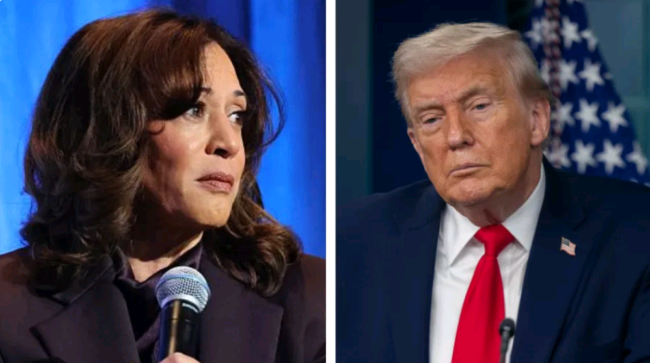
Former Vice President Kamala Harris has accused President Donald Trump of making it harder for Americans to vote by mail as the country heads toward the 2026 midterm elections.
Harris made the criticism in a video posted online after the Supreme Court allowed key parts of Trump’s efforts to change mail-in voting procedures to move forward. She argued that the new measures could create additional obstacles for voters who rely on absentee or mail ballots.
“He’s trying to make it more difficult for you to vote by mail,” Harris said, pointing directly at Trump’s election policies. She also highlighted what she described as an apparent contradiction in Trump’s position, noting that the president himself has used mail voting.
“By the way, he votes by mail from Mar-a-Lago,” Harris said. “But he doesn’t want you to vote by mail.”
The dispute comes at a politically sensitive moment, with the November 2026 midterm elections approaching. Mail-in voting has become an important part of the American electoral system, giving voters who cannot or do not want to appear at polling places on Election Day another way to participate.
Trump and his administration, however, have presented the proposed changes as measures designed to strengthen election security. His March executive order directed federal agencies to establish systems for verifying voter eligibility and instructed the U.S. Postal Service to develop new procedures for handling mail and absentee ballots. The administration says the changes are intended to ensure that ballots are sent only to eligible voters and to prevent people who are not legally entitled to vote from receiving ballots.
Critics see the situation differently. Democratic officials, voting-rights organizations and several states have argued that the federal government is attempting to interfere with an area traditionally administered largely by states. They have also warned that changing election procedures only weeks before a major election could create confusion for election officials and voters.
The legal battle intensified in August after the Supreme Court, in a 6-3 decision, allowed parts of Trump’s executive order to take effect while litigation continues. The ruling did not ultimately settle whether the administration’s broader effort to change mail-voting procedures is constitutional.
The controversy then took another turn when a federal judge temporarily blocked new U.S. Postal Service requirements connected to Trump’s mail-voting plan. The ruling added another layer of uncertainty to an already complicated election process, particularly because states are preparing for ballots to be sent to voters in advance of the November election.
For Harris, the debate is about more than administrative procedures. She is framing the issue as part of a broader struggle over voting access and participation in American democracy.
Her message to voters is essentially that changes to voting rules should not discourage people from participating. With the midterms expected to determine control of Congress and shape the political direction of the country, both parties are paying close attention to how Americans will cast their ballots.
Trump’s supporters, meanwhile, maintain that election rules need stronger safeguards. The administration argues that verifying citizenship and eligibility can protect the integrity of elections and increase public confidence in the voting process. The White House says the president’s executive order is designed to prevent ineligible people from receiving federal election ballots and to modernize the handling of mail-in ballots.
The disagreement over mail voting is therefore likely to remain a major political and legal issue as Election Day approaches. Courts, states and federal agencies are still working through competing claims about who has the authority to establish election procedures and how quickly those rules can be changed.
Harris’s comments also reflect the increasingly partisan nature of the debate over voting in the United States. Republicans have emphasized election security and voter eligibility, while Democrats and voting-rights advocates have focused on access and the potential impact of new requirements on eligible voters.
With millions of Americans expected to participate in the midterms, even relatively small changes to mail-ballot procedures could have significant consequences. Voters in different states may face different rules depending on how ongoing court cases are resolved and how state election officials respond.
For now, the legal fight is far from over. What began as a presidential effort to reshape federal election procedures has developed into a wider confrontation involving the White House, states, the Postal Service, voting-rights groups and the courts.
As the November elections draw closer, Harris and other Democrats are urging voters to pay close attention to changes in voting rules and make plans to participate. Trump and his allies continue to argue that stronger safeguards are necessary to protect the integrity of elections.
The competing arguments are likely to remain at the center of the political conversation in the weeks ahead, making mail-in voting one of the most closely watched issues before the 2026 midterms.
Leave a Reply