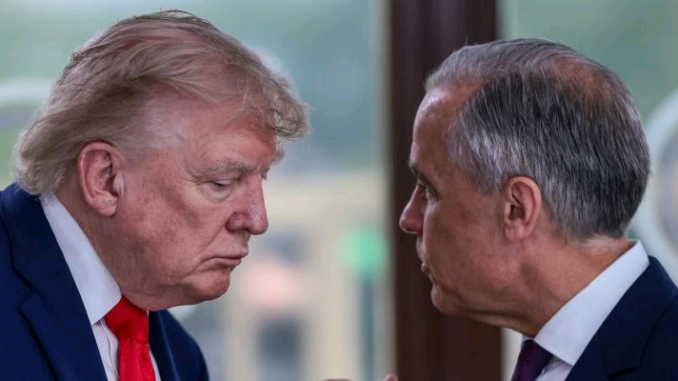
The trade relationship between the United States and Canada has entered one of its most serious periods in decades, after negotiations between the two countries collapsed and both governments moved toward a new round of tariffs. Canadian Prime Minister Mark Carney has made clear that Ottawa will not simply accept Washington’s latest demands, promising a dollar-for-dollar response to new U.S. tariffs.
The breakdown is particularly significant because the United States and Canada have long been among the world’s closest economic partners. Their economies are deeply connected, with businesses, workers, farmers, manufacturers and consumers on both sides of the border depending on cross-border trade. The latest confrontation therefore carries consequences far beyond the negotiating rooms in Washington and Ottawa.
The immediate trigger was the failure of trade talks that had appeared, only days earlier, to be moving toward a possible agreement. On August 21, Carney announced that Canada was suspending negotiations, arguing that last-minute changes proposed by the United States were unfair and economically damaging. Washington subsequently moved ahead with 50% tariffs on roughly $20 billion to $28 billion worth of Canadian goods, depending on the measure being counted.
Carney’s response was unusually firm.
Canada, he said, would match the new American tariffs dollar for dollar. The Canadian measures are expected to target products including steel, dairy, appliances, agricultural equipment, pulp and paper, and electronics, with the new counter-tariffs scheduled to take effect after Labour Day.
For Carney, this is not simply a disagreement over tariffs. It is also a question of how Canada responds to economic pressure from its much larger southern neighbour.
A Negotiation That Fell Apart
The collapse of the talks is striking because both governments had invested considerable effort in reaching a deal.
Canada had been seeking to preserve broad tariff-free access to the American market while reducing tariffs affecting strategically important industries. Ottawa also wanted greater stability for Canadian companies that have struggled to plan investments and production because of repeated changes in U.S. trade policy.
Carney has argued that Canada was prepared to make concessions, including changes involving retaliatory tariffs and access to American products, if Washington offered meaningful improvements in return.
But the final stage of negotiations proved impossible.
According to Carney, the United States introduced new terms that were unacceptable to Canada and threatened the country’s economic independence. He said Ottawa was not prepared to sacrifice sovereignty, cultural protections or key industries simply to secure an agreement.
That position ultimately led Canada to walk away.
The decision reflects a broader change in Ottawa’s approach to Washington. Rather than assuming that economic integration will automatically protect the relationship, Carney’s government is increasingly preparing for a world in which Canada must diversify its trading partners and strengthen its domestic economy.
Trump Doubles Down
President Donald Trump, meanwhile, has shown little indication that he intends to soften his approach.
The latest 50% tariffs represent the most aggressive phase of the current dispute. While many Canadian exports remain outside the newest measures, the tariffs still represent a serious escalation because they directly raise the cost of goods moving from Canada into the United States.
The administration has argued that American trade policy needs to be reshaped to protect U.S. industries and address what it views as unfair trade arrangements.
Canada disputes that argument.
Carney has repeatedly rejected the idea that the United States is being exploited by its northern neighbour. In remarks explaining his decision to suspend negotiations, he pointed to the enormous amount of energy the United States purchases from Canada and argued that the two economies are complementary rather than locked in a simple winner-and-loser relationship.
That disagreement goes to the heart of the conflict.
Trump’s approach treats tariffs as leverage. Carney’s approach increasingly treats resistance to tariffs as a matter of national economic strategy.
The Cost Will Not Stay on One Side of the Border
Trade wars often begin with governments announcing tariffs, but the consequences eventually reach ordinary consumers and businesses.
American companies that depend on Canadian materials could face higher costs if tariffs increase the price of imported products. Canadian exporters, meanwhile, risk losing competitiveness in their most important foreign market.
The two countries have extraordinarily deep economic ties. Trade between them reached hundreds of billions of dollars during the first half of 2026 alone, making Canada one of America’s most important commercial partners.
That interdependence makes a prolonged trade war particularly dangerous.
A Canadian manufacturer selling goods to American customers could find its products suddenly more expensive. An American company importing Canadian materials could face higher production costs. Retailers may eventually pass those additional expenses to consumers.
Farmers could also be affected.
Agricultural trade between the two countries is deeply integrated, and tariffs can disrupt established supply chains. Dairy, agricultural equipment and other farm-related products are among the areas expected to be affected by Canada’s retaliation.
The result could be a situation in which businesses on both sides of the border lose, even if the political leaders involved claim victory.
Carney Is Betting on Canadian Resilience
Carney’s decision to retaliate carries significant risks.
Canada depends heavily on the American market, and replacing that market will not happen overnight. The United States remains Canada’s dominant trading partner, while many Canadian companies have built their operations around access to American consumers.
That is why Carney has paired his tough rhetoric with a broader economic strategy.
His government says it will provide additional support to businesses and workers affected by U.S. tariffs. Ottawa has already committed nearly $25 billion in support over the past 18 months, while promising further measures as the latest dispute unfolds.
Canada is also trying to expand trade beyond the United States.
The goal is not necessarily to abandon the American market. That would be unrealistic given the scale of the relationship. Instead, Ottawa wants Canadian companies to have alternatives if political disputes repeatedly threaten their access to the U.S. market.
That strategy could take years to produce meaningful results.
The Sovereignty Question
Perhaps the most important element of the dispute is that Carney has framed it as more than an economic disagreement.
For the Canadian government, the issue increasingly involves national sovereignty.
Carney has argued that Canada cannot accept trade conditions that restrict its ability to determine its own economic and cultural policies. He has also warned that an agreement reached under excessive pressure would not necessarily provide the stability businesses need.
This helps explain why Ottawa rejected a deal even though Canadian businesses would clearly benefit from greater certainty in the short term.
The Canadian government appears to believe that accepting unfavorable conditions today could create even greater problems tomorrow.
That is a difficult political calculation.
What Happens Next?
The immediate future is likely to be dominated by uncertainty.
Canada’s retaliatory tariffs are expected to begin after Labour Day, while businesses on both sides of the border will be watching closely for exemptions, negotiations or further escalation.
Neither country has an obvious interest in allowing the conflict to continue indefinitely.
American companies benefit enormously from Canadian trade. Canadian businesses depend heavily on American consumers. Supply chains cross the border repeatedly before products reach their final destination.
That reality creates pressure for both governments to eventually return to negotiations.
But the political relationship has been damaged.
The latest collapse came after months of tariff threats, counter-tariffs and disputes over the future of North American trade. The longer those tensions continue, the more difficult it may become to restore the level of trust that existed before the current confrontation.
For Carney, the challenge will be maintaining a firm position without allowing the Canadian economy to absorb excessive damage.
For Trump, the challenge will be demonstrating that tariffs can produce the economic and political results his administration wants without imposing unnecessary costs on American businesses and consumers.
A Fight With No Easy Winner
The U.S.-Canada trade dispute is ultimately a test of whether economic pressure can force a close ally to accept terms it considers unacceptable.
Trump is betting that the size of the American market gives Washington the stronger hand.
Carney is betting that Canada can withstand the pressure long enough to protect its economic independence and negotiate from a stronger position later.
Neither strategy is without risk.
A prolonged trade war could hurt Canadian exporters, American manufacturers and consumers in both countries. It could disrupt supply chains, discourage investment and weaken an economic relationship that has benefited both nations for generations.
Yet the dispute has also changed the political conversation in Canada. Instead of simply asking how to preserve the old relationship with Washington, Canadians are increasingly being asked to consider what a more independent economic strategy might look like.
That may ultimately be the most lasting consequence of the confrontation.
The immediate battle is over tariffs. The deeper struggle is over the future of the U.S.-Canada relationship.
For now, Carney has chosen confrontation over compromise, arguing that a bad agreement would be worse than no agreement at all. Trump, meanwhile, has continued to use tariffs as a central instrument of his trade policy.
The coming months will reveal whether that pressure brings the two countries back to the negotiating table—or pushes them further apart.
What was once one of the world’s most predictable trading relationships has entered a period of uncertainty. And as both governments prepare for another round of economic retaliation, the cost of the conflict may increasingly be felt not in Ottawa or Washington, but in factories, farms, stores and households on both sides of the border.
Leave a Reply