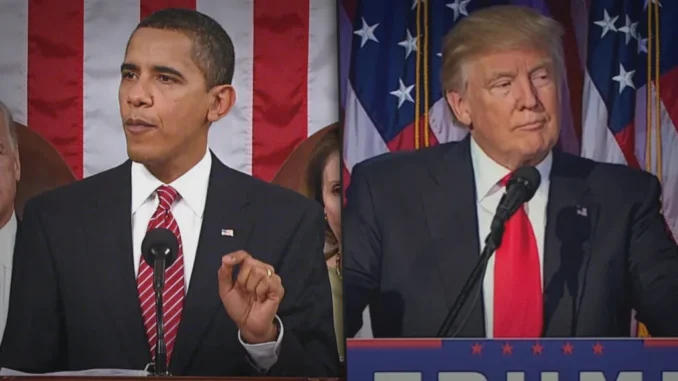
Former President Barack Obama has delivered one of his strongest public warnings yet about the direction of American politics, arguing that the country is facing a dangerous moment as extremist rhetoric and political division continue to gain traction. Speaking before a packed audience during a recent public appearance, Obama said the United States has reached a point where democratic values can no longer be taken for granted, stressing that “we’ve got a problem” if extremism becomes accepted as a normal part of governing.
Obama’s remarks centered on what he described as the growing willingness of political leaders to tolerate or even encourage extreme positions in pursuit of power. Without mincing words, the former president criticized the political climate that has evolved in recent years, particularly under the influence of President Donald Trump, saying that the normalization of inflammatory rhetoric and attacks on democratic institutions poses a long-term threat to the nation’s stability.
According to Obama, political disagreements are an essential part of democracy, but there is a clear distinction between healthy debate and the promotion of ideas that undermine the country’s constitutional foundations. He argued that when elected officials refuse to respect democratic norms or seek to delegitimize elections and public institutions, the consequences extend far beyond partisan politics.
“We’ve got a problem,” Obama emphasized, explaining that citizens should not become desensitized to behavior that would have once been considered unacceptable in American public life. He suggested that the gradual acceptance of increasingly extreme language has shifted the political landscape in troubling ways, making it more difficult for Americans to find common ground.
Throughout his speech, Obama repeatedly urged Americans to reject the idea that division is inevitable. Instead, he encouraged citizens to become more actively involved in civic life, whether through voting, community engagement, or holding elected officials accountable regardless of party affiliation.
The former president also reflected on the importance of preserving democratic institutions, arguing that they depend not only on laws but also on the willingness of leaders to respect established norms. He warned that democracy becomes fragile when individuals begin placing personal or political interests above the Constitution and the rule of law.
Obama’s comments come at a time when political tensions remain high across the United States. Issues ranging from immigration and election integrity to the role of the federal government continue to fuel intense debates between Democrats and Republicans. While fierce political competition has always existed in American history, Obama argued that today’s climate has become increasingly characterized by distrust and polarization.
One of his primary concerns was what he described as the erosion of truth in political discourse. Obama suggested that misinformation and conspiracy theories have become powerful tools capable of influencing public opinion while weakening confidence in institutions that have traditionally served as pillars of democracy.
He argued that a functioning democracy requires citizens to share at least a basic understanding of facts, even when they disagree on policy solutions. When that shared reality begins to disappear, compromise becomes increasingly difficult, creating an environment where political conflict intensifies.
Although Obama directed much of his criticism toward the Trump administration and its broader political movement, he also acknowledged that responsibility for strengthening democracy does not rest solely with elected officials. He encouraged Americans from all political backgrounds to reject extremism and engage in respectful dialogue, emphasizing that meaningful progress depends on participation from ordinary citizens.
Supporters of Obama praised the speech as a necessary reminder of the importance of protecting democratic institutions during a period of heightened political uncertainty. Many viewed his remarks as a call for national unity and civic responsibility rather than simply another partisan attack.
Critics, however, accused the former president of contributing to political polarization by singling out Trump and his allies. Some Republican voices argued that Obama’s comments overlooked concerns held by millions of conservative voters and further deepened divisions between the country’s major political parties.
Despite those criticisms, Obama’s message remained focused on what he believes is a larger challenge confronting the nation. He insisted that the debate is not simply about Republicans versus Democrats, but about whether Americans are willing to defend democratic principles even when doing so may be politically inconvenient.
The former president also encouraged younger generations to remain engaged despite growing frustration with politics. He acknowledged that many Americans feel discouraged by constant political conflict but argued that withdrawing from civic participation would only allow extremism to gain greater influence.
Obama pointed to previous moments in American history when the country faced profound internal divisions, noting that the United States has repeatedly overcome significant challenges through active citizenship and a commitment to democratic ideals. He expressed confidence that Americans are capable of doing so again, provided they remain committed to protecting institutions that ensure accountability and equal representation.
His speech also underscored the importance of leadership that seeks to unite rather than divide. Obama argued that political leaders should strive to lower tensions instead of exploiting public fears for electoral advantage. He maintained that governing effectively requires compromise, empathy, and respect for those with differing viewpoints.
The broader message resonated beyond immediate political debates. Obama framed the issue as one that will shape the country’s future for generations, warning that democracy cannot survive if citizens become indifferent to attacks on its core principles.
As the United States continues navigating another highly charged political era, Obama’s warning is likely to remain part of the national conversation. His assertion that “we’ve got a problem” reflects concerns shared by many observers who believe the country’s democratic institutions face increasing pressure from polarization, misinformation, and growing political hostility.
Whether Americans agree with Obama’s assessment or reject it, his remarks have once again highlighted the deep divisions defining the nation’s political landscape. They also serve as a reminder that debates over democracy, leadership, and political accountability will continue to influence public discourse as the country moves toward future elections.
For Obama, the solution begins with ordinary citizens refusing to accept extremism as the new normal. He believes that safeguarding democracy requires vigilance, participation, and a renewed commitment to the values that have long defined the American political system. His message was clear: preserving those principles is a responsibility shared by every American, regardless of political affiliation.
Leave a Reply