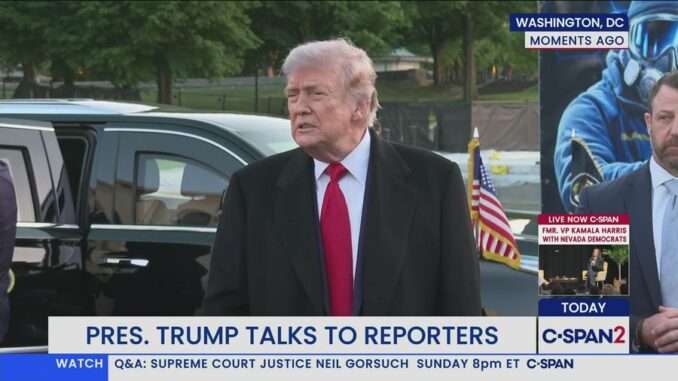
President Donald Trump expressed optimism about the state of diplomatic efforts with Iran on Wednesday, telling reporters that “the denuclearization of Iran is moving along well” as indirect negotiations between the two countries continue in Qatar. His comments offered one of the clearest indications yet that the administration believes recent discussions have produced meaningful progress, even as major issues remain unresolved.
Speaking to reporters before departing for North Dakota, Trump praised the latest round of meetings involving U.S. and Iranian representatives. While acknowledging that negotiations are still ongoing, he said the talks had been productive and suggested that relations between the two sides have improved significantly compared to recent months.
“The denuclearization of Iran is moving along well,” Trump said. “They’ve had very good meetings, and we’ll see.”
The president also described the broader diplomatic climate in positive terms, adding that the United States and Iran are “getting along very well” and that Tehran has “come a long way” during the course of the negotiations. His remarks came as technical discussions were taking place in Doha, where mediators are working to build on a fragile ceasefire and reduce tensions that recently brought the two countries to the brink of a wider conflict.
The negotiations represent another important chapter in a relationship that has been marked by decades of mistrust, sanctions, military confrontations, and disagreements over Iran’s nuclear ambitions. Trump’s administration has consistently maintained that preventing Iran from acquiring a nuclear weapon remains its highest priority in the region.
Although the president spoke confidently about progress toward denuclearization, officials familiar with the talks have noted that the current discussions are primarily focused on implementing an interim agreement, restoring stability to shipping through the Strait of Hormuz, and preserving the ceasefire reached after weeks of heightened military tensions. Nuclear issues remain closely tied to the broader diplomatic process but are not the sole focus of the latest technical meetings.
The latest negotiations are being facilitated by Qatar, with additional mediation support from Pakistan. According to reports, the discussions seek to establish mechanisms that would prevent renewed hostilities while creating a framework for future agreements on more complex security matters.
Trump’s special envoy, Steve Witkoff, along with the president’s son-in-law Jared Kushner, reportedly met with senior Qatari officials ahead of the talks to help lay the groundwork for negotiations. However, neither participated directly in the technical meetings themselves.
The president’s upbeat assessment contrasts sharply with the tense atmosphere that dominated relations only weeks ago, when military exchanges raised fears of a broader regional war. Following those confrontations, diplomatic efforts intensified as international mediators worked to persuade both Washington and Tehran to return to negotiations rather than continue military escalation.
For the Trump administration, securing meaningful restrictions on Iran’s nuclear activities remains central to any lasting agreement. The White House has repeatedly insisted that Iran cannot be allowed to develop a nuclear weapon, arguing that such an outcome would threaten regional stability and global security.
At the same time, Iran has continued to push for sanctions relief and greater economic flexibility while maintaining that its nuclear program serves peaceful purposes. Those competing priorities have made negotiations particularly difficult, with both sides seeking concessions without appearing to compromise their core interests.
Despite Trump’s optimistic tone, analysts caution that significant obstacles remain before any comprehensive agreement can be finalized. Technical negotiations often resolve operational issues, but larger political disagreements typically require direct involvement from senior government leaders.
Among the unresolved issues are long-term verification measures, the future of sanctions, regional security arrangements, and mechanisms for ensuring that any commitments made by either side are fully implemented. These topics have complicated previous rounds of negotiations and continue to challenge diplomats today.
Nevertheless, Trump’s comments suggest the administration believes momentum is moving in a favorable direction. His repeated references to “very good meetings” indicate growing confidence that diplomacy may achieve results where military pressure alone could not.
International observers are closely monitoring developments because any durable agreement between Washington and Tehran could have significant consequences for global energy markets, Middle East security, and international non-proliferation efforts. Stability in the Strait of Hormuz, one of the world’s most important shipping routes, remains a particularly critical objective for both regional governments and global markets.
The president stopped short of declaring victory or predicting an immediate breakthrough, instead emphasizing that negotiations are continuing and that further progress will depend on the outcome of ongoing discussions.
“We’ll see,” Trump remarked, underscoring that while recent developments have been encouraging, substantial work still lies ahead.
The coming days are expected to be crucial as negotiators continue working through technical details while seeking broader political consensus. Should the current talks produce lasting agreements, they could mark one of the most significant diplomatic developments in U.S.-Iran relations in years.
For now, the administration is projecting cautious optimism. Trump’s assertion that Iran’s denuclearization is “moving along well” signals confidence that diplomacy is making headway, even as both sides continue navigating the complex challenges that have long defined one of the world’s most sensitive geopolitical relationships. Whether that optimism ultimately translates into a lasting agreement remains to be seen, but the latest round of talks has clearly renewed hopes that diplomacy can succeed where confrontation has repeatedly fallen short.
If you’d like, I can also rewrite this in a more dramatic breaking-news style suitable for a sports/news blog or social media news outlet.
Leave a Reply