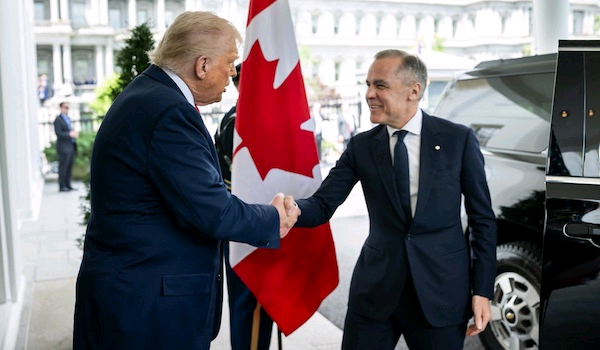
The long-standing economic relationship between the United States and Canada is facing one of its most serious tests in years, as a bitter dispute over tariffs, market access and economic policy continues to deepen. What was once largely viewed as a disagreement between two closely connected trading partners has increasingly developed into a broader economic and diplomatic confrontation, raising concerns about businesses, consumers, workers and the future of North American trade.
The latest escalation follows the collapse of trade negotiations between Washington and Ottawa in August. Canadian Prime Minister Mark Carney has since made clear that Canada is not prepared to return to the negotiating table simply to accept terms it considers damaging to its economy or national interests. On September 1, Carney said the United States needed to adopt a more serious and respectful approach before meaningful discussions could resume.
The comments underline just how far relations between the two countries have deteriorated.
For decades, the United States and Canada have maintained one of the world’s largest bilateral trading relationships. Their economies are deeply integrated, with goods, services, raw materials, agricultural products, energy and manufactured components moving across their shared border every day. Industries on both sides depend heavily on this interconnected system.
That is why the latest tariff battle has generated so much concern.
The immediate crisis intensified after negotiations broke down on August 21. Canada said last-minute changes to U.S. demands were unacceptable and economically damaging, prompting Carney’s government to suspend the negotiations. Washington, however, has maintained that it offered Canada an opportunity to reach a favorable agreement and has disputed Ottawa’s characterization of the talks.
Following the breakdown, the United States moved ahead with new 50% tariffs on about $20 billion worth of Canadian goods. Canada responded by announcing dollar-for-dollar retaliatory tariffs on a comparable amount of U.S. products, with the measures scheduled to take effect on September 8.
The exchange represents a significant escalation because tariffs rarely remain confined to government policy documents. They eventually affect companies that import and export goods, manufacturers that rely on foreign components and consumers who may ultimately face higher prices.
Canada’s retaliatory measures are expected to target a range of American products, including steel, dairy, electronics and other goods. The strategy is designed to place economic pressure on the United States while demonstrating that Ottawa is prepared to respond rather than simply absorb the cost of American tariffs.
Carney has emerged as the central figure in Canada’s response to Washington’s trade pressure. Rather than signaling a willingness to compromise at any cost, the Canadian prime minister has emphasized that his government will protect the country’s economic interests and sovereignty.
His latest comments suggest that Ottawa believes the United States must change its approach before negotiations can restart.
Carney has criticized what he sees as aggressive rhetoric from Washington, arguing that serious trade negotiations require mutual respect and a willingness to compromise. He has also objected to proposed U.S. terms affecting important Canadian industries, particularly the automotive sector.
The dispute therefore goes beyond the simple question of how much tariff one country should impose on another. Canadian officials increasingly see the negotiations as involving broader questions about the country’s economic independence.
For Canada, accepting conditions that could weaken major domestic industries would create a difficult political problem. For Carney, appearing too accommodating could also undermine his government’s credibility at home.
At the same time, Washington faces its own pressures. The Trump administration has argued that American businesses and workers have been treated unfairly in several areas of trade and has used tariffs as a tool to push Canada toward concessions.
Few sectors illustrate the potential consequences of the dispute more clearly than the North American automotive industry.
The United States and Canada have built an integrated automobile manufacturing system in which parts and vehicles can cross the border multiple times before a finished product reaches consumers. A component manufactured in one country may be shipped to a plant in the other, assembled into a vehicle and then transported across the border again.
Tariffs can disrupt that system by increasing the cost at multiple stages of production.
The Trump administration has threatened higher tariffs on Canadian cars, trucks and automotive parts. Reuters reported in August that Trump threatened to raise tariffs on Canadian automotive products to 50%, potentially creating another major challenge for an industry that depends heavily on cross-border supply chains.
Canadian officials have warned that some U.S. demands could effectively weaken Canada’s automotive manufacturing base. Carney has argued that Ottawa cannot accept arrangements that would leave Canadian industries functioning merely as extensions of American companies.
The consequences could extend well beyond Canada.
American factories also depend on Canadian materials and components. If those supplies become more expensive, manufacturers may face higher production costs. Companies could eventually pass some of those expenses to consumers through higher prices.
The uncertainty created by the dispute may be almost as damaging as the tariffs themselves.
Businesses prefer predictable trading conditions. Manufacturers need to know how much imported materials will cost. Farmers need confidence that their products can reach foreign markets. Retailers need to plan inventory months in advance.
A prolonged tariff dispute makes those decisions more difficult.
Companies may delay investments while waiting to see whether negotiations resume. Others may begin searching for alternative suppliers outside the United States or Canada. Over time, such decisions could alter supply chains that have been built over decades.
Canada is already seeing signs that some businesses are considering greater independence from U.S. suppliers. Reuters reported that Canadian companies and consumers have increasingly been reassessing their economic links with the United States as political and trade tensions intensify.
That development could have lasting consequences.
Even if Washington and Ottawa eventually reach a new agreement, businesses that have spent months or years developing alternative suppliers may not immediately return to their old arrangements.
For ordinary Americans and Canadians, the trade dispute may initially appear to be a distant political argument. But tariffs can eventually make their way into everyday household budgets.
When imported products or components become more expensive, companies have several choices. They can absorb the additional cost, reduce their profit margins, find cheaper suppliers or pass some or all of the increase to customers.
The outcome varies from industry to industry.
Some companies may be able to switch suppliers quickly. Others may have few alternatives because their production systems depend on highly specialized components.
Agriculture is another sector vulnerable to retaliatory tariffs. Farmers on both sides of the border rely heavily on access to neighboring markets. Restrictions can reduce demand, create surpluses and force producers to search for new customers.
The longer the confrontation continues, the greater the possibility that these effects become more visible.
Perhaps the most worrying element of the current dispute is that the disagreement is no longer limited to tariffs.
Relations between Washington and Ottawa have become increasingly confrontational, with political rhetoric adding another layer of tension. Carney has urged the U.S. administration to abandon what he considers provocative behavior and focus instead on constructive negotiations.
That matters because the United States and Canada have historically depended on cooperation in areas far beyond trade. The two countries share a vast border and have extensive economic, military, diplomatic and cultural connections.
A prolonged trade conflict could therefore weaken cooperation in other areas.
Canadian consumers and businesses are also increasingly reconsidering their relationship with the American economy. Reports of boycotts of U.S. products, reduced American tourism and efforts by Canadian companies to find domestic suppliers suggest that the dispute is beginning to influence consumer behavior as well as government policy.
Another major concern is the future of the United States-Mexico-Canada trade framework.
The USMCA has provided the basic structure for much of North American trade since replacing NAFTA. A deterioration in relations between Washington and Ottawa could make future discussions over the agreement considerably more complicated.
Trade officials will have to consider not only tariffs but also rules governing automobiles, agriculture, digital commerce, supply chains and other sectors.
The current dispute could make compromise harder because both governments have invested political capital in demonstrating that they will defend their national interests.
That creates a difficult environment for negotiators.
A deal requires both sides to believe that compromise is preferable to continued confrontation. At present, neither Washington nor Ottawa appears eager to make concessions that could be portrayed domestically as surrender.
The central question now is whether the two governments can return to serious negotiations.
Carney has not closed the door completely. His position is that a mutually beneficial agreement remains possible, but Washington must demonstrate greater seriousness and respect before talks can resume.
That leaves room for diplomacy.
The September 8 Canadian retaliatory tariffs could become an important moment. If they proceed, businesses on both sides will have to adjust to another layer of trade restrictions. That could increase pressure on both governments to find a solution, but it could also harden their positions.
The danger is that each new tariff creates another reason for retaliation.
The United States imposes tariffs. Canada responds. Washington then threatens additional measures. Ottawa prepares another response. Such a cycle can continue for months unless political leaders decide that the economic costs of escalation are greater than the benefits of maintaining a hard line.
For businesses, the hope is that negotiations eventually replace confrontation.
The U.S.-Canada trade dispute is no longer simply about tariffs. It has become a test of how two closely connected countries manage disagreement when their economic and political interests collide.
Canada wants to protect its industries and preserve its ability to make independent economic decisions. The United States wants greater access for American businesses and believes tariffs can be used to force changes in Canadian trade policies.
Both governments have legitimate domestic pressures to consider, but neither can escape the reality that their economies are deeply connected.
A prolonged trade war would create risks for workers, manufacturers, farmers, retailers and consumers in both countries. It could also encourage businesses to restructure supply chains that have traditionally depended on the North American market.
For now, the negotiating table remains empty, and the rhetoric remains heated.
Carney’s call for Washington to “start being serious” captures the central challenge facing both countries: before another agreement can be reached, they must first find a way to rebuild trust.
Until that happens, the U.S.-Canada trade relationship will remain under significant strain, with businesses and consumers on both sides watching closely to see whether diplomacy can prevail over escalation.
Leave a Reply