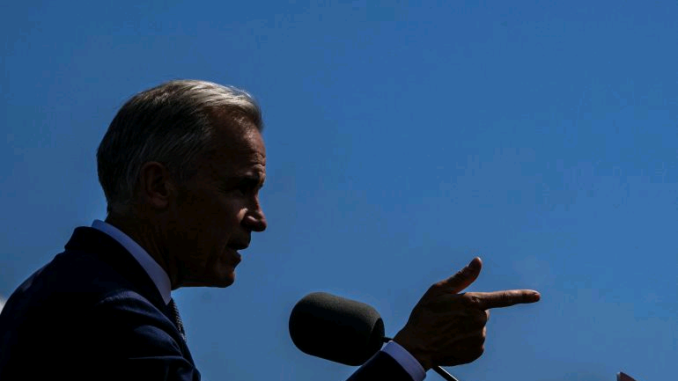
Canada’s Prime Minister Mark Carney has urged the United States to adopt a more serious and respectful approach to trade negotiations, warning that talks cannot move forward while Washington continues what Ottawa views as provocative rhetoric and unacceptable demands.
Carney’s comments come at a critical moment in relations between the two North American neighbors. Trade negotiations between Canada and the United States broke down on August 21, after Canada rejected demands that Carney said threatened important Canadian economic interests and national sovereignty. Since then, the dispute has intensified, with tariffs, retaliatory measures and increasingly sharp public exchanges putting one of the world’s most important trading relationships under renewed pressure.
Speaking on September 1, Carney made clear that Canada remains willing to negotiate, but he said the United States needs to change its approach before meaningful discussions can resume. He called on the Trump administration to “start being serious” about negotiations and criticized the use of social media posts and public attacks in place of constructive diplomacy.
The remarks highlight the difficult balance facing Carney. Canada is heavily dependent on trade with the United States, meaning a prolonged dispute could hurt Canadian businesses, workers and consumers. At the same time, Carney is under domestic pressure to demonstrate that Canada will not accept trade conditions that Ottawa believes would weaken its economy or limit its ability to make independent decisions.
The latest escalation followed the collapse of negotiations designed to establish a new framework for Canada-US trade relations.
According to Carney, Washington introduced significant demands during the final stages of negotiations involving Canada’s automotive sector, cultural protections, French-language policies and the country’s ability to establish trade relationships with other nations. Carney described the late-stage demands as a “power play” and argued that accepting them would have raised serious questions about Canadian sovereignty.
The United States has disputed Canada’s characterization of the talks. U.S. Trade Representative Jamieson Greer said Canada had declined to finalize terms that Washington believed had already been agreed upon, accusing Ottawa of introducing new demands and reversing earlier commitments.
The competing accounts demonstrate how far the two governments have moved apart. Rather than simply disagreeing over individual tariffs or market-access rules, both sides now appear to have different views of what a fair future trading relationship should look like.
For Canada, the issue is increasingly about preserving economic independence while maintaining access to its largest market. For the United States, the administration has emphasized reducing trade barriers and securing better conditions for American producers.
The breakdown in negotiations has already had concrete economic consequences.
The Trump administration imposed 50% tariffs on a range of Canadian goods, increasing pressure on Canadian exporters. Carney responded by announcing that Canada would impose retaliatory tariffs on selected American products, with the measures scheduled to take effect on September 8. The Canadian response includes products such as steel, dairy products, appliances, agricultural equipment, paper and electronics.
The dispute therefore risks developing into a broader cycle of retaliation.
When tariffs are imposed on imported goods, companies frequently face higher costs. Businesses may pass some of those costs to consumers, absorb them through lower profits or search for alternative suppliers and markets. Exporters can also suffer when their products become more expensive in foreign markets.
That is particularly important for Canada because the United States remains its dominant trading partner. Any prolonged disruption could affect manufacturing, agriculture, energy, transportation and other industries on both sides of the border.
Reuters has reported that economists have estimated the latest U.S. tariffs could eventually cost Canada tens of thousands of jobs, underscoring the potential economic consequences of the confrontation. At the same time, American businesses that depend on Canadian materials and customers could also face higher costs and disruptions.
Carney’s response represents a significant shift in the tone of Canada-US relations.
Rather than immediately returning to negotiations after the talks collapsed, the Canadian prime minister has emphasized that Canada will not simply accept a deal because it is under economic pressure.
He has repeatedly argued that Canada is prepared to defend its interests while continuing to look for opportunities to cooperate with the United States. That combination of firmness and openness has become central to his strategy.
Carney has also pushed back against what he considers disrespectful comments from American officials. In his September 1 remarks, he criticized personal attacks and social media mockery directed at Canada, saying such behavior was beneath the office of senior government officials.
His message is straightforward: Canada is prepared to negotiate, but it wants negotiations conducted as discussions between sovereign partners rather than as a process in which one side attempts to dictate terms to the other.
That position has received significant domestic support. A recent poll cited by Reuters found that 76% of Canadians approved of Carney’s decision to suspend trade talks following the breakdown.
The dispute is forcing Canadian companies to reconsider a trading relationship that many had previously regarded as relatively predictable.
For decades, businesses on both sides of the border built supply chains around the assumption that goods could move relatively freely between Canada and the United States. Industries such as automobiles are especially integrated, with components crossing the border multiple times during the manufacturing process.
A prolonged tariff dispute could therefore create problems far beyond the immediate cost of a particular import.
An automobile assembled in Canada, for example, may contain components manufactured in both countries. If tariffs are repeatedly applied as parts and finished products cross the border, the cost of production can increase throughout the supply chain.
This is one reason why Carney has focused heavily on the automotive sector. He has argued that some of the U.S. proposals could leave Canadian industries effectively dependent on American companies or weaken their long-term ability to compete.
Canadian businesses are consequently looking for alternatives. Ottawa has been emphasizing the importance of expanding trade beyond the United States, while exploring deeper economic relationships with Europe and other international partners.
Canada’s Finance Minister François-Philippe Champagne recently highlighted the country’s efforts to strengthen relationships with other countries, describing Canada as an increasingly trusted partner amid global uncertainty.
The current dispute has accelerated Canada’s efforts to diversify its economy.
For years, Canada’s close geographical proximity to the United States made the American market the obvious destination for a large share of Canadian exports. But the uncertainty created by tariffs has encouraged Ottawa to place greater emphasis on other markets.
Europe is one important target. Carney is expected to address the European Parliament later this month, as Canada seeks to deepen economic, security and political ties with European partners. His government has also spoken about increasing Canadian exports to countries outside the United States.
This does not mean Canada can quickly replace the American market. Geography, established supply chains and the sheer size of the U.S. economy make the relationship difficult to replicate elsewhere.
Nevertheless, diversification could give Canada greater leverage over time. If Canadian companies have more customers and suppliers around the world, Ottawa may be less vulnerable to sudden changes in U.S. trade policy.
That appears to be part of Carney’s broader strategy: continue engaging Washington while reducing Canada’s dependence on a single economic partner.
Although the dispute is often discussed in terms of its impact on Canada, American businesses and consumers are not immune.
Canadian companies supply American industries with energy, raw materials, manufactured goods, food and other products. Higher tariffs can raise costs for American importers, while disruptions to Canadian supply chains can create shortages or force companies to find more expensive alternatives.
The interconnected nature of the two economies means that trade barriers can have consequences on both sides.
This makes Carney’s call for serious negotiations significant. The dispute is not simply a political disagreement between two governments. It involves millions of workers and businesses whose operations depend on predictable cross-border commerce.
A negotiated settlement could therefore benefit both countries, even if neither government gets everything it wants.
For now, the biggest question is whether the United States and Canada can return to the negotiating table.
Carney has not closed the door. Instead, he has indicated that Canada is prepared to resume discussions if Washington adopts a more constructive approach.
That leaves room for diplomacy, but the path forward will not be easy.
The United States wants concessions on areas including market access and trade barriers. Canada, meanwhile, wants to protect its industries and maintain the freedom to establish trade agreements with other countries. Both governments also face domestic political pressures that could make compromise more difficult.
The September 8 Canadian retaliatory tariffs could become another important turning point. If the measures take effect as planned, the economic pressure on both governments will increase. That could either encourage negotiations or deepen the confrontation.
Much will depend on whether Washington and Ottawa can move away from public criticism and toward practical discussions.
Carney’s central message is that Canada is ready to talk—but not at any cost.
Canada and the United States have one of the world’s most extensive economic relationships. Their shared border, integrated industries and long history of cooperation make the current confrontation particularly significant.
The disagreement also demonstrates how quickly established trade relationships can become uncertain when governments use tariffs as negotiating tools.
For Carney, the challenge is to protect Canadian interests without allowing the relationship with Washington to deteriorate beyond repair. For the Trump administration, the challenge is to secure better trade terms without causing unnecessary economic damage or pushing a longtime ally toward competing markets.
Both sides have strong incentives to find common ground.
Carney’s call for the United States to “start being serious” is therefore more than a rhetorical statement. It is an invitation to return to negotiations—but on terms that Canada believes respect its sovereignty and economic interests.
Whether Washington responds positively could determine the next chapter of Canada-US relations.
For now, the message from Ottawa is clear: Canada remains willing to negotiate, but it will not accept an agreement simply because it is under pressure. The longer the tariff dispute continues, the greater the economic risks become for both countries. And with retaliatory measures approaching, the need for serious diplomacy is becoming increasingly difficult to ignore.
Leave a Reply