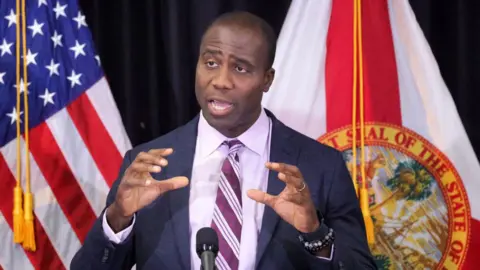
Florida Senate Confirms Surgeon General, But Every Democrat Voted Against the Doctor.. 

Florida Senate Confirms Surgeon General, But Every Democrat Voted Against the Doctor.. 

In a decision that has stirred political and public health debates across the state, the Florida Senate has officially confirmed Dr. Joseph Ladapo for another term as the state’s Surgeon General. The confirmation, which took place in the GOP-controlled chamber, was marked by a stark partisan divide: every Democrat in the Senate voted against his appointment.Dr. Ladapo, who has served as Florida’s top public health official since 2021, has been a controversial figure due to his positions on COVID-19 policies, vaccine guidance, and broader public health strategies. While Republican lawmakers praised his leadership and alignment with Governor Ron DeSantis’ health policy vision, Democrats expressed deep concerns about his approach to science, transparency, and public trust.Republican senators defended their decision to confirm Dr. Ladapo, emphasizing his credentials, experience, and willingness to challenge federal health guidelines when he believes they conflict with Florida’s needs. They argued that his independent stance has been crucial in shaping the state’s pandemic response, particularly in resisting prolonged lockdowns and vaccine mandates.

Supporters also highlighted his academic background — Dr. Ladapo is a Harvard-trained physician and researcher — as evidence of his capability to lead Florida’s Department of Health. For many Republicans, his tenure represents a commitment to “medical freedom” and a rejection of what they see as overreach by federal health agencies.Democrats, however, painted a very different picture. Their unanimous opposition stemmed from what they described as a pattern of politicizing public health and undermining scientific consensus. Several Democratic senators criticized Dr. Ladapo’s handling of COVID-19 vaccine recommendations, particularly his guidance advising against mRNA vaccines for certain age groups — a position that diverged sharply from the Centers for Disease Control and Prevention (CDC) and the Food and Drug Administration (FDA).

They also raised concerns about transparency, citing instances where they believe the Surgeon General failed to provide clear, evidence-based explanations for his policy decisions. For Democrats, the confirmation signals a troubling precedent in which political ideology outweighs scientific rigor in shaping public health policy.The confirmation of Dr. Ladapo is likely to influence Florida’s health policies for years to come. His tenure has already seen significant shifts in the state’s approach to pandemic management, vaccine distribution, and public health messaging. Supporters argue that his leadership has preserved personal freedoms and prevented economic collapse during the pandemic. Critics counter that his policies may have contributed to public confusion and lower vaccination rates, potentially putting vulnerable populations at greater risk.Beyond COVID-19, Dr. Ladapo will oversee a wide range of health initiatives, from tackling opioid addiction to addressing chronic disease prevention. His critics worry that his approach to controversial health topics could extend beyond pandemic-related issues, shaping the state’s stance on reproductive health, environmental health risks, and emerging infectious diseases.The partisan split in Dr. Ladapo’s confirmation mirrors broader national divisions over public health policy, trust in scientific institutions, and the role of government in managing health crises. In many ways, the debate over his appointment is less about one individual and more about competing visions for how public health should be governed in a politically polarized era.For Republicans, Dr. Ladapo represents a challenge to what they see as a rigid, one-size-fits-all federal health system. For Democrats, his leadership embodies the dangers of allowing political ideology to override scientific consensus.As Dr. Ladapo begins his new term, Floridians can expect continued debates over the balance between personal freedom and collective responsibility in public health. His policies will likely remain under close scrutiny, both from political opponents and from public health experts nationwide.Whether his tenure will be remembered as a bold stand for medical independence or a controversial chapter in Florida’s health history will depend largely on how his decisions impact the state’s health outcomes in the years ahead.

Be the first to comment

Leave a Reply

Your email address will not be published.


*