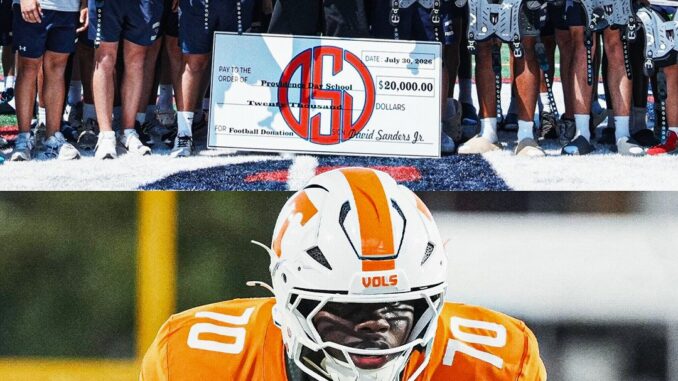
In the fast-moving world of modern college football, where Name, Image, and Likeness deals have turned young athletes into entrepreneurs almost overnight, it is easy to focus on the flashy contracts, the social media endorsements, and the big-money collectives. Yet every so often a story surfaces that cuts through the noise and reminds everyone what the game can still mean at its core. Tennessee offensive tackle David Sanders Jr. provided one of those moments when he returned to his high school campus and handed over a substantial piece of his own NIL earnings to the program that helped shape him.
On a Thursday in late July, just before the Volunteers opened preseason camp for the 2026 season, Sanders spent the day at Providence Day School in Charlotte, North Carolina. There, the towering 6-foot-6, 305-pound sophomore presented a $20,000 check drawn from his personal NIL funds and also delivered new shoulder pads and equipment through a partnership with XTech Pads. The gesture was simple in its execution and profound in its intent. Sanders stood with coaches and current players, posed for photos holding the oversized ceremonial check, and made clear that the money was meant to support the next group of Chargers who will wear the same uniform he once did.
“Having the opportunity to give back to my alma mater has been a dream come true,” Sanders said. “Giving back to a place that I hold dear to my heart means everything to me.” In a social media post that accompanied the visit he added, “Thank you to Providence Day School to allow me to come back and donate to my Alma mater. I graciously donated Providence Day with $20,000. Thank you to XTech Pads for helping me support the boys with shoulder pads as well. It’s a blessing to be able to give back.” The words carried the same straightforward sincerity that has marked his public comments since his high school days.
To understand why the donation landed with such weight, it helps to remember the path Sanders took. Growing up in Concord, North Carolina, he arrived at Providence Day with dreams that once leaned more toward basketball. Football eventually claimed him completely. By his sophomore year he was already ranked among the top prospects in the country. As a junior he earned Gatorade North Carolina Player of the Year honors, a rare distinction for an offensive lineman, while helping the Chargers dominate on both sides of the ball. He played left tackle on offense and defensive end when needed, contributing pressures, sacks, and run-stopping presence. Providence Day won three straight state championships during his time there. As a senior he graded out at an elite level, allowing zero sacks and paving the way for a high-powered offense. He was also a multi-sport athlete, competing in basketball and excelling in track and field events like the shot put and discus.
Recruiters from every major program took notice. Ohio State, Georgia, Nebraska, and others made strong pushes. Sanders ultimately chose Tennessee, becoming one of the centerpiece signees in the Volunteers’ 2025 class. Ranked as a five-star prospect and the top offensive tackle in his class by many services, he arrived in Knoxville with enormous expectations. His freshman season in 2025 did not begin smoothly. An injury sidelined him for the first four games. Once healthy he settled in at right tackle and logged 425 snaps. According to advanced metrics he surrendered only two sacks and eleven pressures across 231 pass-protection snaps. The performance earned him True Freshman All-American recognition. Heading into 2026 he has shifted to left tackle, earned preseason All-SEC honors, and is viewed as one of the top returning offensive linemen in the country. He is part of a veteran group that will be asked to protect a new starting quarterback and open lanes for a productive running game.
Against that backdrop, the decision to write a five-figure check to his high school program stands out. Many athletes in Sanders’ position use NIL earnings for cars, clothes, or investments. Others fund youth camps or personal branding. Sanders chose to send resources back to the place that developed him. The equipment donation, facilitated through XTech Pads and its Cover-2 Program, ensures that current Providence Day players have quality gear. Company president Bob Broderick noted that Sanders reaching out to ask how he could help exemplified exactly what the program aims to achieve.
The broader context of the NIL era makes the story even more meaningful. Since athletes gained the ability to profit from their name, image, and likeness, the conversation has often centered on competitive balance, booster collectives, and the professionalization of college sports. Less attention is paid to the quieter ways some players choose to deploy those resources. Charitable giving, community projects, and support for high school programs have become more visible. Sanders’ action fits into a growing pattern of athletes who view their earnings not only as personal income but as a tool for lifting the communities and institutions that launched them. Tennessee players as a group have participated in various offseason community efforts, yet few have matched the public scale of this particular gift.
For the young athletes still at Providence Day, the visit carried practical and symbolic value. High school football programs, even successful private-school ones, operate with tighter budgets than their college counterparts. New shoulder pads and a direct cash infusion can stretch limited resources, improve safety, and free up money for other needs. Beyond the material help, the presence of a recent alumnus who has already succeeded at the highest level of college football offers living proof that the pathway is real. Sanders walked the same halls, practiced on the same fields, and now returns as a Volunteer starter with national recognition. That visibility can motivate the next generation in ways no recruiting brochure ever could.
Sanders has spoken in the past about staying grounded. His parents have been credited with keeping the focus on football and family rather than the surrounding hype. He has three younger sisters, and the household has tried to limit constant sports talk. That sense of perspective appears to have carried into his early college career and into this decision. He has also expressed interest in eventually becoming a doctor, a goal that suggests a longer view of life beyond the gridiron. Giving back while still a young man in the middle of his playing career aligns with that outlook.
The timing of the donation added another layer. It came during the final window of downtime before the intense grind of SEC preseason preparation. Instead of resting or handling personal business, Sanders chose to travel home and make the presentation in person. The photos from the day show him surrounded by the current squad, smiling, check in hand, looking every bit the big brother returning to encourage the younger ones. Those images circulated quickly among Tennessee fans and high school circles in North Carolina, generating widespread appreciation.
In an era when criticism of NIL sometimes focuses on excess or entitlement, moments like this offer a counter-narrative. Sanders did not wait until the end of his career or until he reached the NFL to share his success. He acted while still early in his college journey, when every dollar of earnings still carries personal significance. The $20,000 represents a tangible sacrifice and a clear statement of values. It says that the program that invested in him deserves investment in return. It says that success is sweeter when it creates opportunity for others.
As the 2026 season approaches, Sanders will return his full attention to protecting the left edge for the Volunteers and helping the offensive line establish consistency. His individual goals will likely include All-SEC recognition and continued growth into one of the premier tackles in the conference. Yet the memory of that Thursday in Charlotte will travel with him. For Providence Day School, the gift will be felt in practices and games for seasons to come. For college football observers, the story serves as a reminder that even in a landscape transformed by money and media, the simple act of giving back still carries power.
David Sanders Jr. did not need to make the donation. He chose to. In doing so he elevated not only his alma mater’s football program but also the conversation around what NIL can accomplish when athletes treat it as more than a paycheck. The next group of Chargers will lace up those new pads knowing a Volunteer has their back. And Tennessee fans can take pride in knowing one of their own understands that the path from high school to college is a circle, not a one-way street.
Leave a Reply