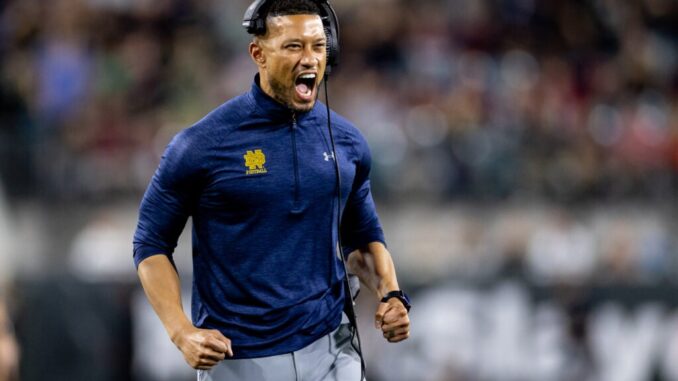
For years, Marcus Freeman has talked about the importance of building Notre Dame from the inside out.
The Fighting Irish head coach has repeatedly emphasized the value of winning at the line of scrimmage, believing that championship teams must be strong, physical and talented in the trenches. In an era when college football recruiting conversations are often dominated by quarterbacks, wide receivers and defensive backs, Freeman has taken a different approach.
He has made the offensive and defensive lines a priority.
Now, Notre Dame’s 2027 recruiting class is providing perhaps the clearest evidence yet that Freeman’s line-driven philosophy is not simply a talking point. The Fighting Irish have assembled a remarkable group of highly regarded linemen, creating a foundation that could shape the program for years to come.
The class has become one of the most impressive recruiting groups in the country, with elite talent concentrated heavily along both sides of the line of scrimmage. Notre Dame’s approach is clear: build strength where games are often won and lost.
That strategy is reflected in the caliber of players joining the class.
One of the biggest additions is five-star offensive lineman Albert Simien, a highly regarded interior prospect from Louisiana who chose Notre Dame over several major programs, including LSU and Texas A&M. His commitment gave the Irish another elite piece for the future of the offensive line and demonstrated the program’s ability to win major recruiting battles in regions traditionally dominated by other national powers.
Simien’s decision was significant for more than just the individual talent he brings.
It showed that Notre Dame can sell elite offensive linemen on the opportunity to develop in South Bend and become part of a program that places enormous value on the trenches. For a player of his caliber, the choice represented a major recruiting victory for Freeman and offensive line coach Joe Rudolph.
But Simien is only one part of the larger picture.
Notre Dame has continued to add elite offensive line talent, including highly rated tackle Oluwasemilore Olubobola and offensive lineman James Halter. Together, those commitments give the Fighting Irish an impressive foundation for the future.
The goal is not simply to collect highly ranked recruits.
The goal is to create depth.
That distinction matters.
College football seasons are long and physically demanding. Injuries are inevitable, and teams competing for national championships must have multiple players capable of stepping into important roles. A strong recruiting class along the offensive line can provide a program with options for years.
Notre Dame appears to understand that.
The same approach has been applied to the defensive line.
The Fighting Irish have assembled a group of talented defensive linemen who could eventually give the program the type of depth and explosiveness needed to compete against the best offenses in the country.
Among the notable names is five-star edge rusher Abraham Sesay, whose talent gives Notre Dame a potential difference-maker on the defensive front. Defensive tackle David Folorunsho has also emerged as another important piece of the class.
The recent addition of Chicago defensive lineman Brayden Parks further strengthened the group. Parks is a powerful interior defender with the size, leverage and physicality to become a major contributor at the next level.
His decision to choose Notre Dame over programs such as Oregon, Ohio State, Michigan, Alabama and Miami was another example of the recruiting battles the Irish are now winning.
The significance of the class is not limited to its national ranking.
What makes the 2027 group so important is the way it reflects Freeman’s philosophy.
Since taking over at Notre Dame, Freeman has spoken about the need to develop a team capable of winning physically. That does not mean the Fighting Irish cannot have a creative offense or elite skill-position talent. It means the foundation of the team must be strong enough to control games when everything else becomes difficult.
The best teams can win in different ways.
They can throw the football. They can run the football. They can pressure the quarterback. They can stop the run.
All of those abilities begin with the line of scrimmage.
Freeman appears determined to make sure Notre Dame has the talent necessary to compete there.
That philosophy is particularly important as the college football landscape becomes more competitive. Notre Dame is competing against programs with enormous resources and national recruiting reach. The Fighting Irish cannot afford to build a roster that is talented in only one area.
They must develop complete teams.
The 2027 recruiting class represents a major step in that direction.
The class also highlights the importance of long-term planning. The players committing today will not all be expected to become immediate stars. Some will need time to develop physically. Others may compete for early playing time.
But Notre Dame is building a pipeline.
The goal is to have talented linemen arriving every year so the program never reaches a point where it is forced to rely on inexperienced players because of a lack of depth.
That is how championship programs are built.
The offensive line, in particular, has become a major focus for Notre Dame. The Irish have historically valued strong offensive line play, and Freeman’s recruiting efforts suggest that tradition remains central to the program’s identity.
A powerful offensive line can make life easier for everyone else.
It can protect the quarterback, create running lanes and allow an offense to remain balanced. It can also help control the tempo of a game and keep a defense off the field.
On the other side, a dominant defensive line can completely change a game.
Pressure on the quarterback can disrupt an opponent’s offensive plan. Strong interior defenders can close running lanes. Versatile edge players can create problems for opposing offensive coordinators.
Notre Dame’s 2027 class appears designed to provide those advantages.
The strategy also sends a message to the rest of college football.
Notre Dame is not simply attempting to recruit a few highly rated players. The Fighting Irish are attempting to establish themselves as one of the premier destinations for elite linemen in the country.
That is a major development for Freeman.
Recruiting success is often about momentum. When a program consistently lands elite players at a particular position, future recruits take notice. Players begin to see a clear pathway for development and success.
Notre Dame is building that type of momentum along the line of scrimmage.
The program’s success in the 2027 cycle is also a reflection of the work being done by the coaching staff. Freeman has surrounded himself with coaches capable of identifying talent, building relationships and selling Notre Dame’s vision.
The results are beginning to show.
The Fighting Irish have created a recruiting class that has become one of the strongest in the country, and its strength is concentrated in the very areas Freeman has repeatedly identified as priorities.
That is why the 2027 class matters so much.
It provides tangible evidence that Freeman’s words are being matched by action.
He said Notre Dame needed to become line-driven.
The recruiting class is filled with elite linemen.
He said the Irish needed to compete nationally for the best talent.
Notre Dame has won major recruiting battles against some of the biggest programs in college football.
He said the program needed to build a foundation for championship success.
The 2027 class is helping create that foundation.
Of course, recruiting rankings alone do not guarantee championships.
Every player must still develop. Every coach must continue to teach. Every team must eventually prove itself on the field.
But recruiting is where the process begins.
Notre Dame’s 2027 class gives the program an opportunity to develop a deep and talented group of players who could eventually become the core of a championship contender.
For Freeman, that is likely the most important part of the entire process.
He is not simply trying to win recruiting headlines.
He is trying to build a program capable of sustaining success.
That requires depth. It requires physicality. It requires elite coaching.
And it requires winning the battles at the line of scrimmage.
The 2027 class suggests that Notre Dame is moving in that direction.
Freeman’s line-driven philosophy is no longer just something he discusses in interviews or press conferences. It is visible in the makeup of the players choosing to join his program.
The Fighting Irish are building from the trenches outward.
That approach may not always produce the flashiest headlines, but it could ultimately be the foundation of Notre Dame’s return to the highest level of college football.
If the players in this class develop as expected, the impact could be felt for years. The offensive line could become deeper and more talented. The defensive front could develop into one of the most difficult groups in the country to block.
And Notre Dame could become the type of team Freeman has always envisioned.
A team that can win with talent, discipline and physicality.
A team that does not depend on one player or one position.
A team that can compete against anyone when the game is decided in the trenches.
That is the true significance of Notre Dame’s 2027 recruiting class.
It is not simply a collection of highly rated prospects.
It is a statement of intent.
Marcus Freeman has said that the future of Notre Dame football must be built at the line of scrimmage.
The 2027 recruiting class suggests he meant every word.
Leave a Reply