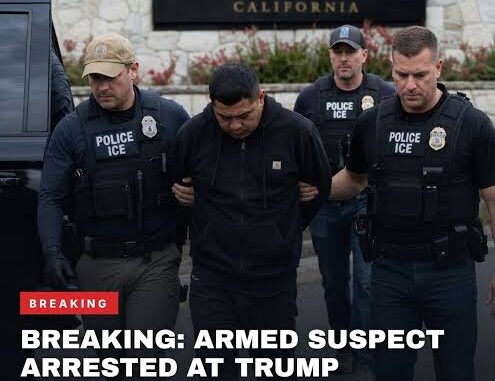
Armed Man Arrested Near Trump’s Golf Course Ahead of Presidential Visit
Law enforcement authorities arrested an armed man near one of President Donald Trump’s California golf properties ahead of a planned presidential visit, prompting heightened security measures in the area. The arrest occurred as federal, state, and local authorities were preparing for Trump’s arrival, adding another layer of concern to an already closely monitored security operation.
Officials have stressed that the incident was handled before the president’s scheduled visit and that there was no indication that Trump was placed in immediate danger. The suspect was taken into custody, while investigators worked to determine the circumstances surrounding the weapons and whether the individual had any connection to the planned presidential visit.
The arrest has attracted attention largely because of its timing. Presidential travel involves extensive security preparations, particularly when the president is visiting a private property or location that regularly attracts members of the public. Security agencies typically begin planning well ahead of the president’s arrival, assessing potential threats and coordinating with local authorities to make sure access to the area is carefully controlled.
The discovery of an armed individual in the vicinity therefore prompted authorities to respond quickly.
According to information released by law enforcement, officers encountered the suspect while carrying out security-related activity connected to the area around the golf course. Authorities subsequently determined that the man was in possession of weapons that raised legal concerns. He was arrested, and investigators began examining the circumstances surrounding the case.
Officials have not indicated that the suspect attempted to enter the golf course or directly approach President Trump. There has also been no public confirmation that the man had a specific plan targeting the president. Those distinctions are important because investigators must establish intent through evidence rather than simply assume a connection based on the timing of an arrest.
The case remains under investigation, and authorities are expected to examine the suspect’s background, movements, communications, and possession of the weapons as they work to determine whether additional charges are appropriate.
Presidential security operations are among the most complicated assignments undertaken by American law enforcement. Whenever a president travels, the U.S. Secret Service coordinates with numerous agencies to establish a protective perimeter and identify potential threats.
Local police departments often provide additional officers, while federal agencies may assist with intelligence gathering and threat assessments. Emergency medical personnel and other public-safety agencies are also incorporated into the planning process.
The objective is to identify potential problems before they become emergencies.
That approach appears to have played an important role in this case. By taking the suspect into custody ahead of the planned visit, authorities were able to address the situation without allowing it to interfere with the president’s movements.
The incident also highlights the challenges of protecting a president at a location outside a heavily controlled government facility.
Trump’s golf properties have become familiar locations during his time in public life. They are private facilities, but presidential visits can transform them into temporary high-security zones. Roads may be monitored, access points restricted, and nearby areas placed under increased observation.
Members of the public who live or work nearby may also notice a significant increase in law enforcement activity.
For authorities, the challenge is finding the right balance between maintaining normal activity and ensuring that potential threats are identified quickly. A single suspicious individual can require an immediate investigation, particularly when weapons are involved and a presidential visit is approaching.
Law enforcement officials have generally avoided releasing unnecessary details while the investigation continues. This is standard practice in cases involving weapons and potential security threats because investigators do not want to compromise evidence or reveal information that could affect the case.
The lack of immediate information has also created room for speculation, but officials have urged the public to rely on confirmed facts rather than assumptions.
At this stage, the most important confirmed development is that an armed man was arrested near the golf course and that authorities addressed the situation before the president’s planned arrival.
There has been no reported confrontation involving Trump, and there is no indication that the president was forced to cancel his activities because of the incident.
For the Secret Service and other agencies involved in presidential protection, such an outcome represents the purpose of advance security planning. Protection is not simply about responding when a dangerous situation occurs. It is also about identifying potential concerns early and taking appropriate action before they escalate.
Security experts frequently emphasize that preventive measures are among the most important elements of protecting high-profile public officials. Officers may investigate suspicious behavior, monitor potential threats, and coordinate with other agencies long before the public becomes aware that anything unusual is happening.
In this case, the arrest demonstrates how quickly law enforcement can respond when a potential weapons-related threat emerges near a presidential location.
The legal consequences for the suspect will depend on the evidence collected by investigators and the specific weapons allegedly found in his possession. California and federal laws impose various restrictions on firearm possession, carrying, transportation, and other weapons-related conduct.
Depending on the circumstances, prosecutors could pursue charges under state law, federal law, or both.
However, an arrest itself does not establish guilt. The suspect remains entitled to due process, and prosecutors must prove any criminal allegations in court. Investigators will therefore need to establish exactly what weapons were involved, where they were found, whether the suspect was legally permitted to possess them, and whether there were other circumstances that could affect the case.
Authorities may also investigate whether the suspect had any prior criminal history or previous interactions with law enforcement.
Another important question is whether the weapons were discovered as part of a broader investigation or during routine security preparations. The answer could provide additional context about how authorities became aware of the individual.
For now, officials have focused on maintaining public safety and ensuring that the presidential visit could proceed without unnecessary disruption.
The incident is also a reminder that presidential movements require extraordinary preparation. Even routine visits to familiar locations involve advance teams, security assessments, communications planning, transportation coordination, and emergency response preparations.
Trump’s status as a highly visible political figure further increases the level of attention surrounding his movements. His public appearances frequently attract supporters, protesters, media organizations, and security personnel, creating an environment in which law enforcement must remain vigilant.
Despite the circumstances surrounding the arrest, authorities have emphasized that there was no immediate danger to the president.
That distinction is important. The presence of an armed individual near a presidential location is understandably serious, but it does not automatically mean that an assassination attempt or direct attack was underway. Investigators must establish the facts before determining whether the suspect had any connection to Trump or his scheduled visit.
As the investigation continues, more information could emerge about the suspect, the weapons involved, and the events that led to the arrest. Authorities are expected to provide additional details when doing so will not interfere with the investigation or any potential prosecution.
For now, the case demonstrates the importance of coordinated security efforts around presidential travel. The arrest took place before the planned presidential visit, allowing authorities to remove a potential source of concern without reported injuries or a direct confrontation.
While questions about the suspect’s intentions remain unanswered, the swift response by law enforcement has ensured that the situation is being handled through the appropriate legal and investigative channels.
Ultimately, the incident serves as another reminder of the unique security challenges that accompany presidential travel. Protecting the president requires constant awareness, careful preparation, and cooperation between agencies at every level.
In this case, authorities acted quickly after identifying an armed individual near Trump’s California golf course. With the suspect in custody and the investigation underway, officials can now focus on determining exactly what happened, why the individual was armed, and whether any further action is necessary.
Until investigators complete that work, the strongest conclusion is also the simplest: an armed man was arrested near a location scheduled to host President Trump, authorities responded before the presidential visit, and officials have found no evidence publicly establishing that the president was in immediate danger.
Leave a Reply