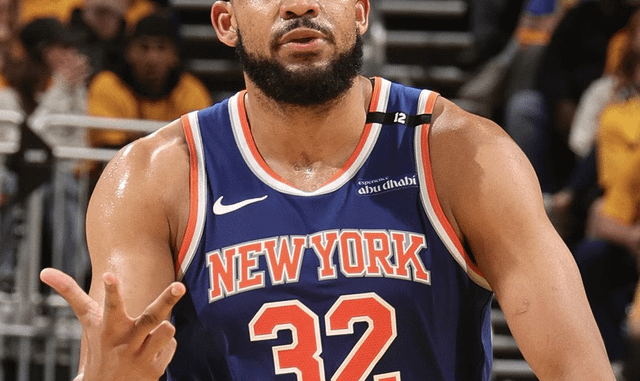
The New York Knicks have entered one of the most important stretches of their offseason, and much of the attention is centered on Karl-Anthony Towns and his long-term future with the franchise. Although Towns is eligible to sign a massive four-year contract extension worth as much as $272 million, reports indicate that negotiations have not moved as quickly as some expected. Instead, the Knicks are reportedly taking a patient approach as they work to preserve financial flexibility while continuing to build a championship-caliber roster.
The delay has naturally sparked questions among fans and NBA analysts. Whenever a superstar becomes eligible for a lucrative extension, expectations often point toward an immediate agreement. However, the current situation appears to be less about uncertainty regarding Towns’ future and more about the Knicks carefully balancing their long-term financial commitments.
League insiders continue to believe that both sides remain interested in reaching an agreement. The challenge is finding a contract structure that rewards Towns while also allowing New York to maintain enough salary cap flexibility to strengthen its roster in the coming years.
Towns joined the Knicks in one of the most significant trades in recent franchise history. The organization viewed him as a player capable of elevating New York from a playoff contender into a legitimate championship threat. His arrival immediately generated excitement throughout the fan base, and expectations increased as the Knicks assembled one of the deepest and most talented rosters in the Eastern Conference.
During his first season in New York, Towns showed exactly why the Knicks made such an aggressive move to acquire him. His offensive versatility once again separated him from nearly every other center in the NBA. Few players at his position possess the combination of size, shooting ability, passing vision, and post-scoring skills that have defined his career.
Whether stretching the floor with three-point shooting, finishing around the basket, or creating offense for teammates, Towns consistently proved capable of impacting games in multiple ways. His presence forced opposing defenses into difficult decisions, opening opportunities for teammates while making New York’s offense significantly more dynamic.
His performances also reinforced his reputation as one of the league’s premier offensive big men. Even after nearly a decade in the NBA, Towns continues to evolve his game while adapting to different teammates and coaching philosophies.
Because of those contributions, many around the league assumed a contract extension would quickly follow. Instead, negotiations have reportedly slowed as the Knicks carefully evaluate their long-term payroll situation.
The timing is significant because the NBA’s current financial landscape is unlike any previous era. Recent changes to the league’s collective bargaining agreement have introduced stricter penalties for teams that exceed certain payroll thresholds. Those rules have dramatically changed the way front offices approach roster construction.
Rather than simply paying luxury taxes, franchises now face additional restrictions on trades, free-agent signings, and roster flexibility if payroll climbs too high. As a result, even teams willing to spend heavily must carefully consider every major contract before making long-term commitments.
That reality appears to be influencing New York’s approach with Towns.
Although the All-Star is reportedly eligible for a maximum extension worth approximately $272 million over four years, committing that amount would significantly affect the Knicks’ future financial flexibility. Every dollar allocated to one player influences the organization’s ability to retain other contributors or pursue additional talent in future seasons.
Reports suggest the Knicks would prefer reaching an agreement that provides Towns with long-term security while preserving enough flexibility to keep the roster competitive around him.
This type of negotiation has become increasingly common throughout the NBA.
Teams are no longer evaluating contracts based solely on whether a player deserves maximum money. Instead, executives are constantly weighing how each deal affects the overall roster several years into the future.
For a franchise with championship aspirations, maintaining roster depth is just as important as retaining star players.
The Knicks understand that championships are rarely won by one or two players alone. Successful teams require quality role players, reliable veterans, and enough financial flexibility to make adjustments when unexpected opportunities arise.
If New York commits the full maximum extension to Towns, the front office must also consider future negotiations involving other key players. Those decisions become increasingly difficult under the league’s updated salary cap rules.
From Towns’ perspective, however, seeking maximum value is entirely understandable.
He has consistently performed at an elite level throughout his NBA career. Since entering the league as the first overall pick in the 2015 NBA Draft, Towns has established himself as one of basketball’s most accomplished centers. Multiple All-Star appearances, All-NBA recognition, and a reputation as one of the greatest shooting big men in league history have positioned him among the NBA’s highest-paid players.
Players of his caliber typically expect contracts that reflect both their production and market value.
After making a seamless transition to New York and helping strengthen the Knicks’ championship hopes, Towns understandably believes he has earned another long-term commitment from the organization.
At the same time, reports indicate there is no significant conflict between the player and the franchise.
Instead, both sides appear to recognize that negotiations involving contracts of this magnitude require patience.
Large NBA extensions often involve discussions beyond total salary. Contract length, guaranteed money, player options, trade protections, bonuses, and payment structures can all influence the final agreement.
Because of those complexities, negotiations sometimes extend well beyond the initial period of eligibility.
The Knicks’ front office has built a reputation for making calculated decisions rather than rushing into agreements. That philosophy has helped reshape the franchise into one of the Eastern Conference’s strongest teams over the past several seasons.
Rather than sacrificing long-term flexibility for short-term headlines, New York has generally prioritized sustainable roster building.
Keeping Towns remains a major priority because his skill set is difficult to replace. Centers capable of scoring efficiently inside while stretching defenses with perimeter shooting remain among the league’s rarest talents.
Beyond his individual production, Towns has also developed strong chemistry with his teammates.
Throughout his first season with the Knicks, his understanding of the offensive system steadily improved. His ability to complement New York’s other stars created matchup problems that few opponents could consistently solve.
His leadership has also drawn praise.
Although he joined an established locker room, teammates have frequently spoken about his professionalism, work ethic, and willingness to embrace New York’s demanding basketball culture.
Those qualities further strengthen the argument for keeping him as part of the franchise’s long-term core.
Fans, meanwhile, remain optimistic despite the ongoing negotiations.
While every delay naturally creates speculation, many understand that today’s NBA financial environment requires careful planning. Teams pursuing championships must think several years ahead rather than focusing exclusively on the upcoming season.
The Knicks appear determined to follow that philosophy.
If reaching a slightly different contract structure today creates greater flexibility tomorrow, the organization may ultimately believe the patience is worthwhile.
For Towns, securing a long-term extension would remove uncertainty and allow him to focus entirely on basketball heading into another season filled with championship expectations.
For New York, finalizing the agreement would reinforce its commitment to one of the league’s premier talents while maintaining continuity for a roster capable of competing with the NBA’s elite.
Despite reports that negotiations have slowed, there remains widespread belief around the league that both sides ultimately want the same outcome.
The Knicks want Towns leading their frontcourt for years to come, and Towns has repeatedly expressed excitement about playing in New York and helping restore the franchise to championship glory.
As the offseason continues, all signs suggest that patience—not panic—is driving the current negotiations.
The numbers involved may be enormous, but so are the stakes. With a potential $272 million extension on the table, both Karl-Anthony Towns and the Knicks understand the importance of reaching an agreement that benefits both the player and the franchise. If that happens later this summer, the temporary delay will likely be remembered as nothing more than a necessary step in securing one of the NBA’s most important long-term partnerships.
Leave a Reply