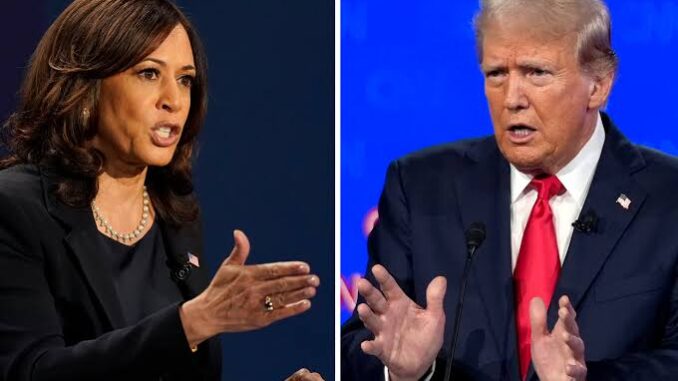
Kamala Harris Fires Back at Trump’s Claim She ‘Turned Black’ for Political Gain, Calling Remarks Divisive and Detached From Reality
Vice President Kamala Harris has forcefully responded to former President Donald Trump’s repeated claim that she “turned Black” for political gain, dismissing the accusation as false, offensive, and another example of rhetoric designed to divide Americans along racial and political lines.
The renewed exchange has once again placed race, identity, and political discourse at the center of the 2024 election conversation, with Harris emphasizing that her heritage has never been a matter of convenience or political calculation.
Trump’s comments, which resurfaced during his campaign, questioned Harris’ racial identity by suggesting she had only recently begun identifying as Black after previously emphasizing her Indian heritage. The remarks sparked immediate backlash from political leaders, civil rights advocates, and members of both major parties, many of whom described the statements as misleading and inflammatory.
Responding publicly, Harris rejected the accusation outright, saying her identity has remained consistent throughout her life and that attempts to rewrite her personal history reflect a broader strategy of distraction rather than a serious discussion about issues affecting Americans.
“My identity is not something that changes depending on the political moment,” Harris said while addressing supporters. “I’ve always been proud of who I am, where I come from, and the family that raised me.”
Harris, the daughter of an Indian mother and a Jamaican father, has long spoken about growing up in a multicultural household. Throughout her career—as a prosecutor, California attorney general, U.S. senator, and now vice president—she has openly discussed both sides of her heritage, often highlighting the values instilled by her parents and the diverse communities that shaped her upbringing.
Supporters argue that Trump’s claim ignores years of public records, interviews, speeches, and biographical information documenting Harris’ background. They note that she attended Howard University, one of America’s most prominent historically Black colleges and universities, and has consistently participated in organizations and events connected to both her Black and South Asian identities.
Political analysts say the controversy reflects a broader pattern in American politics, where candidates’ backgrounds and identities increasingly become subjects of public debate alongside policy positions.
According to experts, Harris has never hidden or altered her heritage. Instead, she has repeatedly embraced her dual identity, often describing herself as both Black and Indian American while recognizing the unique experiences that come with belonging to multiple cultural communities.
The exchange has generated widespread discussion on social media, where millions of users weighed in on the controversy. While critics accused Trump of attempting to provoke controversy and energize his political base, supporters defended his remarks as questioning political messaging rather than Harris’ ancestry.
Nevertheless, historians and scholars of race have pointed out that multiracial identity is a complex and well-established aspect of American society. They argue that individuals with parents from different racial or ethnic backgrounds are not required to identify with only one part of their heritage.
Civil rights organizations also criticized Trump’s comments, warning that questioning someone’s racial identity for political purposes risks reinforcing harmful stereotypes and deepening social divisions.
For Harris, the controversy has become another example of what she describes as an effort to divert attention from substantive issues such as the economy, healthcare, reproductive rights, and national security.
Speaking to supporters, she urged voters to remain focused on policies rather than personal attacks.
“There are real challenges facing families across this country,” Harris said. “People deserve leaders who are talking about lowering costs, creating opportunities, protecting freedoms, and strengthening our democracy—not questioning someone’s identity.”
The White House also defended the vice president, with administration officials describing Trump’s comments as baseless and emphasizing Harris’ longstanding public record.
Political observers note that identity has frequently been a topic in presidential campaigns, particularly for candidates who break historical barriers. Harris made history in 2021 when she became the first woman, the first Black American, and the first South Asian American to serve as vice president of the United States.
That historic achievement, supporters argue, reflected the multiple communities she represents rather than a change in how she identifies herself.
Republican strategists, meanwhile, have maintained that voters are more concerned with economic conditions, immigration, and inflation than with debates over identity. Some within the party have suggested that controversies like this resonate with certain segments of the electorate, while others have questioned whether such remarks distract from broader campaign priorities.
Democratic leaders quickly rallied behind Harris, condemning Trump’s statements and accusing him of employing divisive rhetoric intended to shift public attention away from policy debates.
Several lawmakers emphasized that Harris’ background has been publicly documented for decades and argued there is no factual basis for claims that she recently embraced one aspect of her heritage for political advantage.
The controversy has also reignited broader conversations about the experiences of multiracial Americans, many of whom say they have long faced questions or assumptions about their identities based on appearance or public perception.
Community leaders say Harris’ experience highlights the challenges many people with diverse backgrounds encounter when others attempt to define their identity for them.
Political communication experts suggest that the dispute may ultimately reinforce existing political divisions rather than persuade undecided voters. While supporters on both sides remain deeply engaged, many independent voters continue to prioritize issues affecting their daily lives, including housing costs, jobs, education, and healthcare.
Still, the exchange has underscored how personal identity remains a powerful—and often contentious—element of modern American politics.
As the presidential campaign continues, Harris has indicated she does not intend to allow such attacks to define her candidacy or distract from the administration’s agenda. Instead, she has sought to redirect public attention toward policy discussions and the broader stakes of the election.
Trump, meanwhile, has continued to defend his comments, insisting he was highlighting what he views as political messaging rather than making a personal attack. His campaign has maintained that voters should evaluate candidates based on their records and public statements.
The debate over Harris’ identity is unlikely to disappear entirely as the campaign progresses. However, political analysts believe the long-term impact will depend less on the controversy itself and more on how each campaign addresses the issues voters consistently rank as their highest priorities.
For Harris, her response has been clear and consistent: her identity is rooted in her family’s history, her lived experience, and a lifetime of public service—not political expediency. She has repeatedly stated that she is proud of every part of her heritage and remains committed to representing all Americans, regardless of race or background.
As election season intensifies, the exchange serves as another reminder that political campaigns often extend beyond debates over policy into deeply personal questions of identity, history, and representation. Whether the controversy changes voters’ opinions remains uncertain, but it has once again highlighted the role race and identity continue to play in shaping America’s political landscape.
Leave a Reply