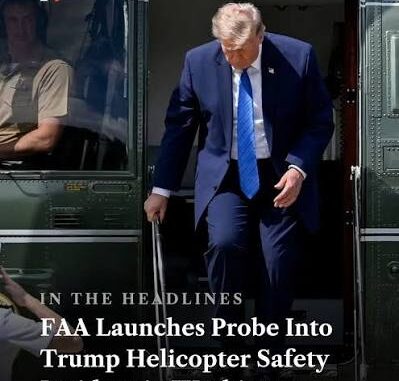
The Federal Aviation Administration (FAA) has opened an investigation into an aviation safety incident involving a military helicopter transporting President Donald Trump and a commercial passenger aircraft departing from Ronald Reagan Washington National Airport. Although the two aircraft came closer to one another than safety officials would have preferred, federal authorities emphasized that the president was never in danger and that both flights continued safely without incident.
The event has nevertheless drawn significant attention because it involved the aircraft carrying the nation’s commander-in-chief as well as one of the busiest and most closely monitored airspaces in the United States. The investigation is expected to focus on how the two aircraft came into close proximity, whether established procedures were followed, and whether any additional measures are needed to prevent similar situations in the future.
According to preliminary information released by aviation officials, the military helicopter was conducting a routine presidential transport mission while a commercial passenger jet was taking off from Ronald Reagan Washington National Airport. During the departure sequence, air traffic controllers observed that the two aircraft came closer than the standard separation typically maintained within controlled airspace.
Officials quickly clarified that despite the reduced distance between the aircraft, there was no immediate threat of a collision. Air traffic controllers remained in communication with both crews, and the situation was managed without any emergency action being required. Both aircraft continued on their planned routes, and all passengers and crew members arrived safely.
The White House also sought to reassure the public by stating that President Trump was never placed in danger during the incident. Military flight crews responsible for presidential transportation undergo extensive training and operate under strict security and safety procedures designed to protect the president during every stage of a flight.
Even so, any event involving presidential transportation receives extraordinary scrutiny. The aircraft used to transport the president are among the most carefully coordinated flights in the world, with military personnel, Secret Service agents, and civilian aviation authorities working together to ensure safe operations. Because of these high standards, even relatively minor deviations from expected separation requirements often trigger formal reviews.
The FAA confirmed that it has begun collecting radar data, air traffic control communications, flight tracking information, and operational reports from all parties involved. Investigators will reconstruct the movements of both aircraft to determine exactly how close they came and whether the separation complied with applicable safety standards.
The National Transportation Safety Board (NTSB) may also monitor the investigation if additional technical review becomes necessary, although the FAA is leading the inquiry.
Ronald Reagan Washington National Airport presents unique operational challenges compared with many other airports across the country. Located just a few miles from the White House, the Capitol, and the Pentagon, the airport operates within one of the most restricted and carefully managed pieces of airspace in the United States.
Commercial airlines, military aircraft, law enforcement helicopters, emergency medical flights, and government transportation missions all operate within relatively close proximity. As a result, air traffic controllers working in the Washington area must coordinate a wide variety of aircraft movements while maintaining strict safety margins.
Presidential flights add another layer of complexity.
Whenever the president travels by helicopter, temporary flight restrictions and specialized routing procedures are often implemented. Military helicopters transporting the president routinely operate between the White House, Joint Base Andrews, Camp David, and other secure locations.
Despite these carefully planned operations, the surrounding airspace remains active with scheduled airline traffic serving thousands of travelers each day.
Aviation experts note that close-proximity incidents do not necessarily indicate that a collision was imminent. Modern air traffic management relies on multiple overlapping safety systems, including radar surveillance, controller instructions, aircraft transponders, onboard collision-avoidance technology, and standardized separation procedures.
If one layer experiences an unexpected challenge, additional safeguards are designed to prevent accidents.
Those systems appear to have functioned as intended during this incident.
Controllers monitored both aircraft, maintained communication, and ensured that each flight proceeded safely. Still, aviation regulators treat every reduction in aircraft separation seriously because even routine deviations can provide valuable lessons for improving operational procedures.
Commercial aviation remains one of the safest forms of transportation in the world, largely because regulators investigate incidents even when no injuries or damage occur. Instead of waiting for accidents to expose weaknesses, aviation authorities examine smaller events to identify opportunities for improvement before more serious situations develop.
That philosophy has contributed significantly to the industry’s outstanding safety record over several decades.
For airlines operating at Reagan National Airport, efficient coordination with military and government flights is part of everyday operations. Pilots flying into and out of Washington receive specialized instructions from controllers and follow tightly managed departure and arrival procedures designed specifically for the region’s congested airspace.
Military crews transporting senior government officials are equally accustomed to operating alongside civilian traffic while following strict operational protocols.
The FAA investigation will likely examine whether weather conditions, aircraft speed, communication timing, routing decisions, or controller workload contributed to the reduced separation. Investigators typically avoid assigning blame during the early stages of an inquiry, instead focusing on gathering all available evidence before reaching conclusions.
Officials may also review whether existing procedures should be modified to provide additional separation during future presidential movements near commercial airports.
Security experts point out that presidential transportation missions involve far more coordination than ordinary flights. Every movement is planned in advance with input from multiple federal agencies. Flight routes, timing, and security arrangements are carefully developed to minimize risks while allowing the president to travel efficiently.
Because of that extensive planning, even a relatively minor operational issue naturally attracts widespread attention.
The incident also serves as a reminder of the immense responsibility carried by America’s air traffic controllers. Working in one of the nation’s busiest aviation corridors requires constant concentration, rapid decision-making, and precise communication. Controllers must manage dozens of aircraft simultaneously while adapting to changing weather, traffic patterns, and operational priorities.
Their ability to maintain order within complex airspace is one of the key reasons commercial aviation continues to achieve exceptionally high safety standards.
Passengers aboard the departing commercial flight were reportedly unaware of the situation as it unfolded. From their perspective, the departure proceeded normally, highlighting how many aviation safety events are managed behind the scenes by trained professionals without disrupting travelers.
Similarly, President Trump continued his scheduled travel without interruption. White House officials reiterated that the president remained safe throughout the flight and that the military crew followed established procedures during the mission.
As the FAA continues its investigation, aviation professionals across the country will be watching closely for any recommendations that emerge from the review. Even incidents that end without injuries often result in updated guidance, revised procedures, or additional training designed to further strengthen aviation safety.
The findings may also contribute to broader discussions about managing increasingly complex airspace around major metropolitan areas, particularly those where civilian, military, and government aircraft routinely operate together.
Ultimately, the incident underscores the aviation industry’s commitment to continuous improvement. While officials have stressed that President Trump was never in danger and that there was no accident, the FAA’s decision to conduct a thorough investigation reflects the agency’s longstanding approach to safety: every incident deserves careful examination, every lesson is worth learning, and every opportunity to strengthen the nation’s aviation system should be pursued.
As investigators analyze radar data, flight records, and controller communications in the coming weeks, the goal will not simply be to understand what happened but to ensure that America’s already robust aviation safety system continues to evolve and protect everyone who flies—from commercial passengers to the president of the United States.
Leave a Reply