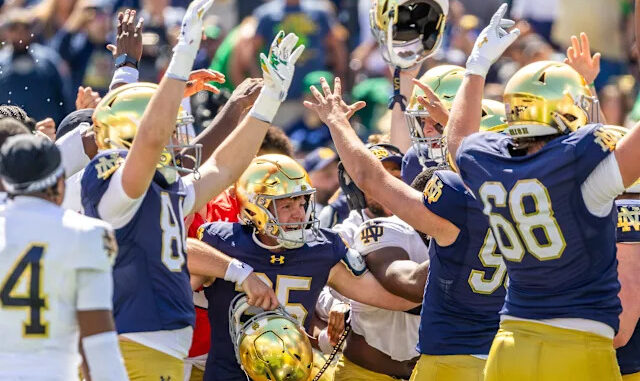
Twelve years have passed since one of the most challenging moments in recent Notre Dame football history, when the university suspended five members of the Fighting Irish football team while conducting an investigation into allegations of academic misconduct. What began as an internal review quickly became national news, placing one of college football’s most respected programs under an uncomfortable spotlight just weeks before the start of the 2014 season.
For Notre Dame, an institution that has long prided itself on balancing athletic excellence with academic integrity, the investigation represented more than just a football story. It became a defining test of the university’s commitment to the values it has consistently promoted for generations. While the suspensions significantly affected the team’s preparations and raised questions about the program, the university’s response demonstrated its willingness to prioritize academic standards over competitive success.
Looking back more than a decade later, the incident remains an important chapter in Notre Dame’s history and serves as a reminder that no athletic program, regardless of its tradition or reputation, is immune from challenges involving academic accountability.
The controversy emerged during the summer of 2014 when Notre Dame announced that five football players had been withheld from practice and competition pending the outcome of an investigation into possible academic dishonesty. The timing could hardly have been worse. The Fighting Irish were preparing for another highly anticipated season under head coach Brian Kelly, and expectations surrounding the program remained high following its appearance in the BCS National Championship Game two seasons earlier.
The players involved included several key contributors expected to play significant roles during the upcoming campaign. Their absence immediately created uncertainty throughout the roster and forced Notre Dame’s coaching staff to adjust preseason plans while awaiting the outcome of the university’s investigation.
Rather than rushing to judgment, university officials emphasized that the process would be thorough, independent, and focused entirely on determining the facts. Notre Dame made it clear that protecting the integrity of its academic system would remain the top priority regardless of the potential impact on the football team.
At the center of the investigation were allegations involving improper academic assistance provided to student-athletes. Questions were raised about whether coursework submitted by certain players had violated the university’s academic honesty policies.
Because the investigation involved educational records and student privacy laws, university officials released only limited information publicly. That lack of detail naturally fueled speculation across the college football world, but Notre Dame remained consistent in refusing to discuss specific evidence while the review continued.
Head coach Brian Kelly found himself navigating one of the most difficult periods of his tenure. On one hand, he had to prepare his team for the upcoming season without knowing whether several important players would eventually become available. On the other, he was careful not to interfere with the university’s independent investigation.
Kelly repeatedly expressed confidence in the process and urged patience while university officials completed their review. His focus remained on preparing the players who were available while respecting the integrity of the investigation.
Inside the locker room, the situation undoubtedly created uncertainty. Teammates watched as friends and fellow players suddenly disappeared from practice while their futures remained unresolved. Yet by most accounts, the coaching staff emphasized staying focused on football while allowing the university’s disciplinary process to take its course.
Notre Dame has historically built its athletic identity around the concept of the student-athlete. Unlike many programs where football often dominates every conversation, the university has consistently promoted academic achievement as an essential part of its mission. That reputation made the allegations particularly significant.
Many observers noted that Notre Dame’s willingness to suspend players before the investigation concluded reflected the seriousness with which the university viewed potential academic violations. Rather than allowing the athletes to continue practicing or competing until final decisions were reached, administrators chose to remove them from football activities during the investigation.
The decision was not without consequences. Losing multiple scholarship players disrupted position battles and affected the team’s overall depth heading into the season. Coaches had to elevate younger players into larger roles while redesigning portions of the depth chart.
When the investigation eventually concluded, several players faced disciplinary action that included dismissal from the university or separation from the football program. Others pursued opportunities elsewhere to continue both their education and athletic careers.
The incident also attracted significant attention from the NCAA, although much of the investigation remained within the university’s own academic disciplinary system rather than becoming solely an NCAA enforcement matter.
For Notre Dame supporters, the episode was both disappointing and frustrating. Fans accustomed to viewing the Fighting Irish as one of college football’s model programs suddenly found themselves answering difficult questions about academic integrity.
Still, many alumni and supporters ultimately praised the university for handling the matter transparently and refusing to compromise its academic principles simply to protect the football team’s chances on the field. While the immediate consequences hurt the program competitively, Notre Dame’s leadership consistently argued that preserving institutional credibility mattered far more than winning games.
The 2014 season itself became one of adjustment and resilience. With several expected contributors unavailable, younger players received opportunities they might not otherwise have seen. Although the Fighting Irish experienced both successes and disappointments throughout the year, the academic investigation remained one of the season’s defining storylines.
For Brian Kelly, the experience reinforced the unique responsibilities of coaching at Notre Dame. Success would never be measured solely by victories and championships. Coaches were expected to develop students who could meet the university’s rigorous academic expectations while competing at the highest level of college football.
Over the years that followed, Notre Dame continued strengthening its academic support systems for student-athletes. Like many universities across the country, the school reviewed policies designed to educate athletes about academic honesty, proper collaboration, and the resources available for legitimate assistance.
Across college athletics, the Notre Dame investigation became another example frequently referenced during discussions about balancing athletic success with academic responsibility. Universities nationwide examined their own compliance procedures and educational programs to reduce the likelihood of similar situations occurring.
Twelve years later, the case remains a reminder that the pressure surrounding major college football extends far beyond the playing field. Student-athletes often face enormous demands as they balance practices, games, travel, coursework, and personal responsibilities. Universities have increasingly recognized the importance of providing academic support while maintaining strict standards of integrity.
Today’s Notre Dame football program looks very different from the one that entered preseason camp in 2014. New players, coaches, and leadership have reshaped the program, while the Fighting Irish have continued competing among college football’s elite. Yet the lessons from that difficult chapter remain relevant.
Academic integrity continues to be one of the foundational principles of higher education. For institutions like Notre Dame, maintaining credibility requires enforcing standards consistently, even when doing so affects high-profile athletic programs.
The events of twelve years ago demonstrated that difficult decisions are sometimes necessary to preserve long-term institutional values. While suspending five football players created immediate challenges for the team, many observers believe the university’s response ultimately reinforced its commitment to accountability and educational excellence.
As college athletics continues evolving through conference realignment, expanded playoffs, NIL opportunities, and the transfer portal, the Notre Dame investigation serves as a reminder that academics remain central to the mission of collegiate sports. Championships and victories may define seasons, but integrity often defines institutions.
A dozen years after five Fighting Irish players were suspended amid an academic misconduct investigation, the story continues to stand as one of the most significant examples of a university choosing principle over competitive convenience. Though painful at the time, the episode reinforced the idea that at Notre Dame, the standards expected in the classroom remain every bit as important as the standards expected on the football field.
Leave a Reply