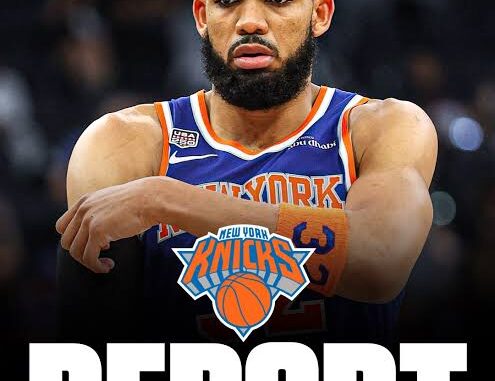
Karl-Anthony Towns’ first season with the New York Knicks proved he could be one of the franchise’s cornerstone players, but as the offseason continues, attention has shifted from his performances on the court to his contract situation. Reports suggest the All-Star center is disappointed that the Knicks have yet to offer him a contract extension, although there remains widespread belief around the league that both sides are expected to reach a resolution before the end of the summer.
While the delay has generated headlines, there is little indication that the relationship between Towns and the organization has deteriorated. Instead, league insiders believe the negotiations reflect the complicated financial decisions NBA teams must make in an era of increasingly restrictive salary cap rules and luxury tax penalties.
For Towns, the situation is understandable. Having established himself as one of the league’s premier big men over nearly a decade in the NBA, he naturally expects long-term security from a franchise that views him as a key part of its championship ambitions. At the same time, the Knicks’ front office appears determined to carefully evaluate every financial commitment before finalizing what could become one of the richest contracts in franchise history.
Towns arrived in New York amid enormous expectations following his blockbuster trade from the Minnesota Timberwolves. The move immediately transformed the Knicks into one of the Eastern Conference’s most talented teams, pairing him with an established core capable of competing against the league’s elite.
From the beginning, Towns embraced the challenge of playing in one of basketball’s biggest markets. Madison Square Garden has always demanded excellence from its stars, and the former No. 1 overall draft pick understood that every performance would be analyzed under an intense spotlight.
Despite the pressure, Towns quickly demonstrated why the Knicks were willing to make such a significant investment to acquire him. His offensive versatility provided New York with dimensions few teams possess at the center position. Equally comfortable scoring in the post, knocking down three-point shots, or creating opportunities for teammates, Towns became one of the focal points of the Knicks’ offense.
His ability to stretch opposing defenses opened driving lanes for teammates while forcing opposing centers to defend far away from the basket. That unique skill set has made Towns one of the NBA’s most difficult matchups throughout his career.
Defensively, Towns continued working to improve his consistency while adapting to the Knicks’ system. Although his offensive production has often drawn the most attention, his willingness to embrace coaching and improve his overall game earned praise from teammates and the coaching staff.
Given those contributions, it is not surprising that Towns reportedly hoped an extension would be completed relatively quickly after the season. Long-term contracts often provide both financial security for players and roster stability for organizations, eliminating distractions before training camp begins.
Instead, negotiations have moved more slowly than many expected.
According to multiple reports, New York’s front office is carefully weighing every option before committing to a maximum extension. The Knicks must balance rewarding one of their best players while maintaining enough financial flexibility to continue building a championship-caliber roster around him.
The NBA’s updated collective bargaining agreement has significantly changed how teams approach roster construction. New restrictions involving luxury tax thresholds and second-apron penalties have forced front offices across the league to become increasingly cautious when negotiating major contracts.
As a result, even organizations fully committed to retaining star players sometimes delay extension talks while evaluating their long-term salary structure.
League executives understand that every large contract affects future decisions regarding free agency, trades, and roster depth. For contenders like the Knicks, maintaining flexibility can be nearly as valuable as adding another star.
Reports have also suggested the Knicks may hope Towns agrees to a contract below the maximum value for which he is eligible. Team-friendly agreements have become increasingly important under the NBA’s current financial rules, allowing organizations to retain additional talent while remaining competitive.
Whether Towns would ultimately consider such an arrangement remains one of the biggest questions surrounding the negotiations.
From the player’s perspective, seeking maximum value is entirely reasonable. Towns has consistently performed at an All-Star level throughout his career, earning multiple individual honors while establishing himself among the league’s best frontcourt players. Athletes often have relatively short careers, making every contract negotiation critically important.
On the other hand, some veteran stars have accepted slightly smaller contracts in pursuit of championship opportunities, allowing their teams greater financial flexibility to strengthen the supporting cast.
Whatever direction the negotiations take, both parties appear motivated to reach an agreement rather than allowing uncertainty to continue into the regular season.
Within the Knicks organization, there remains considerable optimism about Towns’ future. Coaches value not only his production but also his professionalism and willingness to embrace New York’s demanding basketball culture.
Teammates have also spoken positively about his leadership. While Towns entered an already established locker room, he quickly became an important voice through both his experience and work ethic.
His chemistry with fellow starters improved steadily throughout the season as the team developed greater familiarity with one another’s playing styles. That growth only strengthened the belief that New York possesses the foundation necessary to compete for an NBA championship.
The front office understands that continuity often plays a major role in postseason success. Keeping the team’s core together would provide stability while allowing players to build upon the progress made during their first season together.
Fans, meanwhile, remain eager for clarity.
Whenever a star player enters extension discussions, speculation naturally increases regarding the future of both the individual and the franchise. Every delay tends to generate rumors, even when negotiations remain productive behind the scenes.
However, league observers continue emphasizing that delayed negotiations are not uncommon. Complex contracts frequently require weeks or even months of discussions before both sides finalize terms acceptable to everyone involved.
In Towns’ case, there appears to be little concern that negotiations have reached an impasse. Instead, most reports indicate the conversations are simply progressing at a deliberate pace as each side evaluates its priorities.
For New York, the decision extends beyond one player. Every financial commitment influences future roster-building strategies, potential free-agent pursuits, and the organization’s ability to retain other important contributors.
For Towns, securing a long-term extension would reinforce his place as one of the franchise’s foundational stars while providing the stability every elite player seeks.
Ultimately, both sides appear to share the same objective: building a championship contender capable of bringing another NBA title to Madison Square Garden.
As summer continues, attention will remain fixed on the negotiations, but there is growing confidence throughout the league that an agreement will eventually be reached. The Knicks recognize Towns’ value both on and off the court, while Towns has embraced the opportunity to compete in New York and help restore one of basketball’s most iconic franchises to championship contention.
Until an official announcement is made, speculation will continue surrounding the timing and structure of any extension. Yet despite reports that Towns is disappointed by the current delay, optimism remains high that both the player and the Knicks will find common ground before the offseason concludes.
If that happens, the conversation will quickly shift away from contract negotiations and back to basketball, where the Knicks hope Towns can play a leading role in helping the franchise pursue its first NBA championship in decades.
Leave a Reply