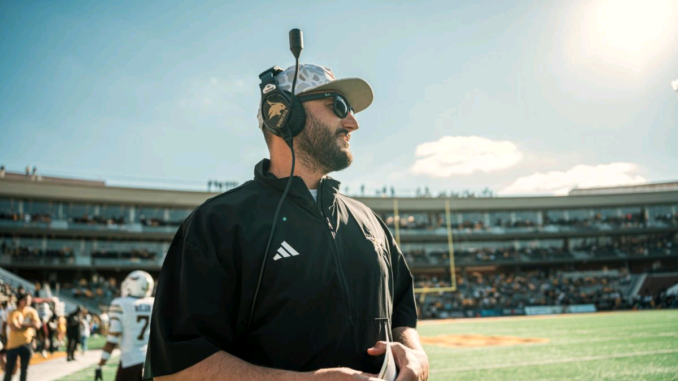
There are some football games that mean more than the final score.
For G.J. Kinne, his return to Darrell K Royal-Texas Memorial Stadium is one of those occasions.
Years ago, Kinne walked into the University of Texas as a highly regarded young quarterback hoping to establish himself in one of college football’s most demanding environments. Now, he is heading back to Austin in a completely different role.
He is no longer the quarterback trying to earn his place on the Texas roster.
He is the head coach of Texas State, standing on the opposite sideline and preparing his team to challenge the Longhorns.
That makes the 2026 season opener more than another game on the schedule. It is a full-circle moment for a coach whose football journey has taken him through college football, the NFL, different coaching stops and eventually to the top job at Texas State.
Kinne’s story began in Texas, where football was more than simply a sport. He grew up in a football family, with his father, Gary Joe Kinne, establishing himself as a respected high school coach and former Baylor player. G.J. followed naturally into the game, developing into one of the most productive high school quarterbacks in Texas history.
Before arriving at Texas, Kinne had already built a reputation as a player capable of putting up enormous numbers. He finished his high school career with 11,695 passing yards and 130 touchdown passes, numbers that helped make him a nationally regarded quarterback prospect.
Texas came calling.
For a young player from the Lone Star State, getting an opportunity to wear the Longhorn uniform was a dream. Kinne joined Texas in 2007, but his time in Austin did not unfold the way he had hoped.
He redshirted during his freshman season and found himself buried on a talented quarterback depth chart. Instead of allowing the setback to derail his career, Kinne made a difficult decision.
He transferred to Tulsa.
At the time, leaving Texas might have looked like a disappointing turn in his career. Looking back, it became one of the most important decisions he ever made.
At Tulsa, Kinne developed into an accomplished quarterback and eventually became one of the most productive players in the program’s history. Texas State’s official biography notes that he threw for 9,472 yards and 81 touchdowns during his three seasons as a starter. He was also named Conference USA Offensive Player of the Year in 2010.
The player who left Austin searching for an opportunity had found one in Tulsa.
But Kinne’s football story was only beginning.
After college, he pursued a professional career, including time with the New York Jets, Philadelphia Eagles and teams in the United Football League and Canadian Football League. His playing career did not turn into a long NFL run, but the experiences he gained along the way would eventually become valuable when he transitioned into coaching.
That transition proved to be the beginning of another chapter.
Kinne started his coaching career as a graduate assistant at SMU in 2017. He later worked at Arkansas and returned to Philadelphia as an offensive assistant. He also became an offensive coordinator and quarterbacks coach at Hawaii before moving to UCF.
Those experiences exposed Kinne to different offensive systems, different coaching philosophies and different levels of football.
Most importantly, they helped him discover what kind of coach he wanted to become.
Then came Incarnate Word.
Kinne took over as head coach at UIW in 2022 and immediately made an impact. His offense became one of the most productive units in college football, and the Cardinals won the Southland Conference championship while advancing deep into the FCS playoffs. Texas State ultimately hired him as its 21st head football coach after that breakthrough season.
The move to Texas State was another opportunity for Kinne to prove that his success was not a one-year story.
He did exactly that.
When Kinne arrived in San Marcos, he brought with him an ambitious vision. Texas State needed more than a coach who could call plays. The program needed an identity, a recruiting strategy and a belief that it could compete for attention in a crowded Texas football landscape.
Kinne’s answer was simple: attack the state.
His background gave him credibility. He understood Texas high school football because he had lived it. He had played under respected coaches and spent years moving through different levels of the game. He knew the importance of relationships, development and recruiting.
That Texas connection became an important part of his work at Texas State.
And the results followed.
Texas State reached a bowl game in Kinne’s first season, setting a new program standard with eight wins and finishing 8-5. The Bobcats then continued their postseason success, winning bowl games in each of Kinne’s first three seasons.
That kind of consistency changed the perception of the program.
Texas State was no longer simply another opponent on a college football schedule.
The Bobcats had become a team capable of making noise.
That is part of what makes the trip to Austin so fascinating.
Kinne is not returning to DKR as a coach looking for a moral victory. He has built a program that expects to compete.
Recent reports surrounding the 2026 opener have emphasized that Texas State views itself as more than a participant in the matchup. Kinne has spoken about the challenge of facing Texas while making it clear that his team is preparing to play with confidence.
That mindset matters.
Texas State will walk into a stadium expected to be packed with more than 100,000 fans. Across the field will be a Texas roster loaded with talent and expectations.
For most coaches, that alone would make the assignment intimidating.
For Kinne, there is another layer.
He knows what it means to be a Longhorn.
He knows what that stadium represents.
He knows the pressure surrounding Texas football.
And he knows what it feels like to wear the uniform.
That experience could be both an advantage and an emotional challenge.
Kinne has already shown that he understands how difficult it is to prepare for Texas. He has praised Steve Sarkisian as one of the best play-callers in college football and has spoken highly of the talent on the Longhorn roster.
But admiration does not mean hesitation.
Once the game begins, Kinne has a job to do.
He has to find a way to give Texas State a chance.
That will require discipline on both sides of the ball, especially against a Texas team expected to have significant advantages in talent and depth.
The Bobcats cannot afford to play a game built around surviving.
They need to play their game.
That means leaning on what Kinne has built since arriving in San Marcos.
Offensively, Texas State has developed into a dangerous team. Kinne’s background as a quarterback and offensive coach naturally shapes the identity of the program. He understands how to create opportunities for quarterbacks, how to use tempo and how to put pressure on defenses.
Veteran quarterback Brad Jackson gives the Bobcats an experienced option behind center, while Texas State also returns important pieces at wide receiver. Recent scouting reports have highlighted Jackson and the team’s returning receiving talent as reasons the Bobcats could be dangerous in 2026.
That could become critical against Texas.
The Longhorns will have more talent across the roster, but football games are not played on paper.
Texas State’s best chance is to make the game uncomfortable.
Avoid turnovers.
Create explosive plays.
Keep Texas from establishing an early rhythm.
And, most importantly, believe.
That last part may be the easiest for Kinne to provide.
He has already taken a program that needed direction and turned it into a legitimate postseason contender.
He has done it by embracing the very state where his own football journey began.
Now that journey is bringing him back to the place where his college career once started.
There is something poetic about that.
Kinne left Texas as a young quarterback searching for an opportunity. He went to Tulsa and built a career. He entered professional football. He moved into coaching. He learned from coaches at different levels. He became an offensive coordinator. He took over at Incarnate Word and immediately won.
Then Texas State came calling.
Now he is returning to Austin as the person responsible for leading an entire program.
The roles could hardly be more different.
Back then, Kinne’s future depended largely on what he could accomplish as a player.
Now, the futures of dozens of players depend on him.
That is the real transformation in his story.
He is no longer simply trying to prove that he belongs.
He is trying to build something that belongs.
Texas State’s rise has made Kinne one of the more intriguing young coaches in Texas football. His journey demonstrates why coaching careers rarely follow a straight line. A player can leave a major program and still find a path back to the biggest stages in the sport.
In Kinne’s case, leaving Texas did not end his connection to the Longhorns.
It simply changed it.
When he returns to DKR, there will undoubtedly be memories.
There will be familiar surroundings.
There may be former teammates, coaches, friends and supporters watching from the stands.
But once the opening whistle sounds, nostalgia will have to take a back seat.
Kinne is not coming home simply to remember his past.
He is coming back to compete.
That is what makes the matchup so compelling.
Texas will have its own goals and expectations. The Longhorns are expected to enter the season believing they can compete at the highest level of college football.
Texas State has a different challenge.
The Bobcats have an opportunity to show that their program has grown enough to stand on a stage like this without being overwhelmed by it.
For Kinne, that challenge is personal without necessarily being sentimental.
He understands Texas.
He understands the magnitude of DKR.
But he also understands his own team.
And that may be the most important thing of all.
The coach who once walked into Austin as a young quarterback is now returning with years of football experience behind him.
He has learned from failure.
He has learned from success.
He has learned from coaches at the high school, college and professional levels.
Most importantly, he has learned how to build.
That is what he is doing at Texas State.
And now the project he started in San Marcos gets one of its biggest tests.
The story almost writes itself.
A former Longhorn returns to DKR.
Only this time, he is not wearing burnt orange.
He is wearing Texas State colors.
He is not carrying a playbook as a young quarterback trying to find his way.
He is carrying the responsibility of an entire program.
And he is not walking into Austin hoping simply to keep the game respectable.
He wants his team to believe it can win.
That is the difference between Kinne then and Kinne now.
The young quarterback who once left Texas could not have known where the road would take him.
The coach returning to DKR knows exactly what he has built to this point.
He also knows the journey is far from finished.
Saturday’s matchup will be another chapter.
Whatever happens on the scoreboard, Kinne’s return to DKR represents something larger than one game.
It is a reminder that football careers can take unexpected turns.
Sometimes leaving home is part of finding yourself.
Sometimes a setback becomes the beginning of a better opportunity.
And sometimes, after years of moving forward, the road eventually brings you right back to where you started.
For G.J. Kinne, that road has led to DKR once again.
But this time, he comes back as the opponent.
Leave a Reply