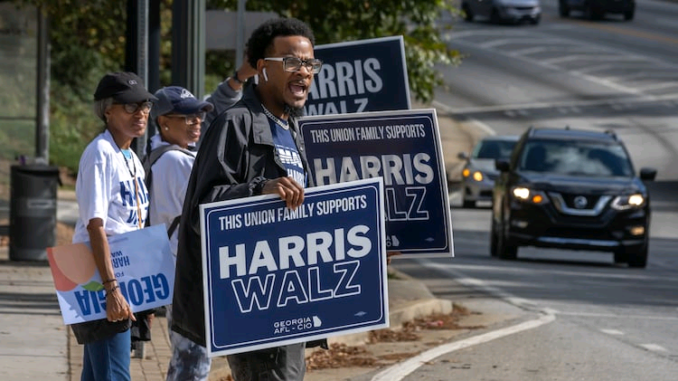
The Democratic National Committee’s decision to remove Atlanta from consideration as a host city for the 2028 Democratic National Convention has triggered a debate that goes far beyond hotel rooms, convention halls and logistics.
For many Democrats in Georgia and across the South, the decision raises a more fundamental question:
Atlanta had hoped to bring the Democratic Party’s biggest gathering back to a city that has long been central to the party’s Southern coalition. Instead, the DNC narrowed its list of potential host cities to Boston, Denver and Philadelphia, eliminating both Atlanta and Chicago from the competition. The convention is scheduled for August 7–10, 2028, with the final host city expected to be selected later this year.
The rejection has been particularly painful for Atlanta because of the city’s political and historical significance.
Atlanta is not simply another American city with a convention center and a large hotel industry. It is one of the most important centers of Black political life in the United States. It is the birthplace of Martin Luther King Jr., a major center of the civil rights movement and a city where Black political leadership has shaped local, state and national Democratic politics for generations.
That history made Atlanta’s bid about more than hosting a four-day political gathering.
It was also an opportunity for Democrats to demonstrate that the South remains part of the party’s political future.
Atlanta Mayor Andre Dickens has been particularly outspoken about the decision. He accused the national party of abandoning both the South and Black voters, arguing that Democrats should be investing in communities that have played a critical role in the party’s electoral coalition.
That criticism has resonated with some Black Democrats who believe the party sometimes takes their support for granted.
The city’s importance to Democrats is difficult to dispute.
Atlanta has developed into a powerful Democratic political hub in a state that was once considered reliably Republican at the presidential level. Georgia’s transformation became especially visible during the 2020 election cycle, when Democrats carried the state in a presidential contest for the first time since 1992.
The state’s two U.S. Senate runoff victories for Democrats in January 2021 further demonstrated the strength of the coalition built around Black voters, suburban voters and younger voters.
That political transformation helped Democrats regain control of the Senate.
It also changed the national perception of Georgia.
The state was no longer simply a conservative Southern state that Democrats visited during election season. It became a genuine battleground.
Atlanta sits at the heart of that transformation.
For Democrats, therefore, the city’s convention bid represented an opportunity to showcase a Southern metropolitan area where the party had achieved some of its most important recent victories.
That is why the DNC’s decision has generated frustration.
Critics argue that if Democrats want to expand their coalition in the South, they should not overlook the city that sits at the center of one of the region’s most important Democratic networks.
At the same time, it would be unfair to assume that the DNC rejected Atlanta specifically because of Black voters.
The convention selection process involves a complicated set of considerations.
Security is one major issue. Transportation, hotel capacity, convention facilities, fundraising opportunities, labor relationships, political geography and the ability to stage a massive national event all matter.
The three remaining cities — Boston, Denver and Philadelphia — also offer significant political and logistical advantages.
Philadelphia, in particular, gives Democrats an opportunity to hold the convention in Pennsylvania, a critical battleground state. Denver and Boston provide established convention infrastructure and strong Democratic political networks. All three finalists have also hosted previous Democratic conventions.
Philadelphia hosted the convention in 2016, Denver hosted it in 2008 and Boston hosted it in 2004.
Atlanta, meanwhile, has not hosted the Democratic National Convention since 1988.
That history cuts both ways.
Supporters of Atlanta’s bid could argue that nearly four decades is precisely why the city deserves another opportunity. The DNC, however, can point to the experience and infrastructure of cities that have hosted national conventions more recently.
The party has not publicly suggested that race or Black voters were a reason for eliminating Atlanta.
That distinction matters.
Still, political decisions can have consequences beyond the official explanation.
And that is where the anger among some Black Democrats comes into focus.
For years, Black voters have been among the Democratic Party’s most dependable constituencies.
That support has been especially important in presidential primaries and general elections.
But there has long been a debate inside the Democratic Party over whether Black voters receive enough political investment between elections.
Some activists argue that Democrats routinely appear in Black communities when they need votes, make promises during campaigns and then return their attention to other constituencies once elections are over.
The Atlanta decision has revived those concerns.
If the party wants Black voters to remain deeply invested in Democratic politics, critics say, it has to demonstrate that those voters are valued beyond Election Day.
A convention in Atlanta would not have solved every problem facing Black voters.
But it would have carried symbolic weight.
It would have brought thousands of Democratic delegates, politicians, journalists, donors, activists and political strategists into one of the country’s most influential Black-majority cities.
It would have placed Southern Democratic leaders and voters at the center of national political attention.
And it would have given the party an opportunity to communicate a message: The South matters. Black voters matter. Atlanta matters.
Instead, the party chose three cities outside the Deep South.
That does not automatically mean Democrats are abandoning Black voters.
But it does make it easier for critics to argue that the party is failing to recognize where some of its strongest political support comes from.
Dickens has made that argument forcefully.
Following Atlanta’s elimination, the mayor criticized DNC leadership and questioned whether national Democrats fully understand the strategic importance of Georgia and the broader South. Reports said Dickens described the decision as an abandonment of Black voters and accused party leaders of being unwilling to move beyond their traditional comfort zones.
His criticism puts pressure on the DNC to explain its decision more clearly.
The party could argue that Atlanta was simply outperformed by stronger bids.
But that explanation may not satisfy everyone.
Political conventions are not awarded solely on the basis of hotel rooms or transportation.
They are also political events.
The location tells a story about where a party believes its future lies.
When Republicans choose Houston for their 2028 convention, Democrats are naturally going to face questions about their own geographic strategy. Philadelphia, Denver and Boston each communicate something different about the Democratic coalition.
Atlanta would have communicated something unmistakable about the South.
Its rejection therefore becomes part of a larger conversation about Democratic strategy.
One of the biggest mistakes either political party can make is assuming that the South will remain politically static.
For decades, Republicans dominated presidential politics throughout much of the region.
But demographic and political changes have created new opportunities for Democrats.
Georgia has become the clearest example.
The state remains politically competitive, but its growing metropolitan areas have transformed its electoral landscape. Atlanta and its suburbs have become increasingly important to Democratic candidates.
That makes continued engagement with Georgia particularly important.
If Democrats are serious about competing in the South, they cannot rely exclusively on traditional strongholds.
They have to build relationships with voters in places such as Georgia, North Carolina, Texas and other increasingly competitive Southern states.
Atlanta would have been a natural stage for that strategy.
The convention could have been used to showcase Democratic candidates from across the region and highlight the party’s relationship with Black voters, suburban communities, young voters and growing immigrant populations.
Instead, the DNC now has to explain how it plans to maintain its Southern ambitions without giving Atlanta the national platform it sought.
It is also important not to portray Black Democrats as holding one universal opinion about the convention decision.
They do not.
Some may agree with the DNC’s choice and see the convention primarily as a strategic and logistical decision.
Others may believe Philadelphia is the better political choice because Pennsylvania is a battleground state.
Still others may prefer Denver or Boston.
And some Black Democrats may strongly support Dickens’s criticism and view Atlanta’s rejection as another example of the national party failing to invest in Black political communities.
The disagreement is legitimate.
Black voters are not simply a voting bloc that can be assumed to support one party without question.
Their political priorities include economic opportunity, public safety, healthcare, education, voting rights, housing and many other issues.
The Atlanta debate should therefore not be reduced to the idea that every Black Democrat is angry.
The more significant issue is whether national Democrats understand that political loyalty cannot be taken for granted.
Ultimately, the 2028 convention will last only a few days.
Atlanta will continue to be a major Democratic city regardless of where the convention takes place.
The larger issue is what the party does after the headlines disappear.
If Democrats want to demonstrate that Atlanta and Black voters remain central to their strategy, they will have opportunities.
They can invest in Georgia organizing.
They can support local Democratic candidates.
They can develop relationships with Black community leaders.
They can spend more time campaigning in Southern states.
And they can make sure that Black voters have meaningful influence over policy and party leadership.
Those actions would matter far more than the location of one convention.
But political symbolism still matters.
National conventions are designed to project a party’s identity and vision.
They are moments when political parties tell voters who they are, where they are going and which communities they want to represent.
Atlanta wanted to be part of that story.
The DNC decided otherwise.
The final verdict on the decision will depend on what happens next.
If Democrats continue investing heavily in Georgia and the broader South, the Atlanta rejection may eventually look like little more than a logistical decision.
If the party neglects the region, however, critics will have stronger grounds to argue that the convention decision reflected a broader strategic retreat.
For now, the anger surrounding Atlanta’s rejection should be viewed as a warning rather than simply a political tantrum.
Black voters have played an enormous role in building the modern Democratic coalition. Atlanta has played an enormous role in the political history of Black America and in the Democratic Party’s recent Southern resurgence.
The party cannot afford to treat either reality casually.
The DNC has narrowed its 2028 convention choices to Boston, Denver and Philadelphia, with the final selection still ahead.
That decision will determine where Democrats gather in 2028.
But it will not determine whether Black voters feel respected.
That will be decided by what Democrats do between now and Election Day — and by whether they recognize that support must be earned continuously, not simply requested when ballots are being cast.
Atlanta’s rejection may not, by itself, represent a rejection of Black voters.
But for Democrats already questioning whether their party values their communities beyond election season, the symbolism is difficult to ignore.
And that is why the DNC’s decision has become much bigger than a convention.
It has become a test of whether the Democratic Party understands where its coalition came from, where it is strongest today and where it needs to go next.
Leave a Reply