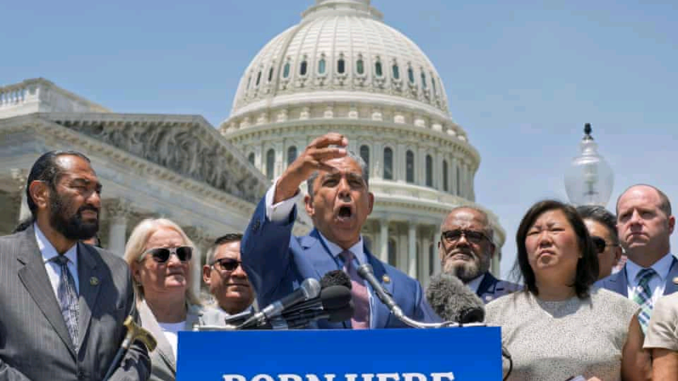
The United States Supreme Court has handed President Donald Trump a significant legal victory in one of the most closely watched immigration cases in recent years. While the ruling does not determine whether Trump’s effort to restrict birthright citizenship is constitutional, it changes how lower federal courts can respond to presidential policies by limiting the use of sweeping nationwide injunctions.
The decision has immediate consequences for Trump’s immigration agenda and could reshape how future presidents, regardless of political party, implement controversial executive actions. It also sets the stage for a prolonged legal battle over one of the most debated provisions of the U.S. Constitution.
For the Trump administration, the ruling represents an important procedural win. For opponents, however, it signals a more challenging legal landscape as they continue fighting policies they believe violate constitutional protections.
A Case About More Than Birthright Citizenship
Although public attention has largely focused on birthright citizenship, the Supreme Court’s ruling centered on a different legal question.
The Court examined whether individual federal judges should have the authority to block a presidential policy across the entire country before the case has completed the normal appeals process.
In recent years, nationwide injunctions have become increasingly common. Judges have used them to halt policies introduced by both Republican and Democratic administrations, preventing enforcement across all states rather than limiting relief to the specific parties involved in a lawsuit.
The Supreme Court concluded that such broad injunctions should generally be used far more sparingly. Instead, courts should tailor relief to the plaintiffs who bring the legal challenge unless broader action is clearly justified under existing law.
That procedural ruling allows portions of Trump’s executive order to move forward in jurisdictions where it has not been specifically blocked, even as lawsuits challenging its constitutionality continue.
The Debate Over Birthright Citizenship
Birthright citizenship has long been recognized under the Fourteenth Amendment to the U.S. Constitution, which states that all persons born or naturalized in the United States and subject to its jurisdiction are citizens.
For more than a century, this provision has generally been interpreted to grant automatic citizenship to nearly everyone born on American soil, regardless of the immigration status of their parents.
Trump has argued that the constitutional language has been interpreted too broadly. His administration contends that children born to parents who are in the United States illegally or only temporarily should not automatically receive citizenship.
Supporters believe this interpretation would discourage illegal immigration and close what they describe as incentives encouraging unauthorized border crossings.
Critics strongly disagree, arguing that decades of legal precedent support the current understanding of birthright citizenship and that any attempt to alter it through executive action violates the Constitution.
The Supreme Court did not resolve that constitutional dispute in this decision, leaving one of the nation’s most significant immigration questions unanswered.
A Major Victory for the Administration
Although the constitutional battle remains unsettled, Trump’s legal team welcomed the ruling as an important success.
Administration officials argued that nationwide injunctions have increasingly allowed individual district judges to effectively determine national policy before appellate courts or the Supreme Court have fully considered the legal issues.
From their perspective, the ruling restores balance between the executive and judicial branches by ensuring that legal challenges proceed through the normal court process.
The administration also believes the decision reduces the ability of opponents to immediately halt executive actions through lawsuits filed in jurisdictions considered more favorable to their legal arguments.
For Trump, whose presidency has faced numerous nationwide injunctions on immigration, border security, and regulatory policies, the ruling represents a meaningful shift in judicial practice.
Critics Raise Concerns
Opponents of the decision argue that limiting nationwide injunctions could create confusion across the country.
Without broad injunctions, different states may temporarily operate under different legal standards while litigation continues. Families, businesses, and government agencies could face uncertainty depending on where they live.
Civil rights organizations also worry that individuals who are not parties to lawsuits may lack immediate protection from policies later found to be unconstitutional.
Legal scholars have noted that nationwide injunctions have historically served as an important tool for preventing potentially unlawful government actions from taking effect while courts evaluate their legality.
They argue that restricting those injunctions may force more individuals and organizations to file separate lawsuits, increasing costs and placing additional burdens on the judicial system.
Broader Implications for Presidential Power
The significance of the Supreme Court’s ruling extends beyond immigration.
Future presidents from both parties could benefit from the new limitations on nationwide injunctions when implementing executive orders involving healthcare, environmental regulations, education, labor policy, and national security.
Legal experts suggest the decision could strengthen executive authority by making it more difficult for a single district judge to immediately suspend federal policies nationwide.
At the same time, states challenging federal actions may increasingly seek alternative legal strategies, including class-action lawsuits or coordinated litigation involving multiple plaintiffs.
As a result, legal battles over presidential authority may become more complex rather than less frequent.
The Political Dimension
Immigration remains one of the defining issues of Trump’s political platform.
Throughout his campaigns and presidency, Trump has emphasized stronger border security, stricter immigration enforcement, and reforms to citizenship rules.
Supporters view these policies as necessary to protect national sovereignty and strengthen immigration enforcement.
Opponents argue that many of the proposals undermine constitutional protections and could have lasting humanitarian consequences.
The Supreme Court’s procedural ruling is therefore likely to become another focal point in the broader political debate surrounding immigration policy heading into future elections.
Both parties are expected to use the decision to reinforce their competing visions for the country’s immigration system.
What Happens Next?
The legal fight is far from over.
Lower federal courts will continue evaluating whether Trump’s executive order restricting birthright citizenship complies with the Constitution and longstanding Supreme Court precedent.
Those cases will likely produce additional appeals before eventually returning to the Supreme Court for a direct ruling on the constitutional question itself.
When that happens, the justices may finally determine whether the Fourteenth Amendment permits the restrictions proposed by the administration or whether automatic birthright citizenship remains fully protected.
Until then, the legal landscape will continue evolving as different courts issue rulings affecting various jurisdictions.
Why the Decision Matters
The Supreme Court’s ruling represents one of the most consequential procedural decisions involving presidential power in recent years.
Rather than deciding who is ultimately right about birthright citizenship, the Court addressed how challenges to executive actions should move through the judicial system.
That distinction is crucial.
The decision does not establish that Trump’s birthright citizenship policy is constitutional. Nor does it eliminate future legal challenges.
Instead, it changes the rules governing when and how federal judges may temporarily block government policies before final constitutional questions have been resolved.
Because executive orders often become the subject of immediate litigation, the ruling is expected to influence presidential administrations for years to come.
Whether future presidents pursue immigration reform, environmental regulations, healthcare initiatives, or other major policy changes, the Supreme Court has made clear that nationwide injunctions should be the exception rather than the rule.
For Donald Trump, the decision provides a meaningful legal victory and allows his administration to continue advancing one of its signature immigration initiatives while the constitutional debate continues. For opponents, it underscores the importance of preparing for a longer legal battle that will ultimately determine the future of birthright citizenship in the United States.
As the underlying constitutional questions move through the courts, the Supreme Court’s latest ruling ensures that the debate over executive authority, judicial oversight, and the meaning of the Fourteenth Amendment will remain at the center of American law and politics for the foreseeable future.If you’d like, I can also adapt this into a more newswire-style article or an SEO-optimized version suitable for publication.
Leave a Reply