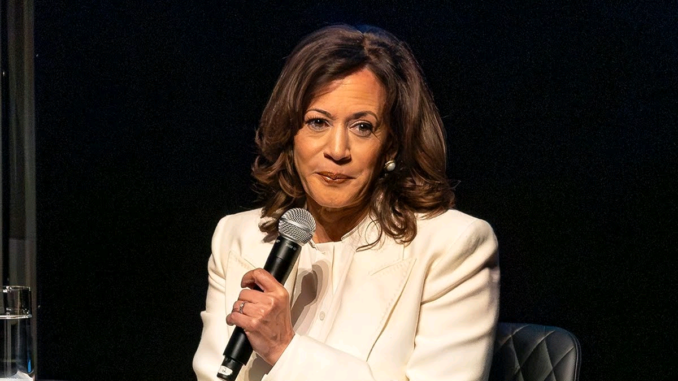
Former Vice President Kamala Harris has once again stepped into the national political spotlight, this time criticizing President Donald Trump’s approach to negotiations with Iran. Harris, who lost the 2024 presidential election to Trump, argued that the administration’s ongoing diplomatic efforts with Tehran could ultimately lead to an outcome remarkably similar to the very agreement Trump spent years attacking during his first term in office.
Her comments have reignited debate over U.S. foreign policy in the Middle East, the legacy of the Obama administration’s Iran nuclear deal, and the political consequences of Trump’s attempts to reshape America’s relationship with one of its most persistent adversaries.
At the center of the controversy is a newly proposed agreement between the United States and Iran designed to halt months of conflict, restore stability to the region, and create a framework for future negotiations. While the Trump administration has promoted the deal as a major diplomatic breakthrough, critics from both parties have questioned whether the agreement truly differs from the Obama-era policies that Trump once denounced.
For Harris, the answer appears clear.
Speaking during a public appearance, she argued that Trump may eventually declare victory regardless of the final outcome, even if the agreement resembles the Joint Comprehensive Plan of Action (JCPOA), the 2015 nuclear accord negotiated by President Barack Obama and several world powers. Harris suggested that after years of criticism directed at the Obama administration, Trump could find himself embracing many of the same principles he once condemned.
The irony of such a scenario has not been lost on political observers.
For nearly a decade, Trump has portrayed the Obama-era nuclear deal as one of the worst foreign policy agreements in American history. During his first presidency, he withdrew the United States from the agreement, arguing that it provided Iran with sanctions relief without permanently ending its nuclear ambitions. Trump repeatedly promised that he could negotiate a stronger and more comprehensive deal.
Now, as his administration seeks a diplomatic solution to a prolonged conflict with Iran, comparisons to the Obama agreement have become unavoidable.
Former President Barack Obama himself recently weighed in on the debate, expressing skepticism that any future agreement could be dramatically different from the framework his administration negotiated years ago. Obama argued that diplomacy often requires compromise and suggested that the fundamentals of any successful agreement with Iran would likely resemble the principles established under the JCPOA.
Those comments added fuel to an already heated political discussion.
Harris has seized upon those similarities to challenge Trump’s claims of achieving a fundamentally different outcome. According to her argument, the administration risks spending enormous political capital only to arrive at a destination that closely mirrors the policy it spent years criticizing.
The dispute comes at a critical moment.
The United States and Iran recently moved toward a memorandum of understanding designed to reduce tensions and establish a pathway toward a broader settlement. The agreement reportedly includes provisions aimed at limiting Iran’s nuclear activities, restoring maritime access through the Strait of Hormuz, and creating conditions for additional negotiations in the months ahead.
Supporters of the agreement argue that it represents a pragmatic effort to avoid a wider regional conflict.
Vice President JD Vance has emerged as one of the administration’s most visible defenders of the negotiations. Long known for his skepticism of foreign military interventions, Vance has argued that diplomacy offers the best chance to achieve American objectives while avoiding a costly and potentially destabilizing war. He has repeatedly emphasized that Iran must fulfill its obligations before receiving long-term benefits under the agreement.
The administration insists that the current framework differs substantially from the Obama-era deal.
Officials point to stricter oversight mechanisms, additional diplomatic leverage, and the broader geopolitical context surrounding the negotiations. They argue that Trump’s willingness to use military and economic pressure has created circumstances that did not exist during Obama’s presidency.
Yet critics remain unconvinced.
Many Democrats believe the administration is effectively returning to a version of the same policy after years of confrontation. Some Republicans, meanwhile, worry that the negotiations may grant Iran significant concessions without securing enough guarantees in return.
That unusual convergence of criticism has created a challenging political environment for the White House.
For Harris, the issue also presents an opportunity to reestablish herself as a leading Democratic voice following her defeat in the 2024 election.
Although she has maintained a relatively lower profile since leaving office, Harris has increasingly spoken out on major national issues. Her criticism of Trump’s Iran strategy reflects a broader effort to position herself as a defender of traditional Democratic foreign policy approaches while highlighting what she sees as contradictions within the administration’s agenda.
Political analysts note that Harris’s comments are likely aimed at both Democratic voters and independent Americans who may be skeptical of prolonged military involvement overseas.
Throughout the recent conflict, Harris has argued that the United States should prioritize diplomacy over military escalation. She has described the confrontation with Iran as a conflict that many Americans never wanted and questioned whether the administration’s approach has produced results commensurate with its costs.
The broader debate reflects a recurring challenge in American foreign policy.
Successive administrations often criticize the strategies of their predecessors only to discover that international realities limit the range of available options. Presidents from both parties have entered office promising dramatic changes in policy, only to find themselves navigating many of the same constraints faced by earlier leaders.
Iran represents one of the clearest examples of that phenomenon.
For decades, American policymakers have struggled to balance competing goals: preventing Iran from developing nuclear weapons, limiting its regional influence, protecting allies, and avoiding another large-scale military conflict in the Middle East.
Achieving all those objectives simultaneously has proven extraordinarily difficult.
As a result, administrations have frequently shifted between diplomacy, sanctions, military pressure, and combinations of all three. The debate over the current negotiations reflects that ongoing tension.
Supporters of Trump argue that his administration has approached Iran from a position of strength. They point to military actions, economic pressure, and diplomatic leverage as evidence that the current negotiations differ fundamentally from those conducted under Obama.
Critics respond that regardless of how negotiations begin, successful diplomacy ultimately requires compromise. If the final agreement includes sanctions relief, nuclear restrictions, international inspections, and phased implementation, they argue, it may not look dramatically different from earlier arrangements.
That possibility lies at the heart of Harris’s criticism.
Her argument is not simply that Trump may sign a deal resembling the JCPOA. Rather, she contends that years of political attacks on the Obama agreement could culminate in an outcome that validates many of the principles behind that earlier accord.
Whether voters accept that argument remains uncertain.
Public opinion on foreign policy often shifts rapidly depending on events on the ground. If the negotiations produce lasting stability, reduce tensions, and prevent further conflict, many Americans may view the agreement as a success regardless of its similarities to previous deals.
Conversely, if the arrangement collapses or fails to achieve its stated goals, critics will likely point to those similarities as evidence that the administration repeated past mistakes.
For now, negotiations continue, and many details remain unresolved.
The coming weeks will determine whether the memorandum evolves into a lasting agreement or becomes another chapter in the long and complicated history of U.S.-Iran relations.
What is already clear, however, is that the political battle surrounding the negotiations has begun in earnest.
Kamala Harris has drawn a sharp contrast between the administration’s rhetoric and its diplomatic strategy, arguing that Trump may ultimately find himself embracing a solution that looks strikingly familiar. The White House rejects that characterization and insists it is pursuing a stronger, more effective framework.
As both sides make their case, the outcome of the negotiations will shape not only America’s relationship with Iran but also the political narratives heading into the next phase of the nation’s electoral cycle.
For Harris, the message is straightforward: after years of condemning the Obama-era approach, Trump could end up declaring victory over a deal that bears many of the same hallmarks. Whether that prediction proves accurate will depend on what emerges from the negotiating table and how history ultimately judges the agreement.Recent reports indicate that Harris has argued the negotiations could lead to an outcome resembling the Obama-era nuclear deal, while the Trump administration and Vice President JD Vance maintain that the current framework is significantly different and stronger.
Leave a Reply