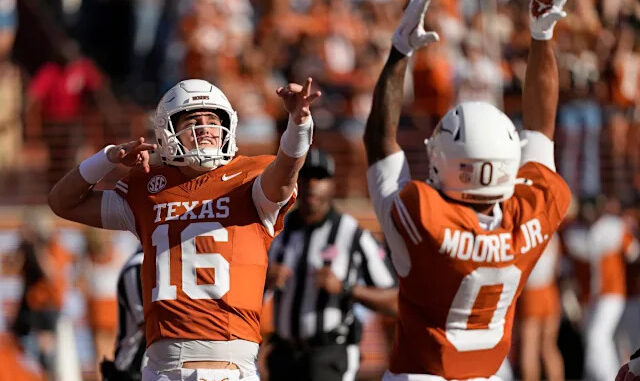
The growing national conversation surrounding sports gambling has reached one of college football’s most prominent programs after reports emerged that two Texas Longhorns football players were investigated for sports wagering violations involving nearly $15,000 in impermissible bets placed through daily fantasy sports platforms.
According to the details that became public, the violations were self-reported to the NCAA by the University of Texas, highlighting the institution’s commitment to compliance and transparency. While the case involved only two players, the developments have once again placed a spotlight on the increasingly complex relationship between college athletics and the rapidly expanding sports gaming industry.
The investigation ultimately produced different outcomes for the two players involved. One player chose to leave the program, while the other was initially ruled ineligible before later being reinstated after meeting NCAA requirements, including donating winnings from the wagers to charity.
The incident serves as another reminder that despite the growing acceptance of sports betting across the United States, strict rules still govern the participation of college athletes in any form of sports wagering.
A Growing Challenge for College Athletics
Over the last several years, legalized sports betting has expanded dramatically throughout the country.
Advertisements for betting platforms have become common during sporting events, while fantasy sports contests and mobile wagering applications have become increasingly accessible to the general public.
For college athletes, however, the rules remain significantly different.
The NCAA prohibits student-athletes from participating in sports wagering activities involving sports sponsored by the organization. These restrictions are designed to protect the integrity of competition and maintain public confidence in collegiate athletics.
As a result, even activities that some individuals might view as harmless entertainment can potentially create eligibility issues for student-athletes.
The Texas case demonstrates how easily athletes can find themselves facing consequences when those rules are violated.
The Investigation
According to reports, the wagers in question totaled nearly $15,000 and were placed through daily fantasy sports platforms.
While fantasy sports contests are legal in many jurisdictions and widely popular among sports fans, NCAA regulations treat certain forms of participation as sports wagering when student-athletes are involved.
University officials reportedly identified the violations and took steps to report the matter to the NCAA.
The self-reporting process is often viewed as an important component of compliance programs across college athletics. Institutions are expected to identify potential violations, investigate them internally, and cooperate fully with governing bodies when concerns arise.
By self-reporting the issue, Texas demonstrated its willingness to address the matter proactively rather than allowing questions to linger.
Different Outcomes for the Players
One of the most notable aspects of the case is the different paths taken by the two players involved.
One player ultimately departed from the Texas football program following the investigation.
While the exact reasons behind the decision have not been fully detailed publicly, departures in situations involving NCAA compliance matters are not uncommon. Athletes sometimes choose to seek new opportunities elsewhere or move on from a program when facing uncertainty surrounding eligibility or future participation.
The second player remained with the team but initially faced significant consequences.
The NCAA ruled the athlete ineligible after determining that wagering violations had occurred. However, the reinstatement process eventually allowed the player to return after fulfilling specific conditions established by the governing body.
Among those requirements was the donation of gambling winnings to charity, a step that helped satisfy NCAA expectations regarding corrective action.
The outcome illustrates that NCAA enforcement often considers both the nature of the violation and the athlete’s willingness to comply with corrective measures.
Texas Responds
The University of Texas has invested heavily in compliance education in recent years, particularly as the landscape of college athletics continues to evolve.
Programs across the country regularly educate athletes about gambling regulations, social media conduct, NIL opportunities, recruiting rules, and other compliance-related issues.
Despite those efforts, incidents still occur.
The increasing popularity of sports betting has created new challenges for universities attempting to ensure that athletes fully understand NCAA policies.
Many compliance departments have expanded educational programs specifically focused on gambling awareness, emphasizing that athletes face restrictions that do not necessarily apply to ordinary fans.
The Texas situation is likely to reinforce those educational efforts moving forward.
The NCAA’s Ongoing Focus on Gambling
The NCAA has treated gambling-related violations seriously for decades.
Protecting the integrity of competition remains one of the organization’s highest priorities, and sports wagering continues to represent a significant area of concern.
Even the perception that athletes might have financial interests tied to sporting outcomes can create questions about fairness and competitive integrity.
As sports betting becomes more accessible, governing bodies have increased monitoring efforts and educational initiatives aimed at preventing violations before they occur.
The Texas case is far from the first gambling-related investigation involving college athletes, and it is unlikely to be the last.
Across the country, athletic departments continue searching for effective ways to educate students about regulations while helping them navigate an increasingly complex environment.
Lessons for Student-Athletes
Perhaps the biggest takeaway from this incident is the importance of understanding NCAA rules.
Many athletes enter college during an era when sports betting advertisements are visible almost everywhere. The normalization of betting culture can sometimes create confusion regarding what is and is not permitted.
However, NCAA regulations remain clear.
Student-athletes carry responsibilities that differ from those of ordinary sports fans. Participation in activities involving sports wagering can lead to serious consequences, including suspension, ineligibility, or the loss of playing opportunities.
The Texas case highlights how quickly those consequences can become reality.
For coaches and administrators, the incident serves as another reminder of the importance of education and communication.
Looking Ahead
Despite the controversy, the Longhorns remain focused on preparing for future competition and maintaining the standards expected of one of college football’s premier programs.
The program’s decision to self-report the violations and cooperate with NCAA officials reflects an effort to handle the matter responsibly while protecting the integrity of the team.
While one player’s departure marks an unfortunate outcome, the reinstatement of the second athlete demonstrates that pathways for accountability and correction still exist within the NCAA framework.
As college athletics continues adapting to an era defined by NIL opportunities, transfer portal movement, and expanding sports betting markets, situations like this will likely remain important learning experiences for athletes and institutions alike.
For Texas, the incident represents a reminder that success on the field must always be matched by responsibility off it. The Longhorns have built their reputation on excellence, and maintaining that reputation requires vigilance in every aspect of the program.
Although the investigation has now reached its conclusion, the lessons it provides will likely resonate far beyond Austin, serving as a cautionary example for college athletes across the country who must navigate the evolving landscape of modern sports.
Leave a Reply